You are using the member interface.
Log out of the member interface →

“There are things that disappeared even before our generation grew up.”
During an activity for Localization Week, a 20-year-old friend shared this with Vcil Community. They said they didn't know the taste of rice from the old days—something the elders in their family described as delicious. They don't know much about the plants, seeds, or dishes that nourished their grandparents, and they haven't even had many opportunities to encounter them. Growing up in such a fast-paced life, their experience is vastly different from that of their parents and grandparents, leading them to wonder: if the memories of those things are gone, where do my roots lie?
This was not just a casual remark from a young person; we believe it represents an entire generation facing the shifts of the era, stepping into a world no one has ever known or experienced, all while struggling to find firm roots to lean on.
Many of us can name the place where we grew up, but we no longer know which foods are best in which season; we don't know who grows what we eat every day; we don't know why a river, a market, a rice variety, or a dish is important to the life of an entire region. There is knowledge that was once passed down naturally within families and neighborhoods—through meals, markets, harvests, work, and the stories of our grandparents or parents—and it is gradually fading into the past.
What is lost is not just a dish, a craft, or a custom. Sometimes, it is the sense of belonging: the feeling of knowing where we live, knowing who and what nourishes us, and knowing how our small choices affect the land, water, livelihoods of others, and the future of our community. It can be the disappearance of a way of life, or the identity of a community.
We are living in a time where many crises occur simultaneously and are intertwined: climate change, biodiversity loss, pollution, supply chain disruptions, livelihood crises, inequality, loneliness, mental pressure, and the decline of community relationships. These are not isolated issues. In particular, we have a food system that relies on long-distance transport, is industrialized, and uses many chemicals; the concentration of power can simultaneously affect the soil, water, farmers' health, consumer safety, and the autonomy of a locality. Consequently, local knowledge and culture can also be lost along with them due to a lack of appropriate practices and contexts to continue and preserve them.
In that context, "localization" is often mentioned as a viable approach to simultaneously address the aforementioned polycrisis, which many studies and scholars attribute largely to a globalized economic system characterized by extraction, exploitation, and profit-driven industrial scale.
Accordingly, localization does not mean closing ourselves off from the world, doing everything ourselves in a single village, or romanticizing rural life. It is also not a call to turn our backs on trade, technology, or international cooperation. Localization is the process of bringing the economy and life back to a human scale: prioritizing the fulfillment of essential needs with closer resources whenever possible; shortening the distance between producers and consumers; increasing the autonomy of the local economy; and giving the community more of a voice in decisions that directly impact their lives.
To put it more simply: instead of just knowing what the products we eat every day are, we actively learn more about the people who grow them, where they are made, and the conditions of the land and labor behind them. Instead of just being consumers, we can become friends and companions to producers—to farmers, artisans, sellers, and neighbors; understanding and connecting with the river and the land that nourishes us. Instead of waiting for a solution from a distant country or a regulatory agency, communities can test actions and initiatives that fit the resources, needs, and culture of the place where they live.
According to Local Futures, a pioneering organization promoting the localization movement and questioning the globalized economic system, localization is the process of building and shifting toward economic structures that are human-scaled and reduce supply chain distances, so that a community's essential goods and services are produced locally or in the surrounding region whenever possible. This does not mean ending international exchange; on the contrary, it allows people to cooperate across borders on knowledge, fair and ethical trade, while reducing dependence on corporations and distant, opaque, and unsustainable supply chains that are not operated fairly.
For Vietnam, this conversation is becoming increasingly urgent. Vietnam is deeply integrating into the world economy, with a network of 17 free trade agreements. At the same time, the country has set a target for GDP growth of 10% or more by 2026.
International integration, innovation, and economic growth are necessary. They can open up many opportunities for knowledge, employment, and improved living standards. But when growth rate becomes the almost sole measure of development, we need to ask further: who benefits, who bears the risks, what is considered expendable, and how can we minimize the negative impacts during that "development" process?
Are ecology, land, water, culture, mental health, small-scale producers, traditional crafts, and community autonomy being given their proper place in development decisions? Can we develop without sacrificing the things that make each region rich or the memories of an entire community?
Vietnam is still at a very precious moment. Much indigenous knowledge, a culture of giving, biodiversity, food, and ways of life that rely on nature are still alive in families, villages, and communities; especially living with the older generations—people who will not be with us in the near future. Furthermore, efforts to preserve heritage and develop local products, culture, and cultural industries are receiving increasing attention.
But those values cannot just be kept as a beautiful story of the past, a souvenir, or a product labeled "local specialty." They need to be practiced in daily life: in how we eat, how we learn, how we organize our work, how we consume, how we care for one another, and how we decide our future together.
Because once those connections are completely lost, recovery will be much more difficult. We are at a golden moment to move together toward a more inclusive and regenerative future.
Driven by that desire, Vcil Community, in collaboration with Local Futures, Learning Cities, and local communities in Da Nang, Ho Chi Minh City, and Vung Tau, organized the Localization Week: Our Local Treasures.
The week is an invitation to reflect on the treasures around us—people, land, food, memories, culture, livelihoods, sustainable/regenerative initiatives, and community relationships. It is a space and an opportunity for everyone to learn how to nurture a future that is more balanced, closer to nature, and fairer to people, starting with simple actions that anyone can take, together!
If localization is an approach to rebuilding relationships between people and with place, we believe the way we organize an activity should reflect that.
Concepts like economic systems, supply chains, or power can feel very distant when discussed only in reports, professional seminars, or small-group debates. But when they enter a market, a journey along a river, a family meal, a film screening, a music session, or a conversation between the young and the old, they become much more tangible. People don't just "hear about" localization; they can touch, taste, observe, question, and try practicing it in their daily lives.
That is why Vcil Community, together with Local Futures, the Learning City initiative, and local communities, chose to organize "Localization Week: Our Local Treasures" as a festival for learning and collective action.
Through this festival, we want to create an open, joyful, and vibrant space that anyone can join. People can enter the week through different doors. Some come out of curiosity about a film. Others come to shop, cook, listen to music, join a circle, or simply meet new friends. Some come because they want to delve deeper into food systems, seeds, livelihoods, culture, or alternative economic models.
From these specific experiences, we hope people can see the bigger questions: Where does our food come from? Who is producing it? What is happening to the farmers, the land, and the water sources? Why do a market, a river, a plant variety, or a dish matter to the health of the entire community? And as citizens, consumers, professionals, or community members, what can we do?
The week is therefore not just a place to remember local beauty, and we do not want to turn local culture into something merely to be viewed, consumed, or nostalgically recalled. Vcil Community wants to work with the community to explore the conditions and actions that help local culture, knowledge, and livelihoods continue to live, be practiced, and nourish life today.
During a market visit, for example, participants don't just buy a local product. They can meet the person who made or provided it, hear the story behind the product—about the land, the season, the ingredients, the work, or the journey of creation and the challenges involved. From there, "local consumption" is no longer just about choosing a product nearby; it becomes an act of caring for the people and the ecosystem in relation to ourselves.
In a conversation about food, we don't just talk about local specialties; we expand to tell stories of climate, geography, history, migration, cultural intersection, and how a community relies on nature. During a trip along a river, we don't just admire the scenery; we can learn about how the river has shaped livelihoods, culture, agriculture, tourism, how the landscape has changed, and the efforts of the people to protect the place they call home.
We also hope the week is not created in a top-down manner, because localization itself is not a formula that can be copied intact from one place to another; and because each locality is an embodiment of its own history, people, ecosystem, resources, concerns, and unique way of life.
Therefore, Vcil Community has partnered with representatives from our Member network—a Social Innovation community we initiated—along with the Learning City initiative, so that local communities can design activities based on what they care about and the resources they have. Vcil Community acts as a connector, helping to build the thematic framework, share resources, and create conditions for communities to learn from one another; meanwhile, each locality is the storyteller of its own narrative.
This is also the spirit of the Learning City—an initiative and social movement launched by Vcil Community to reimagine learning, build community, and restore a culture of gifting. Learning does not only happen in schools, and it does not only come from those labeled as "experts." We can learn from farmers, craftspeople, vendors, the elderly in our families, neighbors, or someone caring for a garden or a river. Everyone can be a learner, a sharer, and a creator of a learning space for others.
The Learning City is organized monthly in Da Nang, Ho Chi Minh City, Vung Tau, and Hanoi with the desire to nurture local learning communities: places where people can play, learn, meet, and do things together. An important part of this initiative is the culture of gifting. It is when each person is willing to open up a part of their capacity, time, skills, resources, or space to welcome others to learn, share, and connect.
A house, a cafe, a garden, an art studio, a kitchen, a park, a riverbank, or a courtyard can become a community learning space. When these spaces are opened, learning is no longer a service or an activity separated from life. It becomes something gifted, co-created, and nurtured through meaningful relationships for the common good.
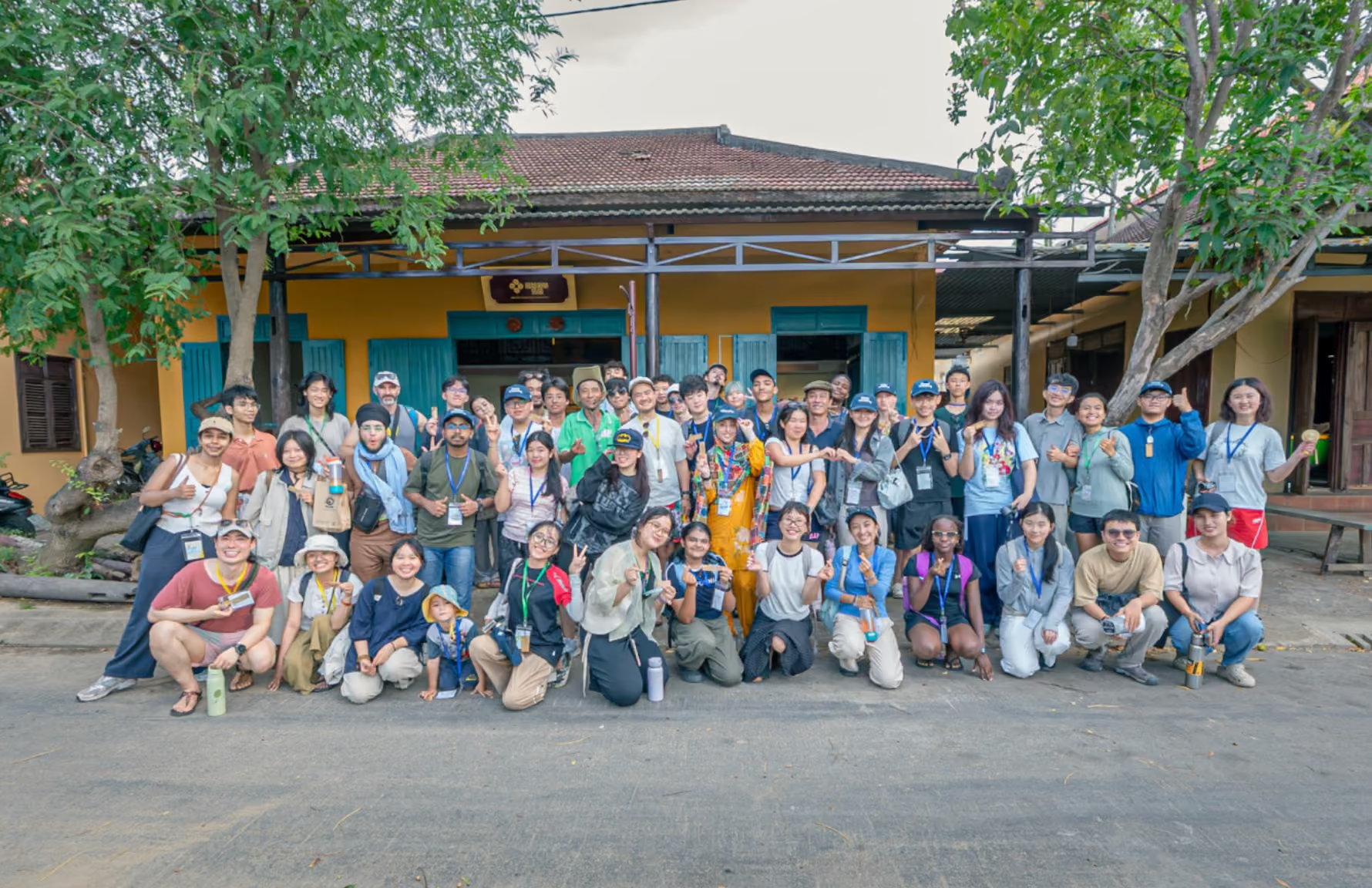
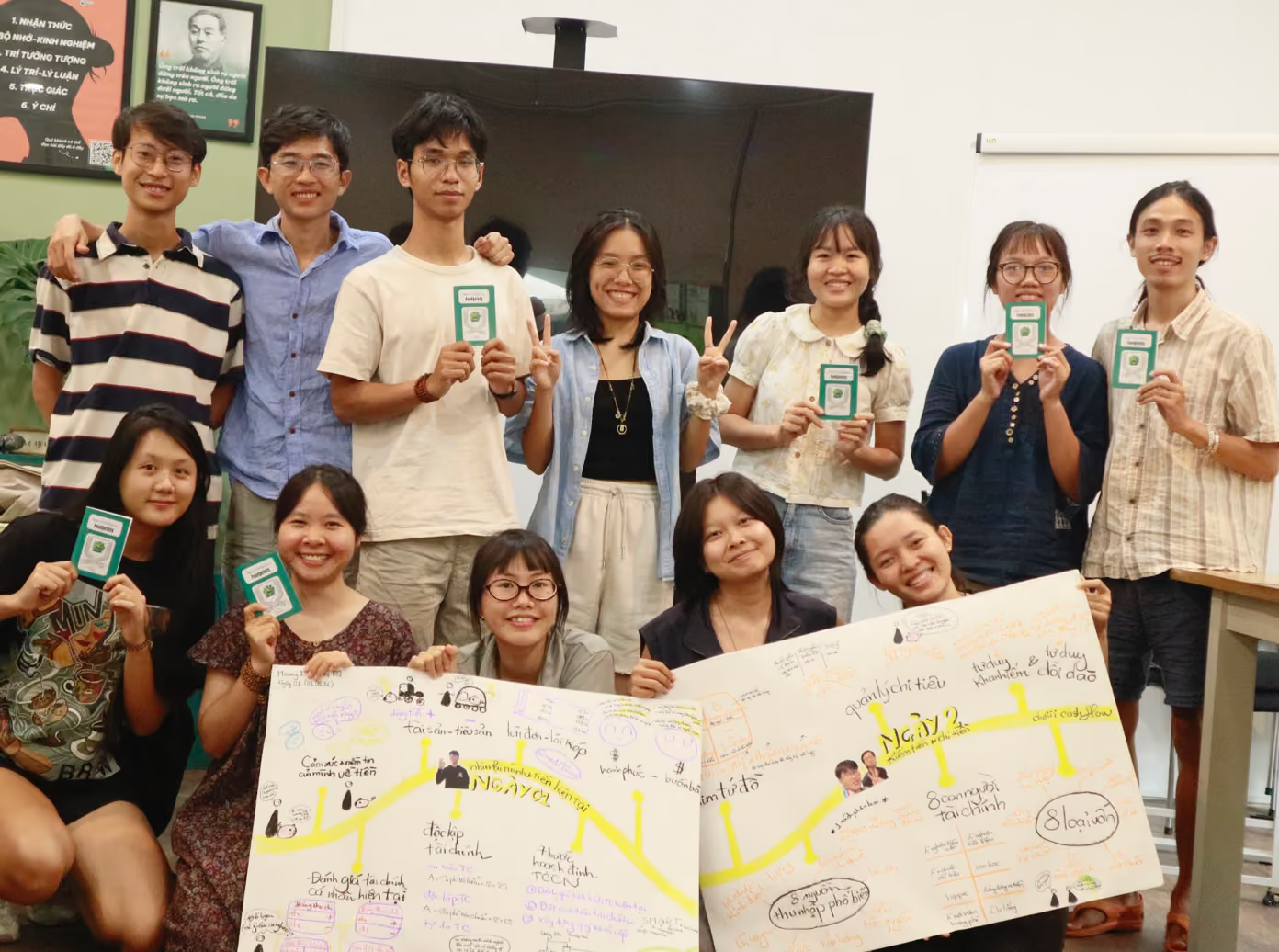
In this Localization Week, communities in Vung Tau and Ho Chi Minh City have joined Vcil Community in Da Nang to co-organize activities.
It is in these encounters that localization ceases to be just a concept. It begins to become a shared experience, and from there, a practice that can continue in daily life.
The week kicks off with an online opening event: "Why do we need localization in a globalized society?", featuring Helena Norberg-Hodge—founder of Local Futures and one of the pioneers of the global localization movement.
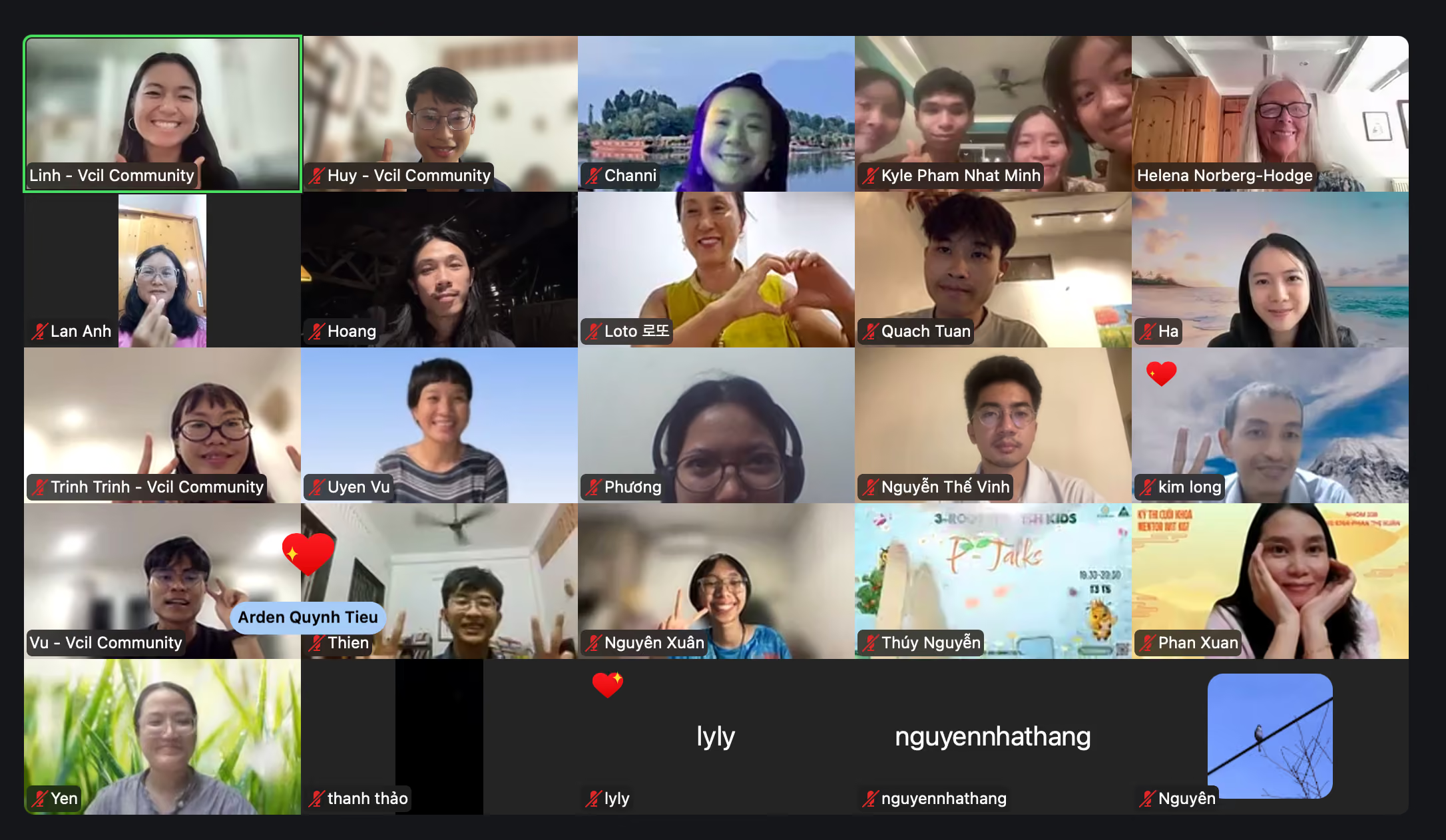
This conversation is an opportunity for everyone to reflect on a fundamental question: why, in a world that is increasingly convenient, wealthier in goods, and more technologically connected, do so many people still feel insecure, lonely, and adrift? And what is the solution?
We were quite surprised by the interest in this topic, with 116 registrations from participants of diverse backgrounds and professions. A common concern among many was: are there economic organizational models that are more viable than the current one? How can localization be part of the answer?
This event serves as the opening activity for Localization Week: Our Local Treasures, and is how the Vcil Community and communities across Vietnam are responding to World Localization Day. Each year, this is an occasion for tens of thousands of people in over 50 countries to engage in activities such as film screenings, discussions, community meals, gardening, tree planting, markets, and many other local-oriented actions.
While these activities may seem small and simple, they create starting points: for people to meet, reflect on where they live, imagine stronger local economies, and do something meaningful for themselves and their communities.
To explain why she has spent decades promoting localization, Helena talks about Ladakh—a region in the Himalayas where she lived and worked starting in the 1970s. There, she witnessed a culture deeply connected to the land, nature, and community life; at the same time, she also saw the rapid changes brought about by the introduction of Western economics, education, media, and consumer culture.
That experience led her to question a common assumption: does modernization—characterized by centralization, industrialization, and globalization—always equate to progress? And if it undermines local livelihoods, cultural self-esteem, and community relationships, what other paths do we need?
From this, she distilled a process to address the question: localization, a social change process aimed at restoring human connections, especially intergenerational ones, while rebuilding interdependence in daily life.
Interdependence here is more than just a sense of closeness. It is practical mutual support: communities caring for children together, sharing responsibilities, creating livelihoods, and building support networks. She noted that in many traditional societies, raising a child was not just the responsibility of one family (like the nuclear family in the current economy), but involved grandparents, relatives, neighbors, and the wider community.
Another aspect of localization is shortening distances. When essential needs, especially food, are met closer to where people live, we have more opportunities to know who is producing it, under what conditions, and what the impact of our consumption choices is. From that visibility, care, responsibility, and the capacity for mutual support can flourish.
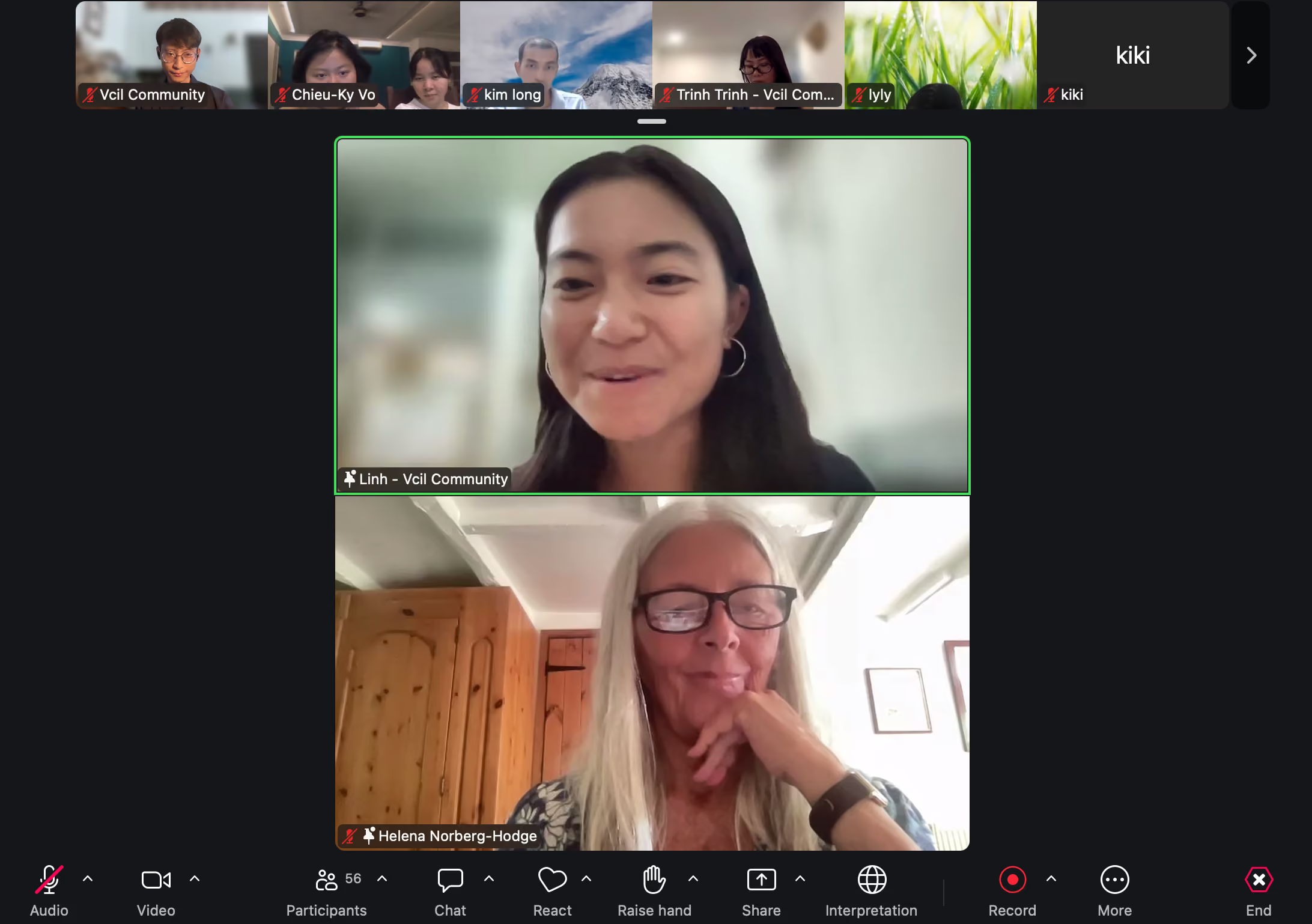
Helena also emphasized that localization does not mean complete self-sufficiency within a single village, nor does it mean ending international trade. Communities can still exchange knowledge, trade appropriate goods, and cooperate across borders. The key is to ensure that the essential needs of life are not entirely dependent on distant, opaque, and unaccountable supply chains controlled by powerful multinational corporations.
During the Q&A session, participants raised very practical concerns. What if a region cannot farm year-round? Is localization a privilege? Do technology, phones, the internet, or modern devices still exist in a localized society? How can education help people change their habits?
Helena’s answers all returned to a common point: localization is not an extreme rejection of trade or technology. It is an invitation to re-examine how economic tools and systems are organized, who controls them, who benefits, and whether they serve people, communities, and the ecosystem.
She also believes that education remains crucial. However, education needs to help people see the bigger picture, rather than just receiving fragmented and overly specialized information. When people understand the connection between their daily choices and food, livelihoods, health, the environment, and happiness, they will have more motivation for real change.
When asked whether we should start with human connection or food connection, Helena shared that human connection is the foundation. However, in the current context, food can be an accessible and practical starting point. Because food is a daily necessity, it is at the heart of the economy and is where the land, farmers, health, culture, and community intersect.
Perhaps that is also why most of the activities during Localization Week began with seeds, markets, meals, stories about the land, and a desire to meet one another more authentically.
When asked whether we should start with human connection or food connection, Helena Norberg-Hodge shared that human connection is the foundation. However, at present, food can be a very accessible and practical starting point.
Because food is something we interact with every day. It connects the land, water, climate, seeds, farmers, sellers, processors, consumers, and the relationships within families and communities. Food is also a central part of the economy: how we produce, distribute, and eat can directly impact human health, rural livelihoods, biodiversity, and a locality's resilience in the face of crises.
Therefore, many activities during Localization Week have started with seeds, food systems, markets, and culinary culture.
In the “Conversation on Food Systems in the World We Live In”, we reflected together on the major changes in Vietnam’s agriculture and food sectors over the past several decades.
Since the Doi Moi reforms, agricultural production has shifted dramatically. Machinery, various inputs, e-commerce, logistics systems, and longer supply chains have enabled food to be produced at a larger scale, transported further, and reach more markets. Agriculture, forestry, and fisheries have also become vital sectors in Vietnam’s economy and export landscape.
These achievements deserve recognition. They have helped many production regions access markets, created jobs, brought Vietnamese agricultural products to the world, and contributed to ensuring food security for daily life.
But looking deeper, we also encounter questions that are not easily answered.
If agriculture and exports are thriving, why do many families still not want their children to continue farming? Why does the cycle of “bumper crops leading to price drops, and poor harvests leading to price hikes” still leave small-scale producers in such a precarious position? Why are consumers increasingly concerned about clean food, yet often find it difficult to know where their food is grown, how it is produced, and how the people who make it are living?
Why, in a country with such abundant natural conditions, is the diversity of our meals and ecosystems potentially shrinking? Why are many plant varieties, traditional food practices, and local knowledge gradually disappearing from the lives of the younger generation?
These questions are not intended to dismiss the entire current food system. They help us realize that food is not just a commodity. It is a condition for life to continue, the result of labor, land, climate, and knowledge accumulated over many generations.
During the conversation, we identified three common issues that arise when food systems become too long and too complex.
The first is dependency. Farmers may become dependent on seeds, fertilizers, pesticides, traders, market prices, and outlets that are beyond their control. Consumers are also dependent on distribution chains that they have little opportunity to understand.
The second is information asymmetry. Buyers often know very little about the production conditions behind their food, while small-scale producers struggle to access full information about markets, standards, prices, and the actual needs of consumers. When the two ends of the system do not meet, trust easily erodes.
The third is cost externalization. A product may be cheap at the counter, but that price does not necessarily reflect other costs: soil degradation, impacts on water sources, worker health, waste, emissions, loss of biodiversity, or the risks that farmers must bear themselves. These costs may not appear on the receipt, but they eventually return to society and future generations.
The conversation also broadened our perspective by placing Vietnam alongside several other food systems in the region. Each country has chosen a different path to modernization, depending on its history, policies, land ownership structures, technological levels, and the power dynamics between the state, businesses, farmers, and consumers.
Some countries have developed food systems with high levels of industrialization and corporate concentration. Some invest heavily in technology, logistics, and e-commerce. Others still maintain a significant role for traditional markets, smallholder farmers, cooperatives, and more decentralized distribution networks.
Vietnam is currently in the midst of an incomplete transition. Traditional markets, small-scale farmers, and local trade relationships still coexist with supermarkets, digital platforms, industrial production, and global export chains. This also means that the future of the food system is not yet fully predetermined.
We still have the opportunity to ask: What kind of food system does Vietnam want to build? One that only optimizes yield, exports, speed, and cost, or one that simultaneously protects farmers' livelihoods, consumer health, biodiversity, local culture, and community autonomy?
Localization does not offer a simple formula to solve all these problems at once. But it suggests a direction: shortening distances, increasing transparency, building more direct relationships between producers and consumers, decentralizing power, diversifying supply, and empowering local communities.
From the story of the food system, we return to something even smaller: the seed.
In Da Nang, the Holy Seeds project—a documentary film project about indigenous seeds involving members of the Vcil Community—organized a “Film Screening and Discussion: The Seeds of Vandana Shiva – Seeds and Food Security”.
Seeds are often viewed merely as inputs for cultivation. But inside every seed lies a long story about the land: which climate the plant has adapted to, how it has been cared for, which dishes it enters, what customs it is tied to, and how it has been passed down through generations.
When an indigenous seed is preserved, it is not just a plant that is saved. We also preserve the ability to diversify food sources, adapt to local conditions, maintain farming knowledge, and protect flavors and cultural memories.
Conversely, when a food system prioritizes only a few uniform varieties that are easy to transport and suitable for mass markets, many local varieties may gradually be replaced. Along with them, ways of farming, processing, and living in harmony with nature are also at risk of being lost.
The screening opened up a conversation not only about seeds but also about nature-friendly agriculture, food security, and collaboration. Participants from various fields—farmers, architects, educators, and those interested in food, the environment, and community—met at a common point: the future of food cannot be decided by just one group of people.
A reflection from Holy Seeds particularly resonated with us: the work of a farmer is something to be proud of. Those who choose to preserve seeds, farm in harmony with nature, or return to the wisdom of their ancestors are not just producing rice, vegetables, or healthy food. They are also safeguarding a part of our culture, ecology, and community autonomy.
If the seed is the starting point of food, the market is where we encounter food as it enters our daily lives.
Going to the market is a familiar practice in Vietnamese culture. However, in the modern pace of life, many of us have less and less time to visit the market, or we treat it as a chore to be completed as quickly as possible: buy what is needed, pay, and return home.
Therefore, in Da Nang, we organized “The Market Challenge! Let’s challenge ourselves to go to the market mindfully!”. Participants were invited to visit Con Market and the GO! Da Nang supermarket to buy ingredients for a signature, everyday dish from their own roots, then observe, talk, and share what they discovered.
The purpose of this challenge is not to claim that traditional markets are better than supermarkets, nor to deny the convenience that modern retail systems provide. What we want is to create an opportunity for people to take a closer look at what actually happens when we buy food.
At Con Market, one participant encountered a coconut stall run by a two-generation family. The son chopped and peeled the coconuts, the mother strained the water, and the father grated the coconut meat. Through their conversation, the participant learned that the coconut water is for drinking, the meat is processed, and the shells are collected to be made into ladles.
From just one small stall, the participant saw a very specific chain of connections: a family's labor, the utilization of raw materials, the input-output of the product, traditional craftsmanship, and how generations work together.
Another experience was equally memorable. A group of participants wanted to eat different dishes but sit at the same table. The bun bo Hue vendor proactively called other stalls to bring food over. On that small table, there was bun bo, grilled pork vermicelli, and sweet soup—not because one stall tried to sell everything, but because the vendors supported each other to serve their customers.
From that everyday experience, the participants connected to the spirit of "trading with neighbors": an economy that operates not only through competition but also through cooperation, support, and human relationships.
That is what we want to inspire through the Market Challenge. When you slow down a little at the market, ask one more question, and listen to one more story, food is no longer just an anonymous commodity. It becomes a gateway to understanding others, the land, and our own lives.
From our activities regarding seeds, food systems, and market visits, we also want to clarify one thing: localization is not just a call to prioritize buying local products.
Local consumption is a meaningful starting point. But if we stop there, we might overlook more important questions: Can producers make a living from their work? Do they have fair access to land, seeds, markets, and information? Is food produced in a way that respects human health and the ecosystem? Can citizens participate in deciding the future of the food system where they live?
Food localization means building closer, more transparent, and fairer relationships between growers, sellers, eaters, and nature. It could be a fair market, a shop connecting small farmers with urban dwellers, a cooperative, a food-buying group, a community garden, a risk-sharing model with farmers, or simply a meal where we know and appreciate the story behind the food.
And from those seeds, dishes, and markets, the week continues to open up another question: how is the culture of a land preserved, passed down, and brought to life in today's world?
If seeds are where the story of food begins, then a dish is where many layers of memory, knowledge, and relationships meet.
We often talk about food in terms of nutrition: what nutrients a dish has, or whether it is good for our health. But food is also culture. It tells of the climate, the soil, the water sources, the seasons, the intersection of communities, how humans interact with nature, and how a land nurtures those who live upon it.
A dish does not appear out of thin air. It is created from what the land can provide, from the skills of those who make it, from trials and errors, seasons of plenty and famine, migrations, exchanges, and adaptations over many generations.
Therefore, during the Localization Week, we are organizing the activity "Storytelling and experiencing local culinary culture" not just to introduce regional dishes. We want to look deeper together into the question: how have people, culture, ecology, and climate blended into the food we eat every day?
The culinary journey during the sharing session took everyone through two very different regions: Hue and the Mekong Delta.
In Hue, cuisine evokes a sense of frugality, refinement, and the historical depth of the ancient capital. Each dish is more than just a combination of ingredients; it reflects how people cherish produce, balance flavors, engage the senses, and uphold family traditions. From royal delicacies to folk pastries, Hue’s culinary culture demonstrates a meticulous approach to food: even the smallest detail is cared for, and abundance is not necessarily measured by quantity.
From the contemplative nature of Hue, the story shifts to the Mekong Delta—a land of rivers, silt, and open-heartedness. A Southern folk song rises, followed by the appearance of flattened green rice (cốm dẹp) with the scent of new sticky rice, the taste of coconut, and the cultural fusion of Kinh and Khmer influences. Participants also recall linh fish, sesban flowers, Ben Tre coconuts, An Giang palm sugar, and the produce tied to the flood season.
If Hue’s cuisine evokes frugality and the depth of time, the cuisine of the Mekong Delta embodies living in harmony with nature: when the waters rise, people eat what the season provides; local produce becomes the soul of the kitchen; and life is organized according to the rhythms of the river, the land, and the seasons.
This transition from Hue to the Mekong Delta within the same space reveals an important realization: every region has its own way of living with nature. But whether it is the Perfume River or the Mekong river system, food is a way for people to shape their identity, remember their roots, and express gratitude for their origins.
That is why we do not want to speak of culinary culture as something that belongs only to the past. Preserving culture is not about locking dishes, recipes, or memories in a glass cabinet. Preserving culture means ensuring that this knowledge continues to be cooked, eaten, shared, passed down, and renewed in our present lives.
In Ho Chi Minh City, activities such as “Flavors of the Marshlands” and “The Circle of Earth’s Soul Within Us” have opened up a different way to explore the story of food.
Participants are invited to bring a gift, an ingredient, a specialty, or a flavor they feel connected to. Some bring dishes from their hometowns; others bring a specific leaf, a type of cake, or an ingredient they haven't encountered in a long time; some simply bring a story about a childhood snack.
From there, strangers sit together around a multi-regional meal. They wrap sticky rice cakes, scrape coconuts, chop ingredients, cook, share delicious food, and tell each other the memories they brought along. One person remembers the grilled cassava cake that was once a great joy for a little girl. Another says the atmosphere of the gathering makes them feel as if they have returned to their grandparents' home.
These experiences show that food has a very special power: it makes memories tangible. When we cook a dish together, we are not just learning a skill. We learn about each other’s hometowns, about the people who raised us, and about the lands that shaped who we are.
This is also a form of intergenerational connection. Those who know how to cook guide those who don't; elders share stories; and children eagerly try their hand at each step. Knowledge is not transmitted through a lecture, but through doing, eating, and being present together.
In Vung Tau, the week-long event explored local culture through a conversation about the Doan Ngo Festival, through products associated with cajeput, coconut, Ho Tram wild yam, herbs, and stories about caring for the body and mind.
These practices remind us that indigenous knowledge is not just found in ancient documents or remote places. It can be present in a slowly brewed pot of tea, a folk remedy, a plant growing on sandy soil, a way of using ingredients found around the house, or a seasonal custom.
However, exploring and practicing such knowledge does not mean idealizing everything traditional. The key is to approach it with respect, a spirit of inquiry, and the ability to verify appropriately; while also recognizing that knowledge accumulated by a community over time can help us rethink how we live, how we care for our health, and how we use resources today.
At the Vung Tau market, local products are not just presented as mere commodities. They become a catalyst for participants to ask: Where do these ingredients come from? How is this plant connected to this land? What have the makers learned from nature, their families, or their predecessors? How can an indigenous value continue to live in a modern context without being reduced to a decorative image or a simple marketing tool?
When we talk about food, we often think of personal needs: what we like, what we need, and what we can buy. But localization expands that question.
Where does this dish come from? Under what conditions was it made? Who cared for the soil, saved the seeds, farmed, transported, processed, and sold it? Is it suitable for the season, the climate, the body, and the life of the land where we live? When choosing this food, what kind of relationship between people and nature are we nurturing?
These questions are not intended to pressure anyone into making a perfect choice. No one can fix the entire system with a single meal. But they can help us eat more consciously; be more grateful to those who produce our food; and be willing to learn about and try closer, healthier, and fairer options within our means.
A designer of community culinary experiences during the week shared that we don't just eat to be full, but also to listen, to empathize, and to honor the diversity of this land.
Perhaps that is also a very accessible way to understand localization: not by starting with something grand, but by looking back at our own dining tables. Within them lie the soil, water, climate, labor, memories, emotions, and even choices about the future.
From those meals and conversations, the week continued to another question: how can those creating value locally—farmers, artisans, small business owners, cooperatives, and community initiatives—be seen, connected, and supported to continue living with their land?
Following the stories about seeds, food, and culinary culture, the Localization Week continued to pose a very practical question: how can those creating value locally continue to live, work, and remain attached to their land?
This is when we need to talk about the local economy.
A local economy does not just mean a product made near where you live. More importantly, it is about: who owns that economic activity, whether the value created returns to nourish the community, whether the producers can make a living from their craft, and whether decisions affecting the land are made with the participation of local people.
When someone buys an item from a small business, a cooperative, a farmer, or a local artisan, it can help a portion of that value continue to circulate within the community. But if we want to build a stronger local economy, we need to go beyond just "buying local."
We need to create more sustainable relationships between producers, consumers, artisans, vendors, community spaces, and local government. We need models where people can collaborate, share risks, support each other in accessing markets, care for the ecosystem together, and have a collective voice in the future of where they live.
During the week, the markets were among the most important spaces for testing that spirit.
In Da Nang, The Dong Day Market – What's up? took place for the third time with 18 local stalls and initiatives. Amidst the sweltering summer solstice of Central Vietnam, the market brought together those working with seasonal produce, handicrafts, food, beverages, recycled products, seedlings, creative activities, and small workshops.
Each stall is a small corner that carries its own story. Some have been with the market for many seasons, while others are bringing their products and ideas to the community for the first time. Some bring produce, others offer handmade goods, and some share their expertise in fermentation, hand-sewing, seeds, or new experiments with local ingredients.
What is truly valuable is not just the variety of products. The market creates an opportunity for makers to talk about their work: how they source their ingredients, the trial and error they’ve experienced, why they choose to make products in a more wholesome way, and what keeps them patient with their craft.
When those stories are heard, products are no longer judged solely by price or appearance. Buyers can see the time, effort, passion, and ethical choices behind a meal, a recycled bag, a seedling, or a handcrafted item.
The market, therefore, is more than just a place to exchange goods. It is a space for connection. People can sit down, eat, chat, join workshops, dance, sing, make friends, and find others who share an interest in a lifestyle more in harmony with nature.
Perhaps that is why the organizers of the Dong Day Market say the most important thing is "the heart"—the bond between people. A healthy economy needs more than just good products; it also needs trust, joy, and relationships strong enough for people to support one another.
In Vung Tau, The "Localization" storytelling market opens up a different approach, rooted in the products and knowledge of the Ba Ria – Vung Tau region, especially Ho Tram and Chau Duc.
Participants encounter stories about Chau Duc cacao through the Chocoland workshop; handmade products and foods made from local ingredients; herbs, cajeput, coconut, and yam; as well as stories about the Doan Ngo Festival, self-care, and how local knowledge can coexist with modern life.
Notably, those who come to the market are not viewed merely as customers. They are invited to converse, share their experiences using natural products at home, learn from the makers, and contribute their own stories to the shared space.
In this way, the market becomes a classroom without a podium. A maker can share knowledge about ingredients; a family can talk about their health habits; and a participant can ask questions about the origin, process, and impact of the goods they use every day.
Vung Tau's treasure, therefore, does not lie only in coconuts, cajeput, cacao, yams, or other tangible resources. The greatest treasure is the people living on this land: business owners who persist in quality, young people finding ways to elevate local produce, those who preserve traditional knowledge, and those ready to meet one another with an open mind.
A reflection from Loto, a member of the Vcil community who pursues culinary education, helped us better define this shift.
You mentioned that before the week-long event, you already used local food and had many friends in different regions. But after the experiences of going to the market and meeting farmers, hosts, and makers, you realized that localization carries a much more proactive spirit.
It is not just about visiting a place to sightsee or consume local products. Each person can learn about issues in their own community, contribute value, connect others, initiate an idea, or participate in work already being done by the community.
This is the difference between a shopper and a companion.
A shopper might care about price, quality, and convenience. A companion cares about those things too, but also asks further questions: What do the producers need? What risks are they facing? How can I support them beyond just buying their products? How can the relationship between grower and eater be fairer? How can we ensure the maker doesn't bear the brunt of the risk alone while the benefits are split among too many intermediaries?
These questions open up possibilities for new collaborative models: consumer groups buying directly from small farms; seasonal risk-sharing models; cooperatives; community markets; shops that connect small farmers with urban dwellers; local support funds; or networks for exchanging skills and resources.
Not every model is suitable everywhere. But what they all share is that they help make economic relationships closer, more responsible, and less dependent on systems where neither producers nor consumers have much say.
If the market shows us forms of direct interaction between artisans and the community, then the field trip “Down the Thu Bon River – What does the river tell us?” opens up a broader perspective on the local economy.
The trip, co-organized with XomTour, took participants to communities living along the Hoi An river ecosystem, including the Kim Bong Community-Based Tourism Cooperative.
Here, we learned about efforts to build livelihoods based on existing local strengths: traditional crafts, knowledge of the river, community life, culture, and the landscape. At the same time, the community is finding ways to protect what is being threatened by environmental changes and modern extraction methods.
The trip helped us see more clearly that a river is not just a landscape or a resource. The river is a living system. It is connected to the fish, the fields, the alluvial soil, livelihoods, memories, tourism, transportation, culture, and the lives of riverside communities.
When an ecosystem is damaged, livelihoods are affected. When livelihoods are unstable, people may be forced to leave their land. And when a community can no longer live in the same place, knowledge, crafts, and culture are also at risk of gradually fading away.
Therefore, collective and community economic models are particularly significant. They are not just a way to generate income. They are a way for people to cooperate, participate in decision-making, share benefits, and take responsibility for local common assets.
A local model is only truly sustainable when people are not excluded from the development of their own land. When they have a voice, the power to decide, and the right to benefit, they have the conditions to continue preserving the ecosystem, culture, and livelihoods for future generations.
Markets, meetings with artisans, or trips along the Thu Bon River cannot immediately change a vast economic system. But they help us see the seeds of a different economy that is already in existence.
It is an economy where producers are not invisible; where products carry the stories of the land and its people; where value is not measured solely by short-term profit; where cooperation is valued alongside competition; and where the community can care for what sustains them together.
Localization does not require us to abandon all trade or do everything on a small scale. But it sets a clear direction: for the essentials of life, we need to build closer, more diverse, transparent, and resilient relationships.
And for those relationships to last, we need more than just changing how we produce and consume. We also need to nurture memories, art, joy, creativity, and a sense of belonging—the things that make people want to stay, care for, and build a place together.
When talking about localization, we easily think of food, agriculture, markets, cooperatives, or economic models. Those are very important. But if we only talk about systems, policies, and problems to be solved, this journey can become heavy and distant from many people's lives.
Humans do not live by analysis alone. We also live by memories, emotions, music, stories, creativity, shared meals, and a sense of belonging.
In the opening talk, Helena Norberg-Hodge also emphasized the importance of "celebration"—singing, dancing, meeting, practicing rituals, and opening ourselves to the beauty of life. This is not to avoid crises. On the contrary, joy, connection, and the ability to create together are the resources that give a community the resilience to face difficult challenges.
Another space where these stories can be heard is Untalent Show: Art for People and Place in Da Nang.
In a society that often sets high standards for achievement, expertise, and "talent," the Untalent Show is an invitation for everyone to step onto the stage for the sake of joy and connection, rather than for performance. Participants can sing, dance, recite poetry, craft, perform improv, or share something they love.
What matters is that everyone has the opportunity to express themselves, to be heard, and to be recognized as a valued part of the community.
The Untalent Show featured 13 acts, ranging from songs, original poetry, and Cai Luong to dance, improv, and craft demonstrations. These performances carried local dialects, lullabies, and imagery of rivers, stones, mangroves, trees, childhood, family, and the lands that shaped each individual.
Interestingly, it is through these spaces that young people have the opportunity to engage with art forms deeply rooted in culture. Some began practicing traditional "Ly Muoi Thuong" folk songs, while others started exploring. Some even began practicing Cai Luong through the play "Vo Dong So – Bach Thu Ha”, sharing that they were not only impressed by the art of Cai Luong but also found the Vietnamese language to be incredibly rich and diverse. They were particularly struck by the remarkable memory of our elders, who could memorize an entire two-hour Cai Luong play. Others tried analyzing lullabies and folk songs through the lenses of psychology, cognitive science, and modern knowledge.
Art, in this way, is a part of localization. It helps us name things that are difficult to express through rational language, allows individual memories to meet collective ones, and helps everyone see that love for a place can also become a creative act.
In Ho Chi Minh City, the Playback Theatre night “People of the Land” also opened up a space to talk about the feeling of belonging.
From the audience's stories, a multi-layered Saigon emerged on stage. There were people from the North, Central, and South who came here to study, work, and build their lives. There were dishes that carried the flavors of home, which gradually became a part of Saigon. There was broken rice, local markets, diverse accents, old trees, familiar cafes, friendships, generosity, and the chapters of life that the city has witnessed.
The city in these stories is not defined by famous landmarks or high-rise buildings. It is created through relationships.
This helps us better understand an important aspect of localization: "local" is not just where we were born. For many, especially in the context of migration and urbanization, a place is also where we are welcomed, where we learn, work together, share, and gradually become a part of a collective life.
A person may be born in one place, grow up in another, and find their home in a new city. Localization does not require us to return to a fixed image of our hometown. It invites us to build a more responsible relationship with the place where we live, with the people we live alongside, and with the ecosystem that sustains us all.
In Vung Tau, the mini-concert “Together as One” is another way for the community to connect. In Da Nang, people sing, dance, and share food at the Dong Day Market. In Ho Chi Minh City, people gather to cook and relax on the attic floor, just like grandchildren visiting their grandparents' home.
These moments may seem simple, but they create something that social movements often need: the belief that we are not alone.
Ky shares that when you join the Vcil Community, you no longer feel alone. You realize that more and more people are returning, asking the same questions, and finding one another. “When you find each other, something begins.”
Perhaps that is what the week aims to preserve most.
Localization is not just a reaction to what is being lost. It is also an act of affirmation: we can still create kinder relationships together; we can still sing, tell stories, celebrate, and care for the beautiful things that are present.
Because when a community has memories to share, art to express, joy to encounter, and a sense of belonging, it has more reasons to protect its land together.
Localization Week does not just take place in three cities. It is also part of a broader conversation unfolding in many places around the world.
On World Localization Day, June 21, 2026, the Vcil Community joined Local Futures and organizations and networks in many countries to co-create the multimedia magazine “Rooted in Place: Stories of Localization from Around the World”.
The magazine is the result of a journey of connecting, mapping, and storytelling that spans Ladakh (India), Vietnam, Germany, Brazil, and California (USA). In the context of poly-crises, Rooted in Place opens a door to see the efforts underway in many places: restoring local economies, preserving culture, protecting indigenous knowledge, regenerating ecosystems, and reimagining education.
Rooted in Place is more than just a publication. It is a tangible form of a growing movement: a movement to rediscover our connection to place, culture, the land, and one another.
The stories from Vietnam in this magazine show that localization is not a new idea imported from abroad. It has been present in many concrete initiatives: preserving rice culture; developing cooperatives to conserve culture, ecology, and create livelihoods in Cu Lao Cham; the A Song art ecosystem in Central Vietnam; or Co – Green Store, which connects small-scale organic/natural farmers in rural areas with urban consumers.
These initiatives may vary greatly in scale, location, and approach. But they share one thing: instead of waiting for a development model from the outside, they start with the people, needs, resources, culture, and ecosystems already present locally.
Including these stories in an international magazine is significant. Many people are doing good, valuable, and meaningful work, yet they are almost invisible in mainstream media. We often hear more about crises, competition, growth, and large corporations, while the quiet efforts to care for the soil, save seeds, preserve crafts, organize cooperatives, open community spaces, or connect farmers with consumers are rarely seen.
Rooted in Place We want these wholesome, interesting, and beautiful stories to spread further. Not to sugarcoat reality or claim that communities already have all the answers, but to show that a different future and a different economy are possible—and in many cases, they are already being practiced.
In Vietnam, the Localization Week: Our Local Treasures took place through 27 activities across three cities.
Vung Tau hosted 7 activities with 150 registrations. Da Nang held 11 activities with 150 registrations, including 18 local stalls/initiatives at the Dong Day Market and 13 art performances expressing the land, people, and a sense of belonging. Ho Chi Minh City had 9 activities with 70 registrations. Participants ranged in age from 3 to 70.
These numbers are not meant to claim a completed success. But they show us a real need: the need to understand a different economy; to be closer to food, nature, culture, and community; to meet people with similar interests; and to find meaningful ways to act in daily life.
We also learned that localization can reach people through many different paths.
Some come from questioning the globalization system. Some start with seeds. Some see a market for the first time as a space for cooperation and knowledge. Some touch upon memories when encountering a leaf, a dish, or a scent they haven't experienced in a long time. Some find a feeling of returning to their grandparents' home. Some realize they are no longer just consumers, but can become partners with farmers, artisans, and the local community.
But the week also showed us what still needs to be done better.
Many have clearly felt the value of cultural preservation, local consumption, wholesome food, and returning to explore indigenous knowledge. However, seeing these issues within the systemic picture—understanding how globalization, power concentration, supply chains, economic policies, and development decisions are impacting life—still needs to be deepened.
Furthermore, a week-long event can spark interest, but it is not enough to create long-term action. We need more pathways for participants to continue connecting, learning, experimenting, and collaborating after the festival ends.
That is what we want to take away from this week: not to see this as a destination, but as a starting point.
Localization Week: Our Local Treasures has concluded. But localization should not stop at a single week, a market, or a recap article.
If localization is understood only as buying goods nearby, reminiscing about traditional culture, or participating in a short-term activity, we might miss the most important part: the process of rebuilding the capacity, power, and autonomy of the local community.
In the coming time, Vcil Community looks forward to continuing to learn alongside Local Futures, communities, hosts, and fellow companions to take localization further and deeper.
First and foremost, we want to continue creating educational and communication spaces that help everyone see the systemic picture more clearly. Not just talking about isolated issues like contaminated food, pollution, loneliness, or cultural loss, but exploring their connections to the economic system, the concentration of power, distant supply chains, and how we define "development."
Understanding the big picture isn't meant to make us feel pessimistic or helpless. On the contrary, it helps us know where to start, who to collaborate with, and why local actions, however small, still matter.
Second, we want to continue connecting, mapping, and highlighting local-based initiatives in Vietnam. There are many individuals, small groups, cooperatives, farmers, artisans, cultural spaces, educational groups, green shops, and communities quietly doing good work. They need to be seen, to meet one another, to share experiences, and to be supported so they don't have to go it alone.
Third, we want to continue experimenting with community and solidarity economy models. These could be local markets, groups buying food directly from farmers, seasonal risk-sharing models, cooperatives, skill-sharing spaces, community gardens, or other forms of cooperation suited to each location.
These models don't follow a single template. What matters is that they help people increase their capacity for cooperation, retain more value locally, and together create livelihoods that respect both people and the limits of nature.
Fourth, we wish to foster more spaces for participation within the community. Localization is not just about changing consumption habits. It is also about bringing decision-making closer to those affected by those decisions.
When people are heard, involved in designing activities, and empowered to co-decide and share in the benefits, local initiatives have a better chance of being sustainable. This is also the spirit that Learning Cities pursues: everyone can be a learner, a sharer, a host, and a co-creator of community life where they live.
For each individual, this journey can start with things very close to home.
It could be asking your grandparents about a dish, a plant variety, or a family story. It could be slowing down at the market, asking the vendor an extra question, learning about the origins of your food, and supporting an artisan you trust. It could be joining a community activity, opening a small space for people to meet, bringing a local gift to share, or connecting a friend with a meaningful initiative.
No one needs to do everything alone.
Localization is a journey of interdependence. When many people start with small steps, learning together, collaborating, and creating kinder relationships, something greater can gradually take shape.
Thank you to Local Futures for your trust and for accompanying Vcil Community on the journey of bringing localization to communities in Vietnam.
Thank you to Learning Cities, the communities in Da Nang, Ho Chi Minh City, and Vung Tau; the hosts, spaces, artisans, farmers, cooperatives, artists, vendors, participants, and friends who contributed their time, effort, knowledge, stories, and energy to make this week happen.
Thank you to those who opened their homes, gardens, cafes, art studios, markets, and hearts to welcome others.
The inaugural week was certainly not without its imperfections and lessons to be learned. But we believe that the encounters that took place were real; the questions raised were necessary; and the seeds that were sown will have the chance to continue growing.
Localization does not require us to save the world alone.
It invites us to start with our closest relationships: knowing who feeds us, listening to each other's memories, caring for the place where we live, and deciding together the future we want to live in.
If the Localization Week has sparked a question, an idea, an initiative, or a story about your local area, Vcil Community would love to hear from you and walk this path with you.
Because when we find each other, something begins.