You are using the member interface.
Log out of the member interface →

 ← Bản tin
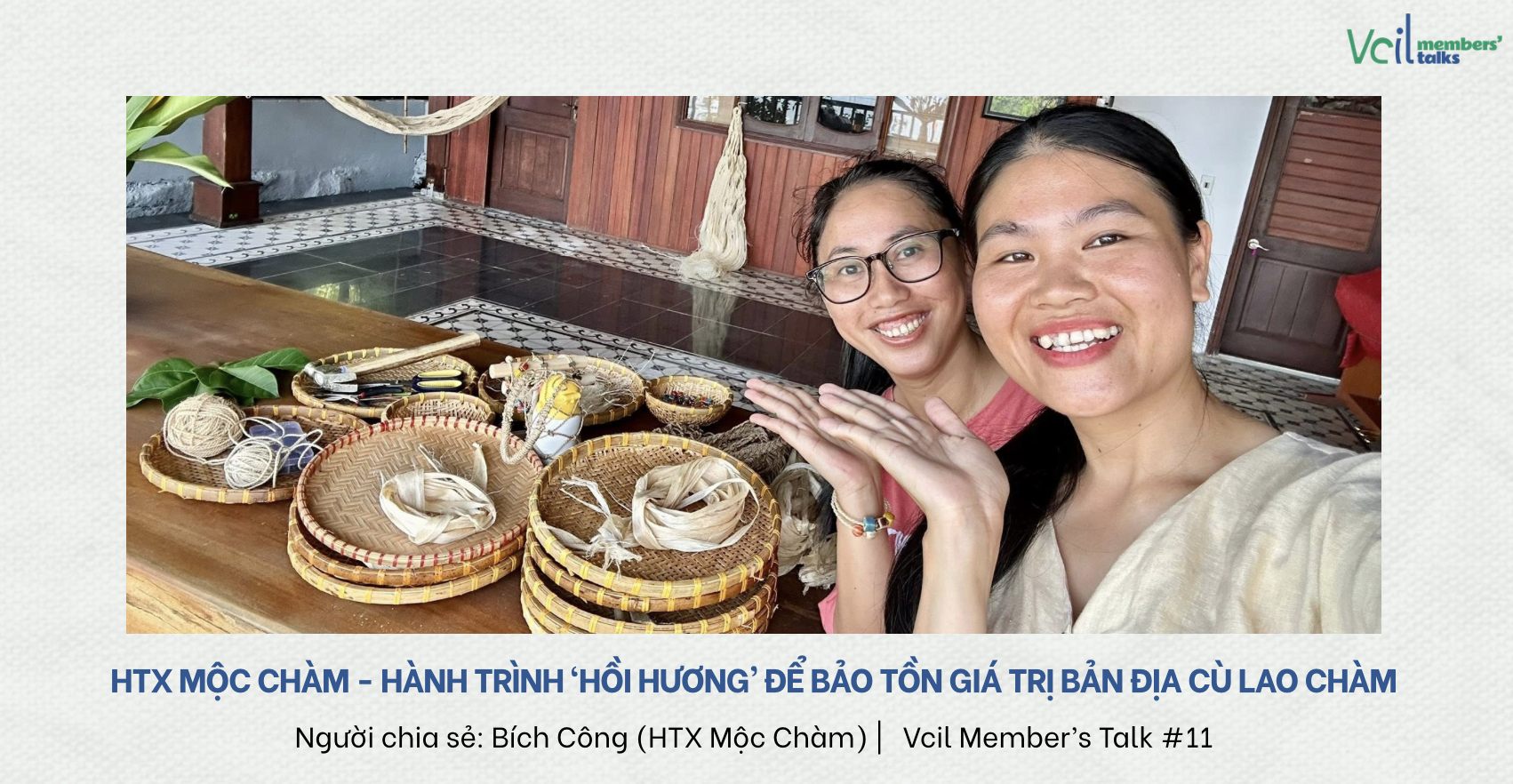
On the evening of 20/7, the talk "Vcil Members' Talks #11: Tourism as a tool for cultural conservation & sustainable livelihoods" took place with guest Bích Công, Director of the Mộc Chàm Cooperative (Cù Lao Chàm) and a member of the Vcil Community. Công shared her journey: leaving the island to study, the years working on the mainland while quietly nursing the intention to return, and the day she came home and began her work with the community, conserving culture and local values through the Mộc Chàm Cooperative.
The session was a conversation about the concerns and the journey of reimagining how tourism happens, so that tourism becomes a tool for conservation and sustainable local livelihoods, helping participants learn and connect more deeply with the people and the land.
Công began by telling participants about having to leave the island to study on the mainland. At 13, when the education system on Cù Lao Chàm stopped at lower secondary school, she and many other children had to go to the mainland to continue their studies. The island's children were often described as “studying abroad early”: leaving their parents at secondary-school age and starting to fend for themselves, from renting a room, cooking and washing to studying on their own initiative.
Having to be independent from a young age became part of how Công grew up. But those years away from home also gradually planted in her an idea of return: that one day she wanted to go back and do something for the place where she was born.
That idea grew clearer as she witnessed the first changes in how the community viewed the island's resources and nature. Just as she was preparing to leave Cù Lao Chàm to study, the Cù Lao Chàm Marine Protected Area management board was completing the paperwork for its establishment. The experts and adults who came from the mainland to teach schoolchildren about marine conservation sowed in her a love of nature, and helped her recognise the value of the local resources she saw every day.
After graduating from university and working in the city for two or three years, she began to realise she did not really belong in the repetitive rhythm of office life. She decided to ask her family's permission to return to the island. Her parents and the people around her did not support the decision: after years of investing in her education in the city, her parents wanted her to live there with all its conveniences and an easier life. A young person choosing to leave the city to live on the island was seen as a “failure”.
From Công's point of view, returning meant something completely different. It was not going back to the place she had left, but returning to a part of herself: to her roots, to nature, and to the values she had begun to recognise precisely through the distance of her years away from the island.
Công returned to Cù Lao Chàm at a time when the island faced many changes. In 2016, Cù Lao Chàm was officially connected to the national grid by undersea cable, ending the years when islanders had electricity from generators for only about four hours a day, from 6 pm to 10 pm. Electricity opened up many new opportunities for daily life and economic development, especially as tourism became an ever more important part of the island's growth.
Returning at just that moment, Công started with something very close to home: free English classes for the island's children. She wanted to give the children skills they needed for their own development, while also preparing Cù Lao Chàm for a new phase of tourism.
Alongside this, she joined the local Youth Union and began bringing environmental stories closer to the community. Campaigns such as “Say no to plastic bags and single-use plastic”, or folding paper bags as an alternative to plastic ones, were run together with educational activities for students. At the time, students had few options beyond going to school and coming home. The children's lack of opportunities to learn and grow was what drove Công to organise a wide range of educational activities to enrich their experience of living and learning.
From those first steps, Công gradually realised that conservation is not only about keeping a forest, a stretch of sea or a species. Conservation is also the story of how a community understands the value of the place it lives in, so that it knows how to protect it and can decide together the future of its own home.
After a few years back, observing Cù Lao Chàm's development, Công began to notice a gap in how tourism was happening on the island. Although tourism had been developing for a long time, most visitors, around 90%, came for the day only, joined a few activities such as swimming, and quickly returned to the mainland. Those experiences had become familiar and somewhat repetitive, while the island's daily life and its more interesting, deeper stories were hardly known.
Cù Lao Chàm is not only blue sea and beaches. In the lives of its people, knowledge and traditional crafts handed down over generations still survive: hammock-weaving from the bark of the ngô đồng tree, a craft more than 300 years old; making bánh ít lá gai; or the know-how of gathering forest leaves for herbal medicine. To local people these may just be familiar tasks of daily life, but seen from another angle, Công recognised them as values that could help visitors understand the land they were setting foot on. Tourists come to Cù Lao Chàm not only to enjoy its natural beauty; they can also learn more deeply about the culture, way of life, people and indigenous knowledge that already exist here.
The deeper she went into the life of the community, the more she realised that this knowledge is not something found in a book or a pre-packaged tour. It lives in the hands of the people on the island, in the memories of the elderly and in the forests that have nourished generations.
After marrying a local man whose father is a traditional herbalist, Công had the chance to step deeper into that “world of local knowledge”. Guided by the elders, she went into the forest with others to learn about medicinal plants and how local people have used them for generations. These experiences taught her that to conserve, perhaps you first have to enter the life where that value exists, to listen to and understand the people who are keeping it alive.
From those circumstances, in February 2026 the Mộc Chàm Cooperative was officially founded. Mộc Chàm did not begin with the ambition of becoming a large business, but as a small livelihood model built from the values already present on the island, where conserving indigenous culture, building people's capacity, and bringing Cù Lao Chàm's distinctive products and knowledge closer to visitors can coexist and reinforce one another.
Below is a summary of the questions and discussion about how the Mộc Chàm Cooperative works (see the images or read on below):
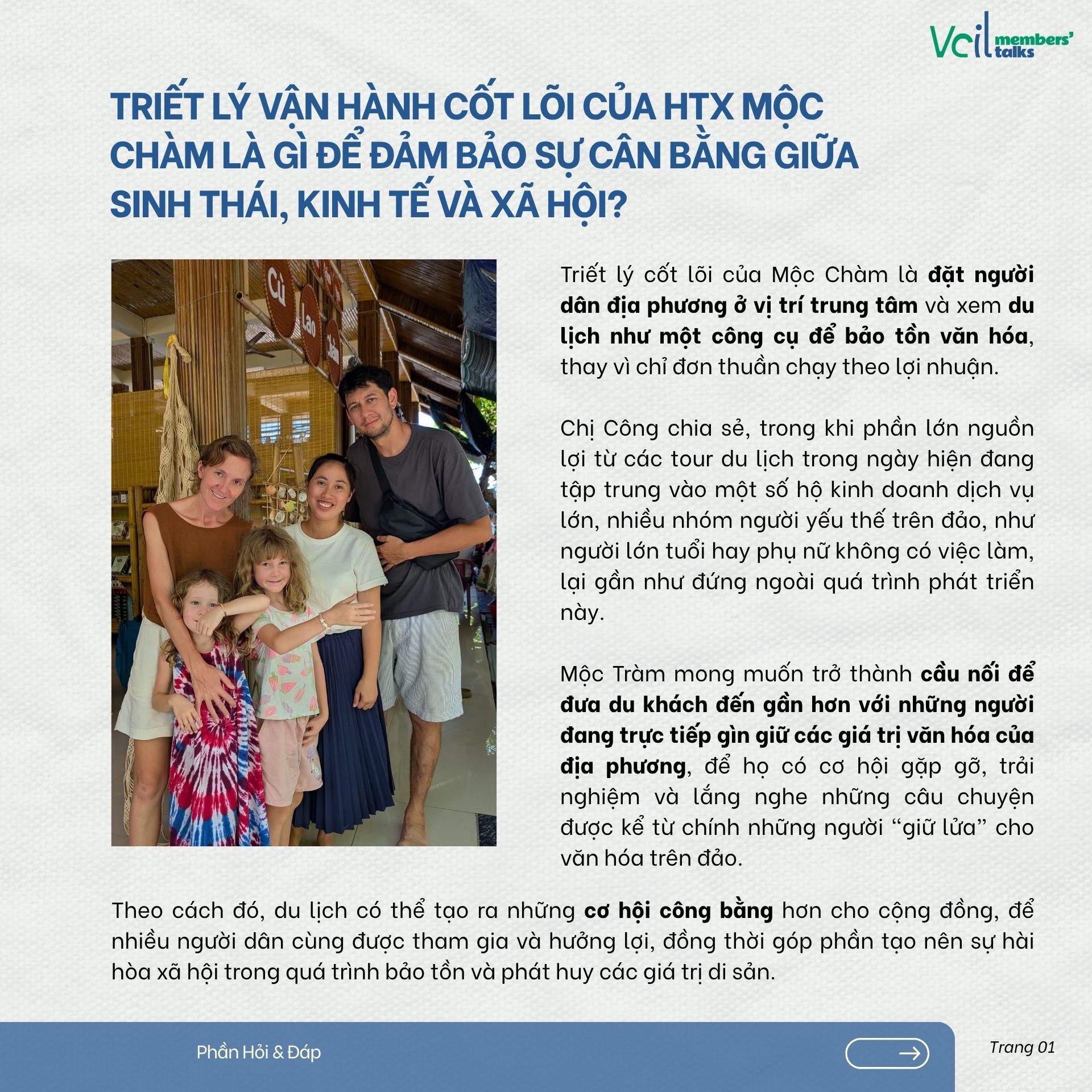
Mộc Chàm's core philosophy is to put local people at the centre and to treat tourism as a tool for cultural conservation, rather than simply chasing profit.
Công explained that while most of the income from day tours is concentrated in a few large service businesses, many vulnerable groups on the island, such as the elderly or women without work, are almost entirely left out of this development.
Mộc Chàm wants to be a bridge that brings visitors closer to the people who directly keep the local culture alive, so they can meet, experience and listen to stories told by the very people who “keep the flame” of the island's culture.
In this way, tourism can create fairer opportunities for the community, so that more people can take part and benefit, while contributing to social harmony in the process of conserving and promoting heritage values.
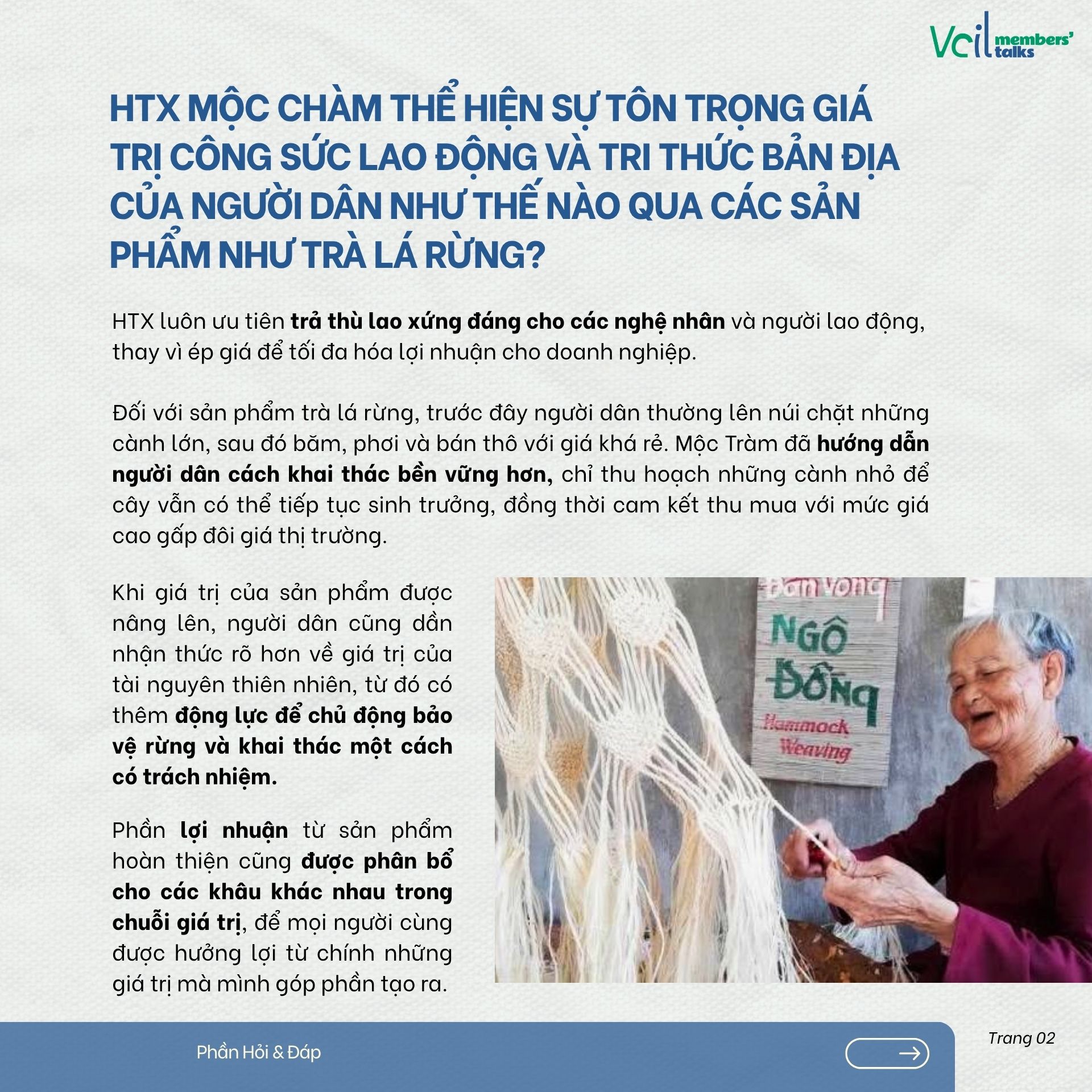
The cooperative always prioritises paying artisans and workers what they deserve, rather than squeezing prices to maximise the business's profit.
For the forest-leaf tea, people used to go up the mountain and cut large branches, then chop, dry and sell them raw quite cheaply. Mộc Chàm taught people a more sustainable way of harvesting, taking only small branches so the tree can keep growing, and committed to buying at double the market price.
As the product's value rose, people also became more aware of the value of natural resources, giving them more motivation to protect the forest and harvest responsibly.
The profit from the finished product is also shared among the different stages of the value chain, from the leaf-pickers and packers to those who run the operation, so everyone benefits from the value they help to create.
1/ Real benefits from conservation:
Công finds that people are only truly motivated to protect the environment when they see the direct benefits conservation brings to their own lives. The story of protecting Cù Lao Chàm's coral reefs is a typical example.
Before the Marine Protected Area was established, people used to harvest coral to build houses. But once they understood that coral is where fish and shrimp breed, and an important resource for attracting tourists, they stopped harvesting it entirely. Thanks to that, Cù Lao Chàm's coral reefs have been well protected for more than 20 years and are considered among the best-preserved in the country.
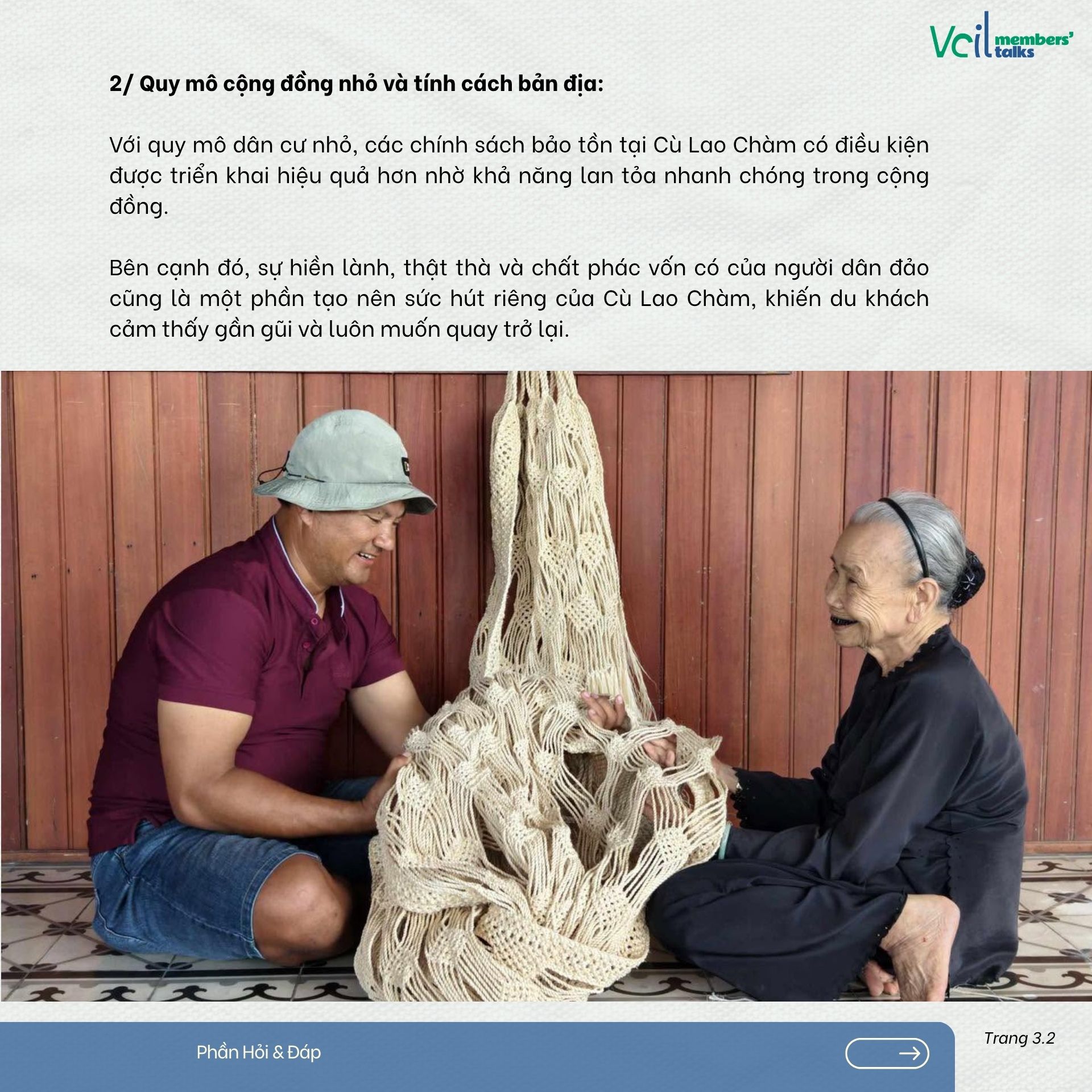
2/ Small community size and local character:
With a small population, conservation policies on Cù Lao Chàm can be implemented more effectively because they spread quickly through the community. In addition, the islanders' natural gentleness, honesty and simplicity are part of Cù Lao Chàm's particular appeal, making visitors feel at home and want to return.
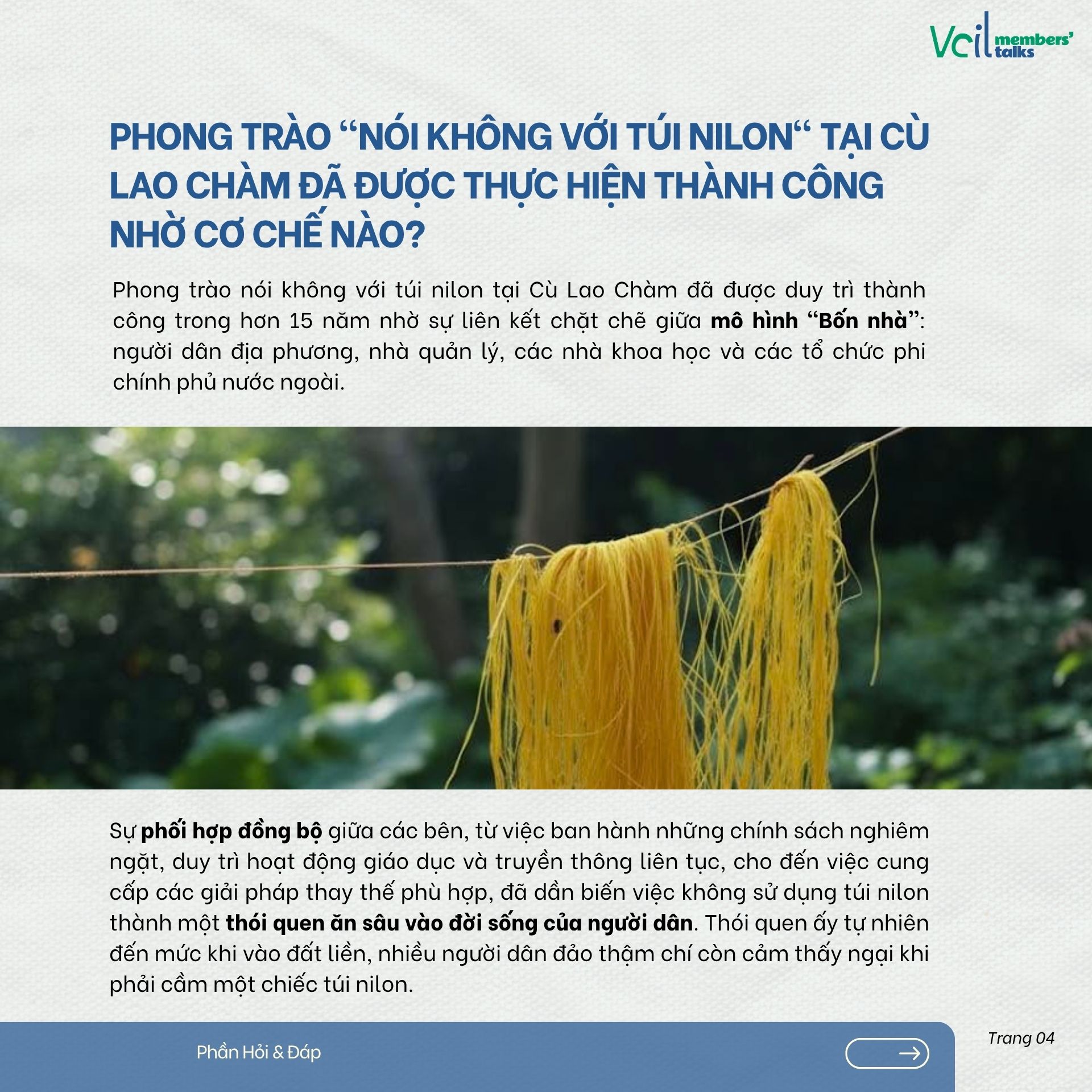
The “no plastic bags” movement on Cù Lao Chàm has been sustained for more than 15 years thanks to close links within a “four-party” model: local people, managers, scientists and foreign non-governmental organisations.
Coordinated action by all parties, from issuing strict policies and maintaining continuous education and communication to providing suitable alternatives, gradually turned not using plastic bags into a habit deeply rooted in daily life. The habit is so natural that when they go to the mainland, many islanders even feel embarrassed to hold a plastic bag.
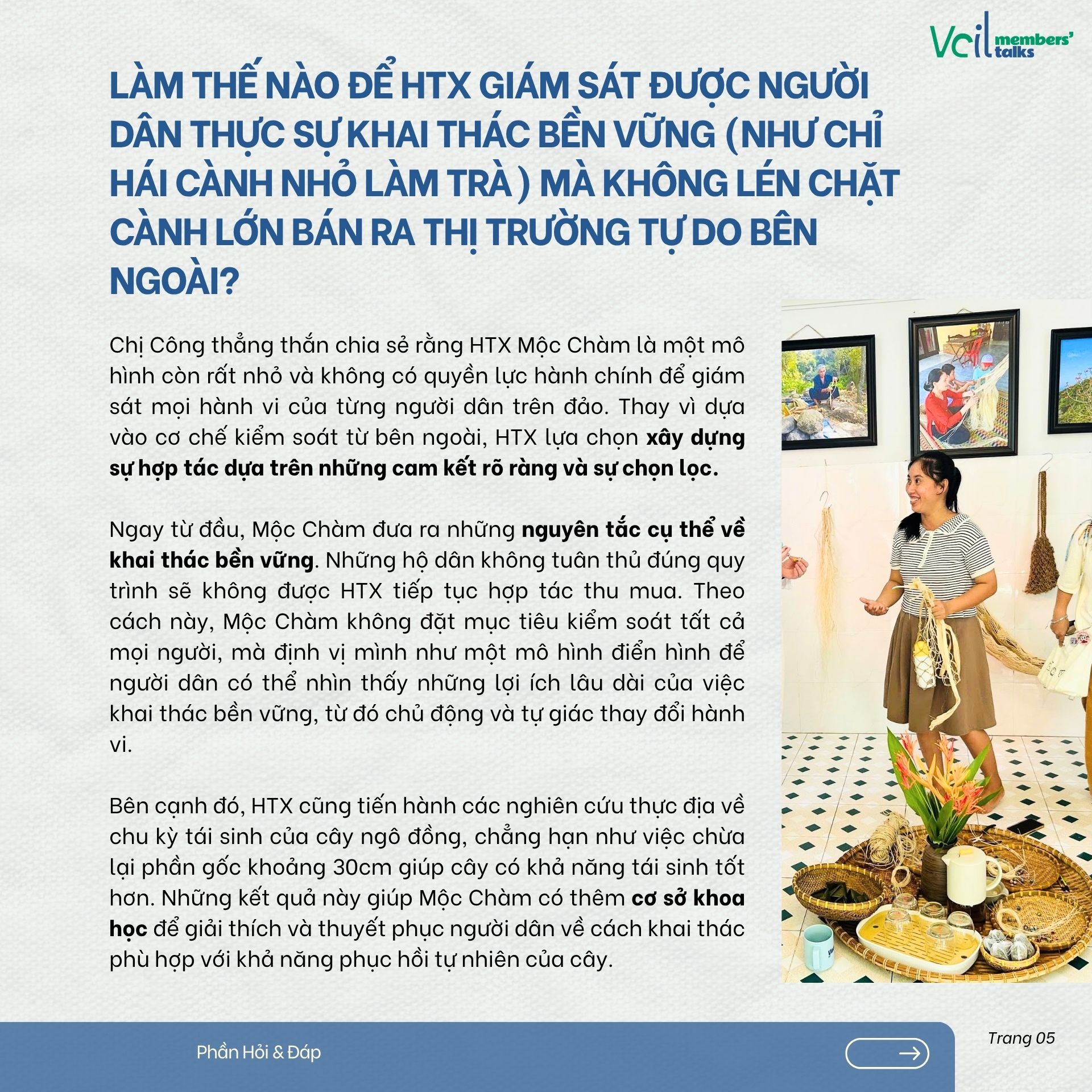
Công said frankly that the Mộc Chàm Cooperative is still a very small model with no administrative power to police every islander's behaviour. Instead of relying on external control, the cooperative chooses to build cooperation on clear commitments and selectivity.
From the start, Mộc Chàm set specific rules for sustainable harvesting. Households that do not follow the process will no longer have their produce bought by the cooperative. In this way, Mộc Chàm does not aim to control everyone; it positions itself as a model in which people can see the long-term benefits of sustainable harvesting, and then change their behaviour of their own accord.
The cooperative also carries out field research on the regeneration cycle of the ngô đồng tree, for instance leaving about 30 cm of the base so the tree regenerates better. These findings give Mộc Chàm a scientific basis for explaining and persuading people to harvest in line with the tree's natural capacity to recover.
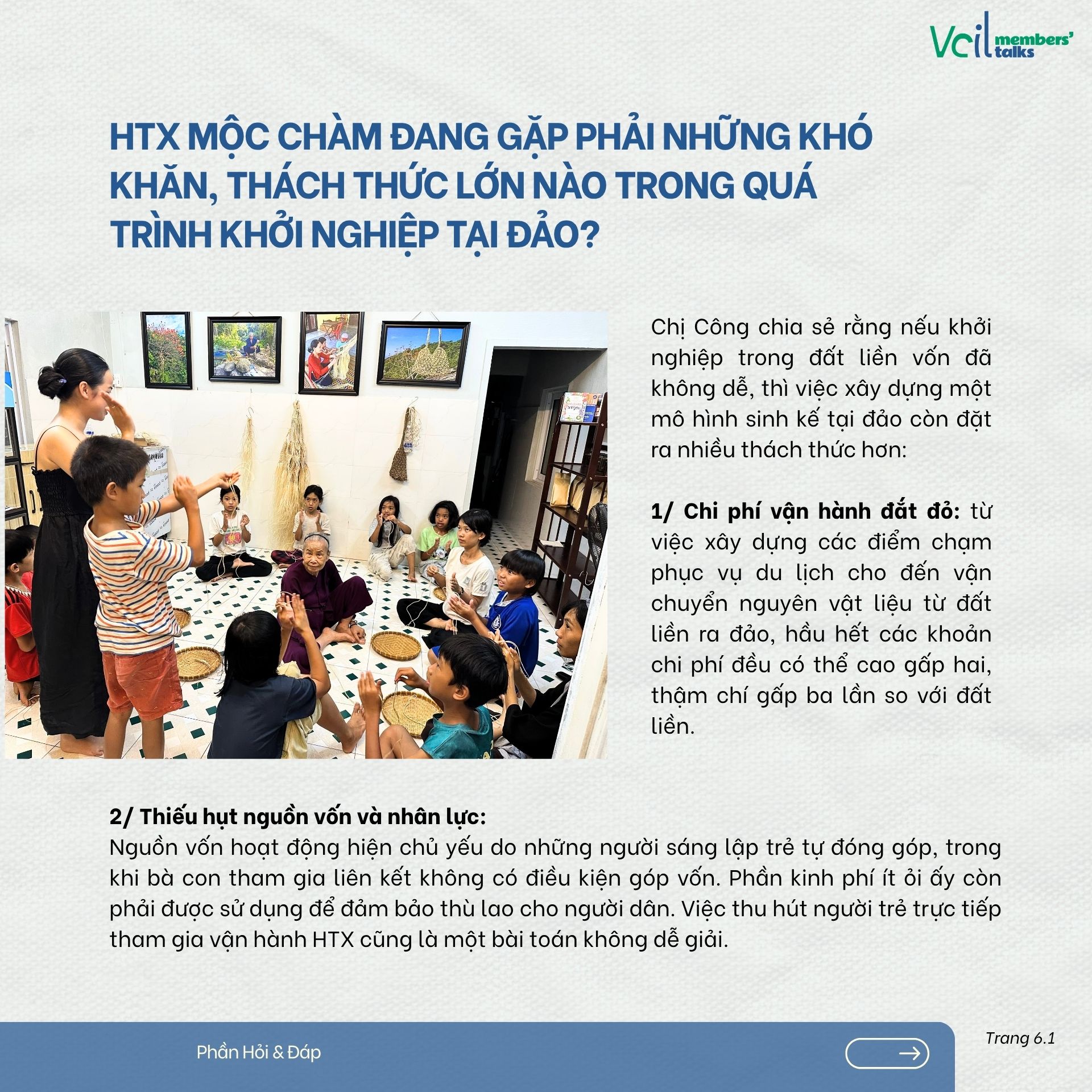
Công said that if starting a business on the mainland is already hard, building a livelihood model on an island poses even more challenges:
1/ High operating costs: from building tourist touchpoints to shipping materials from the mainland to the island, most costs can be two or even three times higher than on the mainland.
2/ Lack of capital and people: operating capital currently comes mainly from the young founders themselves, while the local people who take part are not in a position to contribute capital. That small budget also has to cover fair pay for the people involved. Attracting young people to run the cooperative directly is another hard problem.
3/ Limited administrative capacity: the legal procedures around tax, financial reporting and running a cooperative require specialist knowledge that the founding members are still learning as they go.
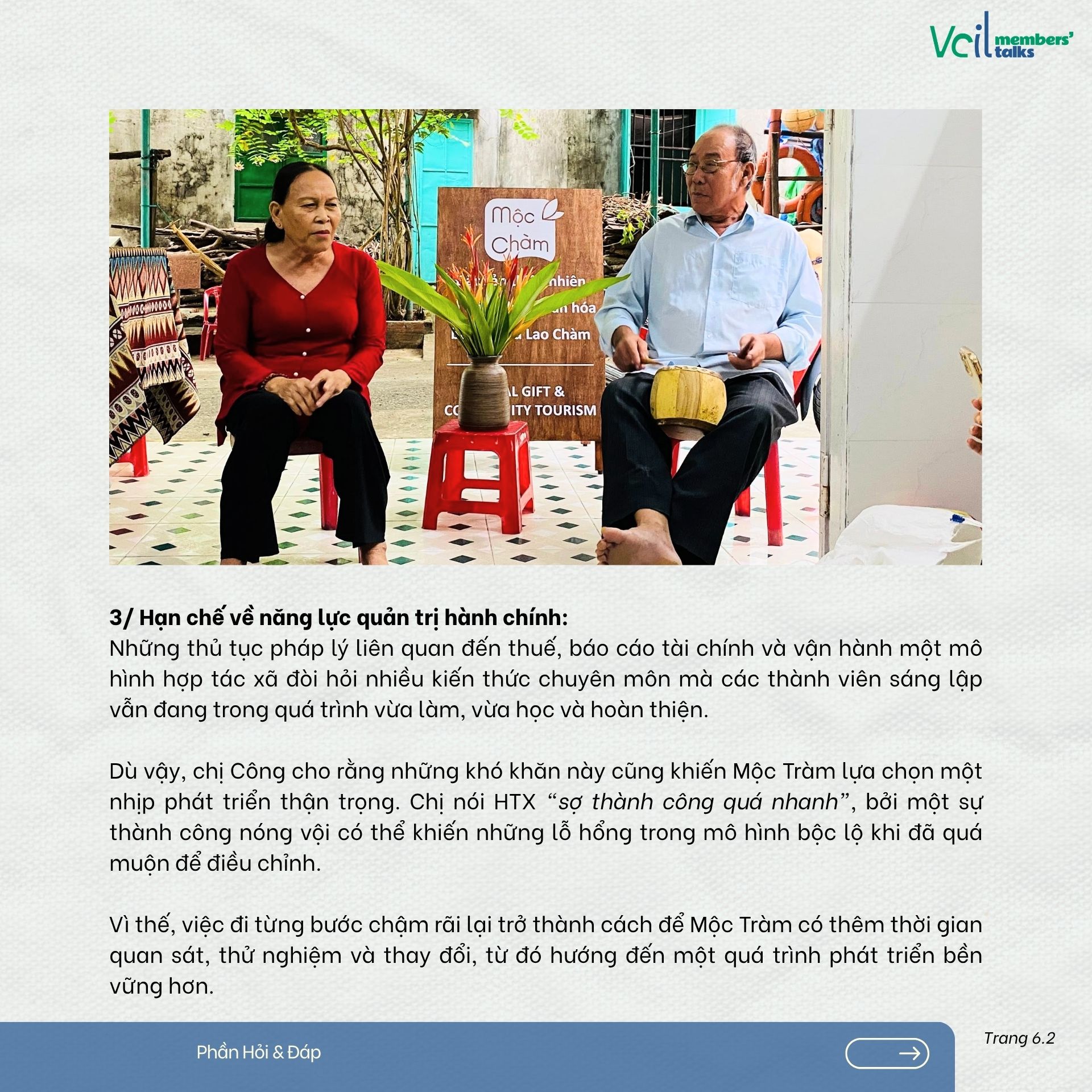
Even so, Công believes these difficulties have led Mộc Chàm to choose a cautious pace of growth. She said the cooperative is “afraid of succeeding too fast”, because hasty success can expose the gaps in a model when it is too late to adjust. Going step by step has therefore become a way for Mộc Chàm to gain time to observe, experiment and change, on the way to more sustainable development.
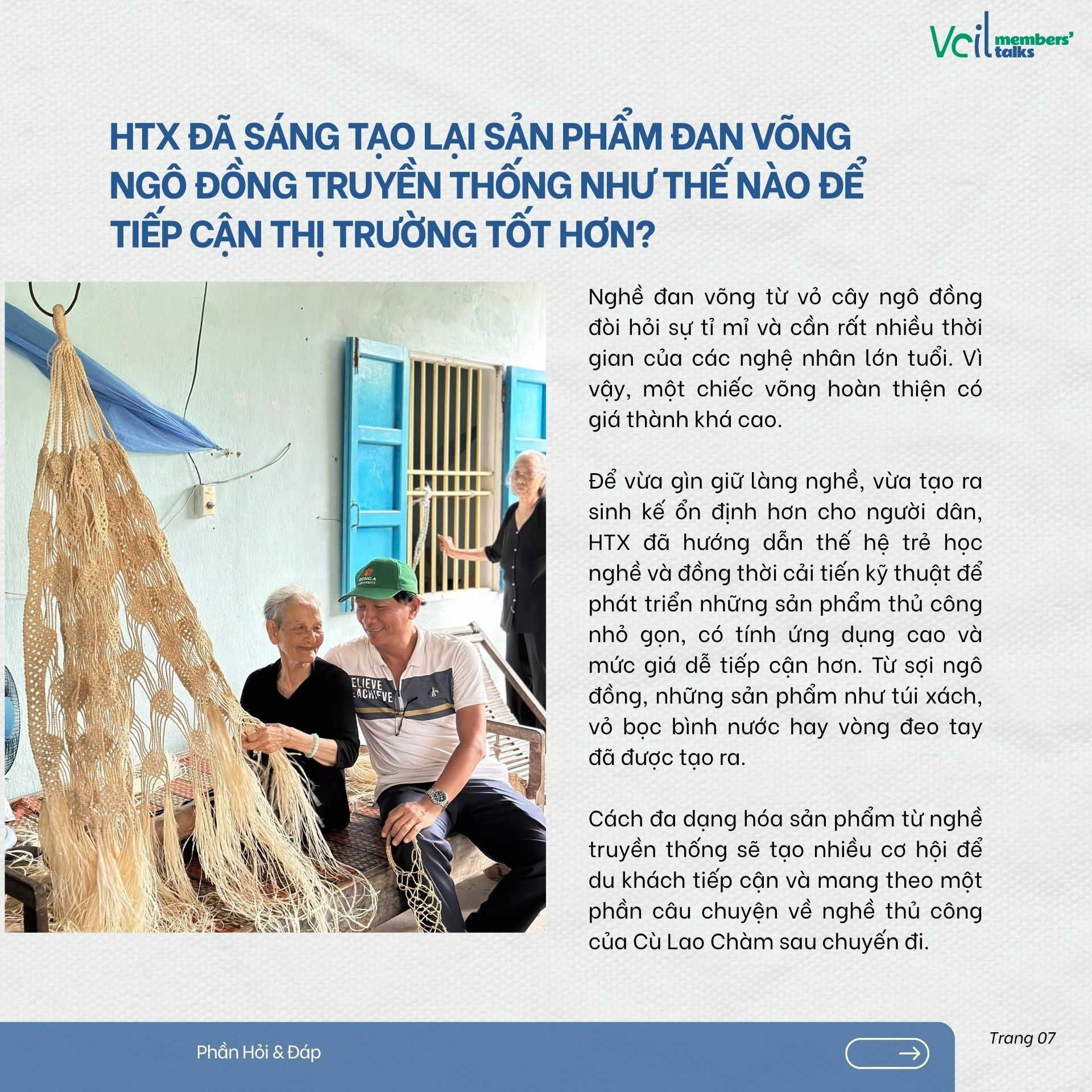
Weaving hammocks from ngô đồng bark demands great care and a great deal of the elderly artisans' time. A finished hammock is therefore quite expensive, which makes it hard for many customers to afford.
To preserve the craft village while creating a more stable livelihood, the cooperative has taught the younger generation the craft and, at the same time, refined the technique to develop small, highly practical handicrafts at more accessible prices. From ngô đồng fibre, products such as bags, water-bottle sleeves and bracelets have been created.
This approach diversifies the products of the traditional craft and creates more opportunities for visitors to engage with, and take home, a piece of the story of Cù Lao Chàm's handicrafts after their trip.
According to Công, every locality has its own cultural and geographical conditions, so a model cannot be copied wholesale from one place to another.
She believes the small population is one of the key advantages that lets Cù Lao Chàm run conservation activities effectively. This is completely different from the pressures facing densely populated islands such as Lý Sơn, especially the problem of waste.
She also cited the story of the island's motorbike-taxi union. Motorbike taxis used to operate quite spontaneously, sometimes leading to touting. The authorities then encouraged the drivers to form a motorbike-taxi cooperative with a mechanism for sharing the daily profit equally.
Since then, the drivers do more than ferry visitors around. They have become photographers, storytellers about the heritage, and friendly faces who help visitors understand Cù Lao Chàm better.
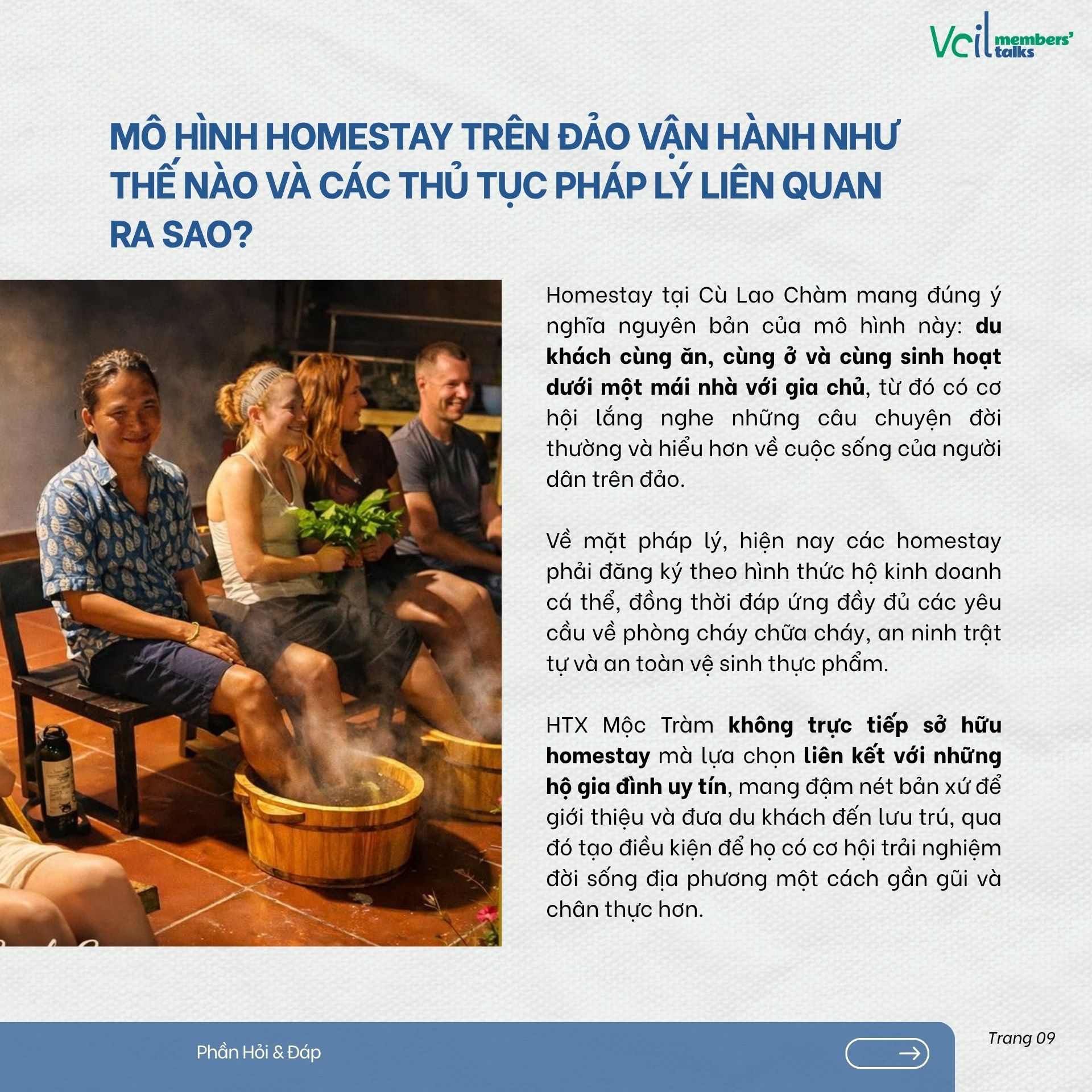
Homestays on Cù Lao Chàm keep the original meaning of the model: visitors eat, sleep and live under the same roof as the host family, giving them the chance to hear everyday stories and understand the islanders' lives better.
Legally, homestays must currently register as individual household businesses and fully meet the requirements on fire safety, public order and food hygiene.
The Mộc Chàm Cooperative does not own homestays itself; it partners with reputable, authentically local families to introduce visitors and arrange their stays, giving them the chance to experience local life in a closer and more genuine way.
Công feels that the key to connection between host and guest lies in sincerity and in other ways of communicating, such as body language.
On Cù Lao Chàm, the homestay community at Bãi Hương receives up to 70% international guests, even though many of the host families speak no English at all. Instead of relying on language, they communicate with visitors through natural gestures, simplicity and hospitality: laying the table together, eating together and sharing everyday moments under one roof.
Tour operators should also not be too rigid in demanding that local people provide luxurious or modern facilities. Sometimes it is precisely the simplicity, the lack of frills and the authentic experience of daily life that become priceless values, moving international visitors and staying in their memories.
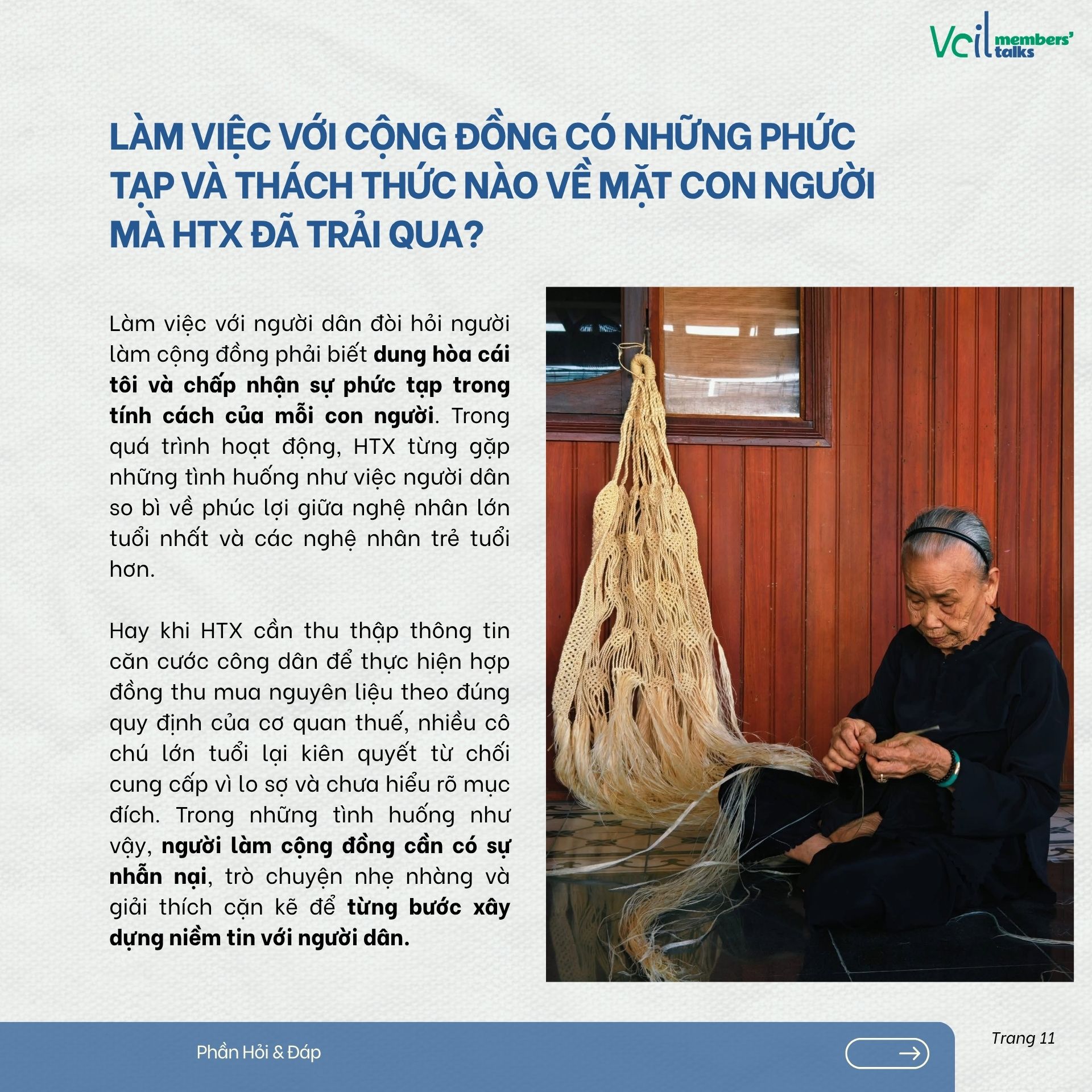
Working with local people requires a community worker to soften their own ego and accept the complexity of each person's character. In the course of its work, the cooperative has met situations such as people comparing benefits between the oldest artisan and the younger ones.
Or, when the cooperative needed to collect national ID details to sign purchasing contracts as required by the tax authorities, many elderly people flatly refused out of fear and a lack of understanding of the purpose. In such situations, the community worker needs patience, gentle conversation and thorough explanation to build trust with people step by step.
____
Closing the conversation, Công expressed her hope that conservation will no longer be a task standing outside of life, but that keeping these things alive will become part of livelihoods, of pride, and of how the community chooses to go on living with its homeland.
_______
Vcil Members' Talks is a monthly event series open to the public, where stories, initiatives and regenerative models from the ecosystem of Vcil community members are shared. Vcil Members' Talks is not just a place to listen, but a space to learn together, widen networks and nurture a spirit of collaboration for a regenerative future.
Details of Vcil Members' Talks #12 will be announced soon on the Fanpage. Follow the Zalo group, Substack or Facebook for the latest updates.
If you are interested in sustainable/regenerative production models, or in connecting with the individuals, organisations and communities building a society of well-being and regeneration, Vcil Community invites you to explore and join Vcil Community Membership for the chance to live, learn, work and collaborate with members who share your values.
Nội dung đầy đủ của bài viết này chỉ dành cho Hội viên Vcil. Đăng nhập để đọc tiếp phần còn lại.