You are using the member interface.
Log out of the member interface →

Gyeongju today is often called “the museum without walls”. Grass-covered burial mounds sit beside city streets; palace foundations, ponds, an observatory and temples connect with mountains, fields and residential areas. But if we see Gyeongju only as a collection of beautiful ancient sights, we miss what matters most: this was the seat of power of Silla, a kingdom that lasted nearly a millennium and profoundly shaped Korean art, religion, statehood and historical memory.[1][2]
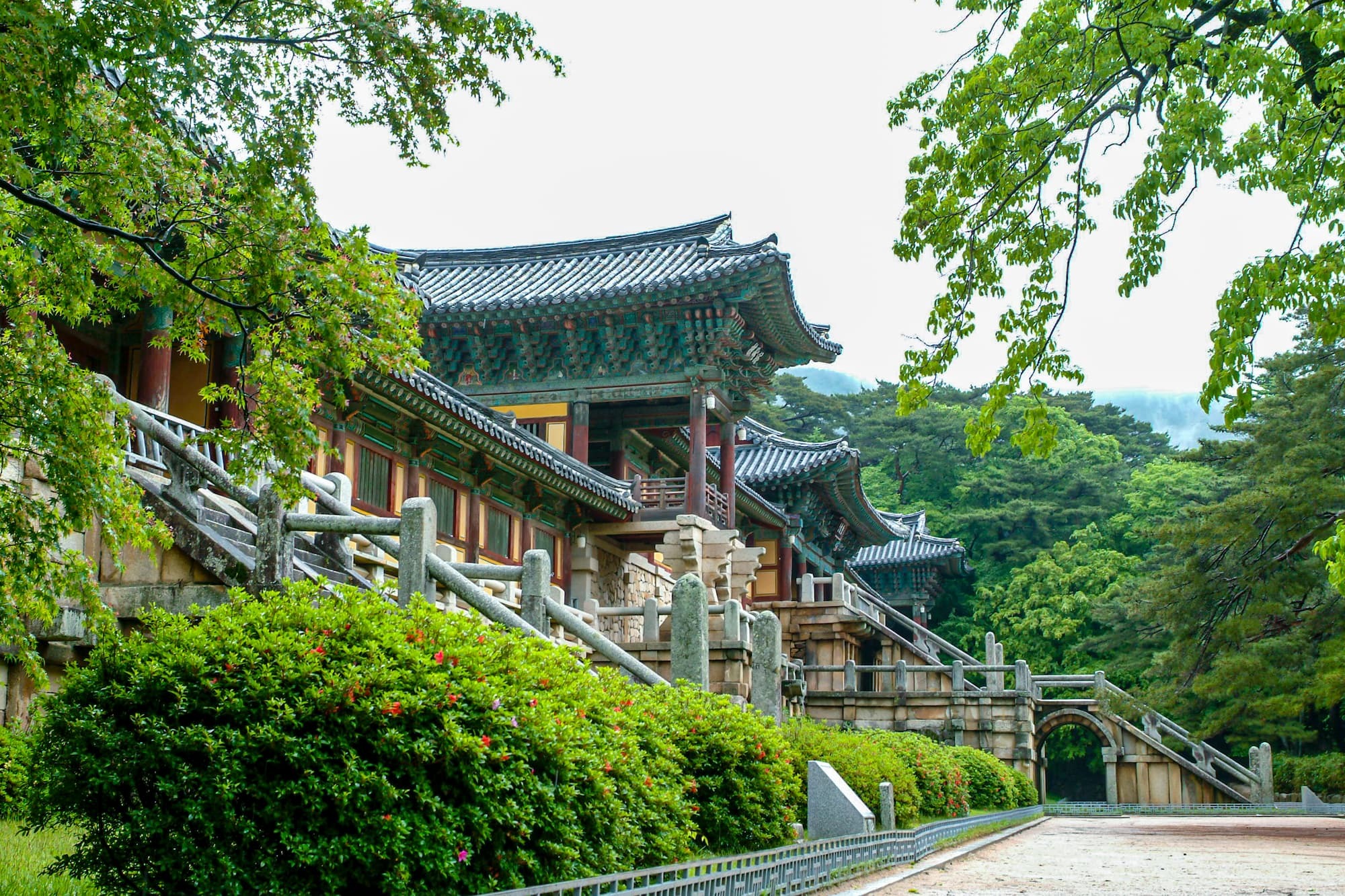
The capital's ancient name was Seorabeol or Geumseong. From a small polity in the south-east of the peninsula, Silla gradually absorbed local confederations, competed with Baekje and Goguryeo, allied with and then fought the Tang dynasty, and finally controlled most of the southern peninsula. Gyeongju is therefore a place where one can read, at the same time, a story of cultural creativity and a story of power: who built the capital, who was allowed to live near the centre, who could hold office, who was buried with gold, and who left almost no name in the records.
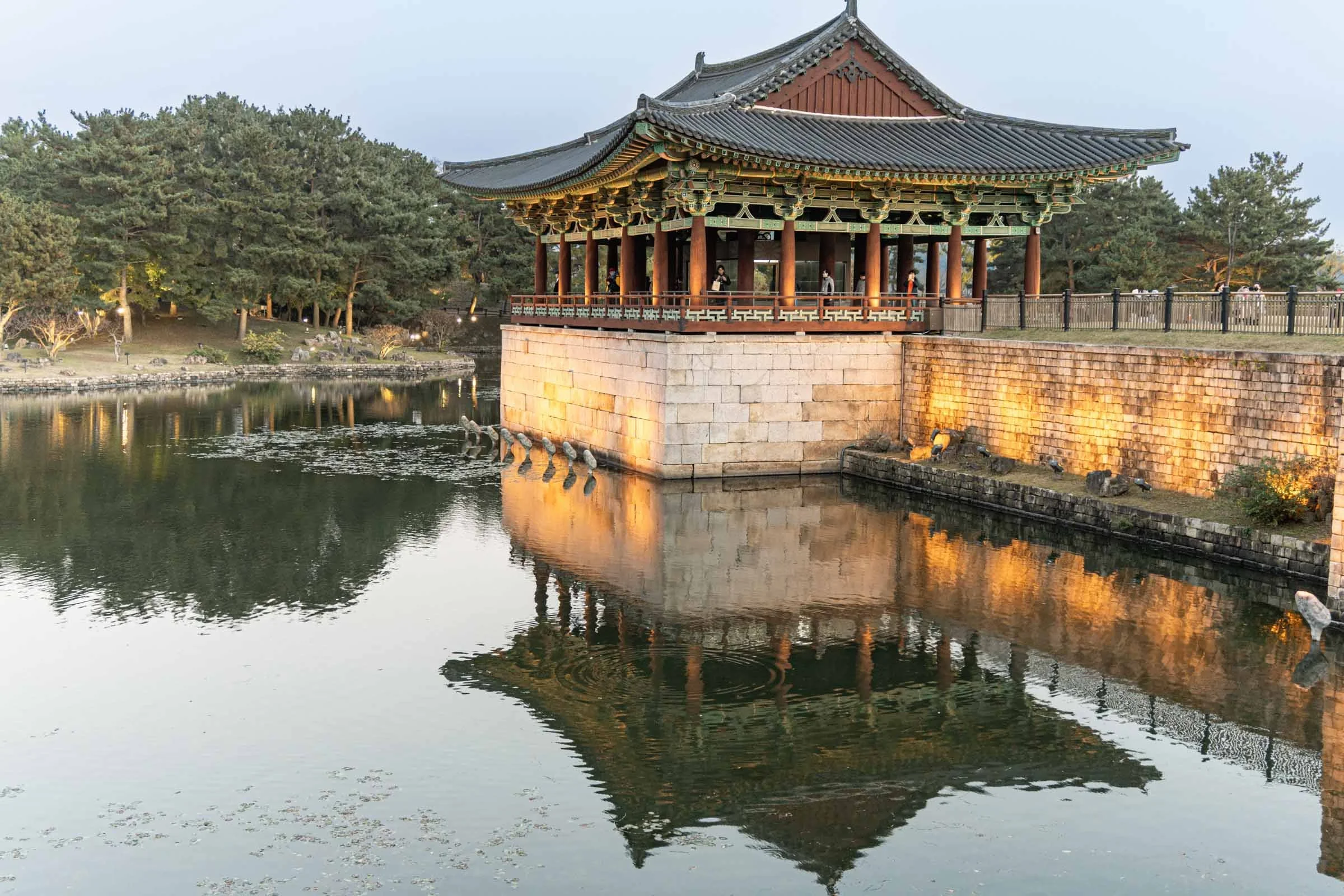
By the traditional chronology, Silla was founded in 57 BCE and ended in 935, spanning 56 monarchs, including three queens.[3] Archaeologists are more cautious about the early period, since the histories were compiled many centuries later. Early Silla can be understood as Saroguk, one of the polities of the Jinhan confederation in the south-east of the peninsula, which gradually concentrated power around the Gyeongju area.
In the first centuries the throne was shared among the Bak, Seok and Kim clans. From around the 4th century the Kim clan became dominant, royal power was consolidated and Gyeongju developed into the centre of a territorial state. The great burial mounds of the 4th–6th centuries, with wooden coffins under thick layers of stone and earth, show the ruling class's enormous capacity to mobilise labour.[1]
Silla was later than Goguryeo and Baekje in adopting state institutions and Buddhism from the mainland. But coming “late” did not mean being passive. The kingdom selected outside influences, kept native symbols and gradually created its own culture of power, clearly visible in its gold, its funerary rituals and the landscape of Gyeongju.
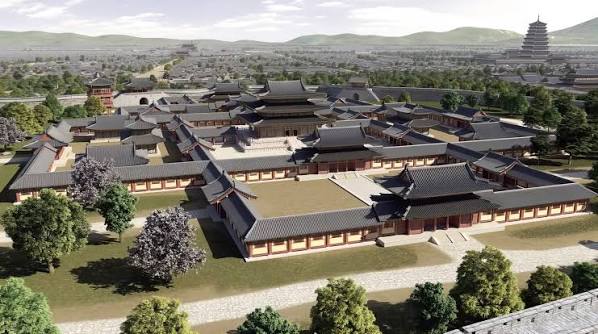
Silla officially recognised Buddhism in 527 under King Beopheung. This adoption was more than a change of faith. Buddhism gave the monarchy a universal language, a network of scholarship and ritual, and the image of a king who protects the Dharma. It helped tie local communities into a wider order and placed Silla within the East Asian Buddhist world.
Great building projects turned religion into material power. Hwangnyongsa, begun on the orders of King Jinheung in the 6th century, was once the largest temple ever built in Korea, covering around 72,500 m². Its nine-storey wooden pagoda, roughly 80 metres tall, was raised in 645 under Queen Seondeok. The structure no longer exists, but its foundations reveal the scale of labour, technology and resources the state could mobilise.[1]
The religious and political layers cannot be separated. The nine storeys of the pagoda are usually interpreted as a symbol of protecting Silla from the powers around it. A sacred landscape was also a map of the state's ambition.
By the 8th century, Bulguksa and Seokguram represented the peak of Silla Buddhist art. UNESCO describes Bulguksa as the realisation of the Buddhist realm on earth, while Seokguram expresses enlightenment through an artificial stone grotto and a set of granite sculptures. The two sites are material expressions of faith and, at the same time, achievements in architecture, geometry, sculpture and the organisation of labour.[4]
Silla had three female monarchs: Seondeok, Jindeok and Jinseong. Queen Seondeok reigned from 632 to 647 and is associated with Cheomseongdae and the building of the nine-storey pagoda of Hwangnyongsa. That an ancient society had queens is noteworthy, but we should not rush to see Silla as a gender-equal society.
Women's ability to succeed to the throne was tied to the logic of the bone-rank system: when no suitable man of the highest bloodline was available, lineage could matter more than gender.[5] The three queens are evidence that female power could exist at the very top, but they tell us nothing about how far ordinary women could own property, study or decide their own lives.
What is worth learning is how an extremely stratified structure could still produce exceptions that modern society can read in many ways. Heritage does not speak for itself; the present chooses which questions to ask of it.
In the 7th century, North-East Asia was an arena of international war, not the internal story of three states that already shared a single national identity. Squeezed between Baekje and Goguryeo, Silla sought an alliance with the Tang dynasty.
The Silla–Tang alliance defeated Baekje in 660 and Goguryeo in 668. The Tang then tried to bring the former territories under its own rule. Silla turned to fight its former ally and, by 676, had pushed Tang forces out of most of the southern peninsula.[6]
This outcome expanded Silla's territory, population and resources, and set the stage for a period of strong growth in cities, art and religion. Yet calling it “the unification of all of Korea” is a modern narrative that should be used with care.
Silla did not control all of the former Goguryeo territory. In 698 Balhae was founded in the north and lasted until 926. Some historians therefore use the concept of the North–South States period, with Silla in the south and Balhae in the north. A 2025 study argues that the term “unification of the Three Kingdoms” is no longer an uncontested label; it reflects modern debates about nation, centre and periphery.[7][8]
A balanced reading is this: Silla integrated most of the people and territory of the three kingdoms in the south, creating a new political order with a lasting influence; but this was unification by war, international alliance and uneven absorption, not the inevitable result of an already united nation.
Gyeongju after 676: capital of a wide world
After the wars, Gyeongju entered a period of prosperity. The capital concentrated palaces, temples, aristocratic residences, markets, roads, ponds and gardens, and workshops. Wolseong was the palace complex; Wolji, better known as Anapji, was the pond within the palace grounds; Cheomseongdae embodies a tradition of astronomical observation; and Namsan became a Buddhist landscape with statues, reliefs, temples and pagodas spread across the mountain.[1]
Gyeongju was not an isolated city on the edge of Asia. The artefacts in the royal tombs include gold, glass and ceramics; some objects or styles originate from regions between China and the Mediterranean. The Metropolitan Museum describes Silla as a small kingdom that rose to prominence, embraced cosmopolitanism and preserved treasures crafted along trans-Asian routes of exchange.[9]
This does not mean Gyeongju was “the end of the Silk Road” along a single simple route. Goods and styles could travel through many intermediaries, by trade, diplomatic gifts or the movement of people. What is more certain is that the Silla elite belonged to a widely connected world, able to absorb and then transform foreign influences.
Ancient sources describe Silla as “the land of gold and silver”. From the 4th to the 6th century, royalty and aristocrats built great burial mounds and were buried with gold crowns, belts, earrings, weapons and ornaments. Six Silla gold crowns are known today; five were excavated from five tombs in Gyeongju, and the Gyeongju National Museum displayed all six together for the first time in its 2025–2026 exhibition.[3][10]
The tree branches, antler shapes and curved jade pieces on the crowns may relate to native symbolism, power or the sacred world, but their exact meaning is still being studied. What is clearer is that the technique of thin gold sheeting and the details that tremble in the light created a powerful image of authority.
Gold did not merely demonstrate “artistic skill”. It created distance between rulers and ruled, turning hierarchy into spectacle. When looking at a crown, it is worth asking two things: whose hands made this beauty, and what social order needed that beauty to appear legitimate?
UNESCO inscribed the Gyeongju Historic Areas in 2000 as a serial property of five areas, with a total area of 2,880 ha and a buffer zone of 350 ha.[1]
The Namsan Belt covers 2,650 ha. At the time of inscription, archaeology had identified the remains of 122 temples, 53 stone statues, 64 pagodas and 16 stone lanterns, along with traces of nature worship predating Buddhism. The mountain is not a backdrop but a sacred space that was carved, built upon and walked through.[1]
The Wolseong Belt includes the Wolseong palace foundations, the Gyerim forest, Wolji and Cheomseongdae. Here political power, origin legends, royal landscape and astronomical knowledge are all present together.
The Tumuli Park Belt consists of three groups of royal tombs. The wooden-coffin structure covered in stone made intrusion difficult, so many grave goods were preserved. The mounds, like small hills, bring the dead into the everyday landscape of the city.
The Hwangnyongsa Belt includes the foundations of Hwangnyongsa temple and Bunhwangsa. On one side is the empty space of a once colossal structure; on the other, a stone pagoda built in 634 still stands. The absence at Hwangnyongsa matters as much as the objects that remain: it lets us imagine history through evidence rather than a finished reconstruction.
The Fortress Belt contains defensive structures at strategic locations, including Myeonghwal Mountain Fortress. It reminds us that the prosperity of the capital always went hand in hand with the need for control and defence.
UNESCO rates the site highly for authenticity because many monuments have been kept in place, with little arbitrary reconstruction and interventions based on archaeological evidence. At the same time, it warns that the height and design of new buildings, urban encroachment and traffic could break the visual integrity of the site.[1]

The museum organises its Silla history gallery into three parts: the formation of the kingdom; the tradition of goldwork; and the conquest of the Three Kingdoms together with the culture of the period after 668. The Silla art gallery focuses on Buddhist sculpture and artefacts from temples such as Hwangnyongsa, Bunhwangsa and Gameunsa.[2]
This arrangement creates an easy-to-follow storyline: formation, the power of gold, expansion and cultural flowering. But learners should read the museum on two levels. The first is what the artefacts say about technology, belief and international relations. The second is what a modern museum chooses to place at the centre, what it calls the wars, and how much space it gives to commoners, labourers, the conquered, or Balhae.
A museum does not only preserve the past; it produces a present-day understanding of the past.
The records and the exhibitions lean towards kings, wars, temples and gold, because those things were written down and lasted. But Gyeongju could only function thanks to the farmers who supplied food, the miners and metalworkers, the carpenters and stonemasons, the road builders, the people who tended the palace, the merchants, and the communities integrated after the wars.
Roof tiles, tools, pottery and traces of housing help widen the story, but the imbalance remains. The more magnificent a structure, the more it invites questions about the resources and the labour regime behind it. This is not a way of denying the heritage, but of putting people back into its beauty.
From the late 8th century, succession disputes and conflicts among aristocratic clans weakened the centre. The bone-rank system limited the opportunities of the educated classes; landowners and local military powers grew ever more autonomous; the burden on farmers and the resulting uprisings eroded the tax and labour base.
The extreme concentration on Gyeongju also became a weakness. A system built around the privileges of the capital struggled to integrate wide and diverse territories effectively. In the late 9th century, local powers founded Later Baekje and Later Goguryeo, opening the Later Three Kingdoms period. In 935 King Gyeongsun submitted to Goryeo, bringing Silla to an end.
The collapse reveals a paradox: the blood-line institutions that once stabilised the elite made the system inflexible; the capital that once concentrated resources left the centre detached from the regions; and the religion that once reinforced legitimacy could not by itself resolve the distribution of power and wealth.
1. UNESCO World Heritage Centre, “Gyeongju Historic Areas”: https://whc.unesco.org/en/list/976
2. Gyeongju National Museum, “Permanent Exhibitions”: https://gyeongju.museum.go.kr/kor/html/sub01/ajax/0101_ajax_4.html
3. The Metropolitan Museum of Art and National Museum of Korea, Silla: Korea's Golden Kingdom: https://resources.metmuseum.org/resources/metpublications/pdf/Silla_Koreas_Golden_Kingdom.pdf
4. UNESCO World Heritage Centre, “Seokguram Grotto and Bulguksa Temple”: https://whc.unesco.org/en/list/736
5. Academy of Korean Studies, InfoKorea 2017, section on the Golpumje system: https://www.aks.ac.kr/ikorea/upload/intl/korean/UserFiles/Infokorea_2017_eng.pdf
6. National Institute of Korean History, materials on the Silla–Tang war: https://contents.history.go.kr/front/ta/view.do?levelId=ta_m21_0040_0010_0010
7. Journal of Korean Art and Archaeology, “Unified Silla”: https://www.ijkaa.org/v.13/0/2019
8. Kwon Soon-hong, “When Historical Terms Lose Their Validity: Reevaluating Silla's ‘Unification of the Three Kingdoms of Korea’,” Journal of Northeast Asian History, 2025: https://www.accesson.kr/jnah/v.21/2/121/55754
9. The Metropolitan Museum of Art, “Silla: Korea's Golden Kingdom”: https://www.metmuseum.org/exhibitions/listings/2013/koreas-golden-kingdom
10. Gyeongju National Museum, “Silla Gold Crowns: Power and Prestige”: https://gyeongju.museum.go.kr/eng/html/sub02/0202.html?d_mng_no=219&mode=VD
11. The Metropolitan Museum of Art, “Golden Treasures: The Royal Tombs of Silla”: https://www.metmuseum.org/essays/golden-treasures-the-royal-tombs-of-silla
12. National Museum of Korea, “Gold Crown from Geumnyeongchong Tomb”: https://www.museum.go.kr/ENG/contents/E0403000000.do?relicId=638&schM=view&searchId=rrepresent
13. Kim Bo-Kyoung, “Social Participation Movement of the Lay Buddhist Community Jungto-Society,” 2018, used for comparison with modern engaged Buddhism: https://www.kci.go.kr/kciportal/ci/sereArticleSearch/ciSereArtiView.kci?sereArticleSearchBean.artiId=ART002329007
Nội dung đầy đủ của bài viết này chỉ dành cho Hội viên Vcil. Đăng nhập để đọc tiếp phần còn lại.

International Travel & Experiential Learning Program Uses Context-Based Learning Methods in a Multicultural Environment