You are using the member interface.
Log out of the member interface →

 ← Bản tin
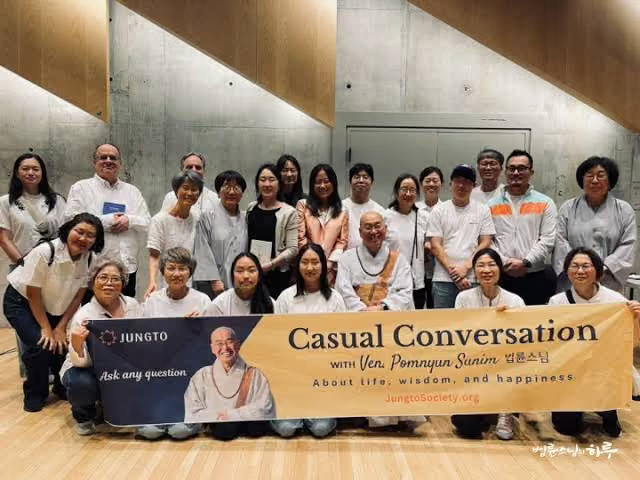
Jungto Society (정토회, roughly “Pure Land Community”) is an engaged-Buddhist community founded by Pomnyun Sunim in South Korea in 1988. The organisation defines itself not simply as a temple, a congregation or a charity, but as a “community of practitioners”: people who together seek a way out of suffering in daily life and together work to make the world better.(Source 1)
Jungto's vision is captured in the image of the “Pure Land”: a place where people are happy, society is peaceful and nature is preserved. These three aspects are not three separate areas of activity. In Jungto's logic, personal unease, social injustice and the ecological crisis are related; inner practice without concern for society is therefore not enough, but social action without looking at the greed, anger and ego of the person acting is hard to sustain.(Source 1)
It is precisely this way of connecting the two that makes Jungto worth studying as an ecosystem for social change, and not only as a religious organisation.
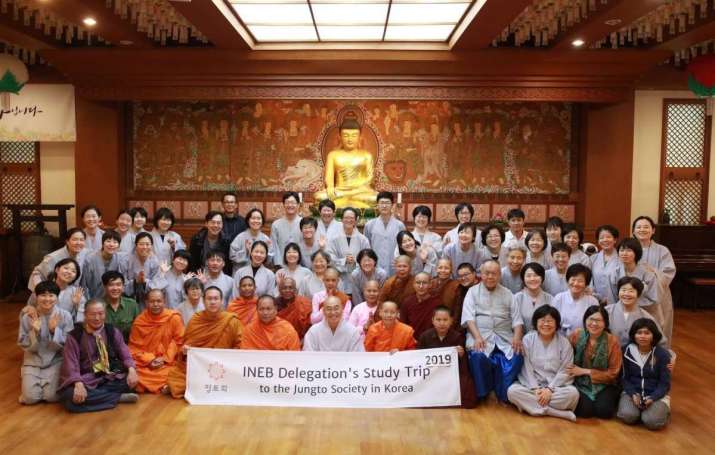
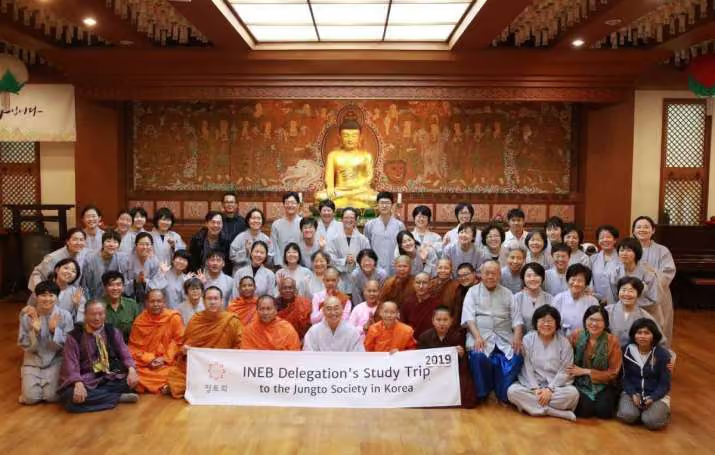
Jungto was born in the South Korea of the late 1980s, which had just emerged from military dictatorship, as the democracy movement and currents of engaged Buddhism were re-asking questions about the social role of religion. A peer-reviewed study from 2022 places Jungto under the influence of Minjung Buddhism and the Korean democracy movement of the 1980s. Instead of continuing a model of Buddhism centred on monasteries and the ordained, Jungto built an urban lay community in which social action is treated as a core part of religious life.(Source 2)
1988: Jungto Society is founded.(Source 1)
1990: the Jungto Training Center is set up to train lay practitioners; according to academic research, the programme once required learners to complete 40 hours of volunteering to receive certification.(Source 2)
1993: Jungto launches its 10,000-day cycle of practice, nearly 30 years, equivalent to the time it takes a generation to grow up.(Source 2)(Source 3)
1996: Good Friends is founded in the context of the North Korean famine and refugee crisis.(Source 4)
1999: the Join Together Society (JTS) is formally established to carry out humanitarian relief and community development; its precursor activities in India had begun earlier.(Source 4)
2002: EcoBuddha is founded to promote ecological living, waste reduction and moderate consumption.(Source 4)
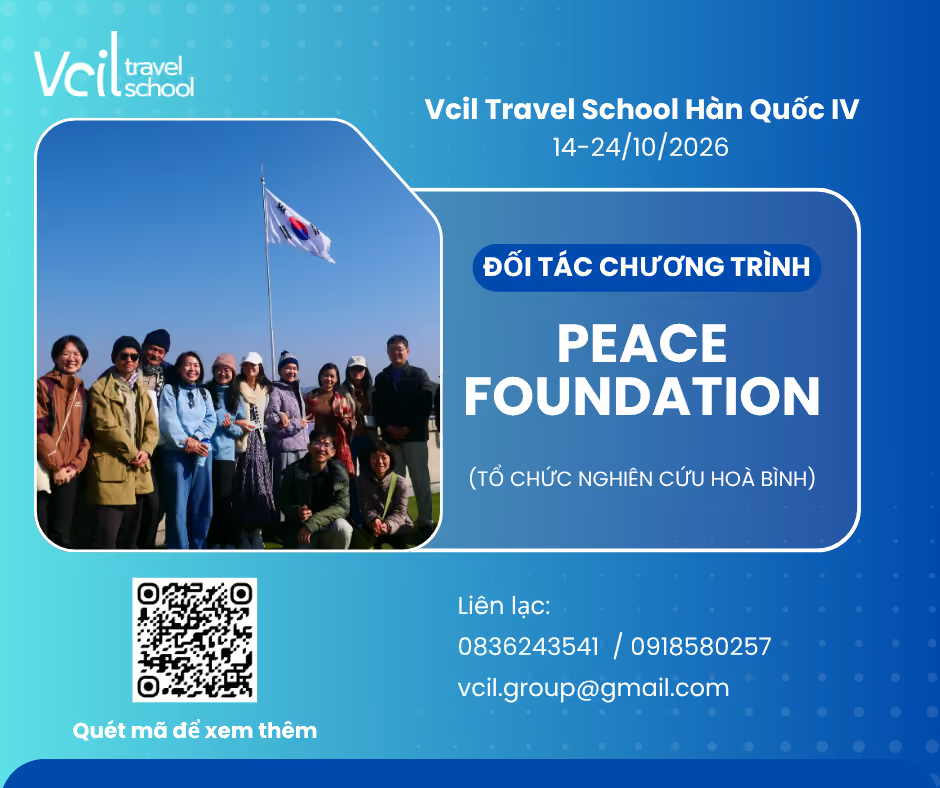
2004: the Peace Foundation is born as a private, non-profit research institute that declares itself non-partisan, working towards lasting peace on the Korean Peninsula.(Source 4)
2020–2021: the pandemic forces Jungto to close its network of around 200 in-person practice centres and move most activity online. According to Pomnyun Sunim, the organisation held around 130 consultations before agreeing on a new understanding: every room where a person practises can become a “dharma hall”.(Source 5)
2023: Jungto completes its first 10,000-day cycle and enters the second.(Source 3)
15/3/2026: around 8,000 people in and outside Korea join online for the opening ceremony of the second 1,000-day period of the new cycle, according to Jungto's own newsletter.(Source 6)
What is notable is not simply the number of years. Jungto has turned its long-term vision into an operating architecture. One hundred days is the rhythm for reviewing habits; 1,000 days, about three years, is the rhythm for personal transformation and organisational review; 10,000 days, nearly three decades, is the rhythm for social change.(Source 3) In a world of projects usually framed by terms of office or one-to-three-year funding cycles, publicly committing to “the timescale of a generation” is a fairly radical choice.
Jungto describes its approach to Buddhism through three qualities:
Right does not mean conservative about ritual; it means trying to strip away preconceptions and return to the fundamental question: why do people suffer, and how can they become freer.
Easy to understand means the teachings must be expressed from the listener's starting point, rather than becoming the privilege of those fluent in scripture.
Practical means that eating, working, keeping house, handling conflict and consuming are all places of practice; the path does not exist in a space separate from life.(Source 1)
Three further slogans express the destination of practice: a clear mind, good friends and a clean earth. They correspond to three layers of change: oneself, social relationships and the living environment.(Source 1)
Pomnyun Sunim is famous for the Dharma Q&A format: a participant raises a specific problem from their life, and the answer usually brings them back to observing how they see their situation rather than promising a blessing. This direct, jargon-light communication focused on real problems keeps Jungto open even to people who do not call themselves Buddhists. Kim Bo-Kyoung's research notes that Jungto pursues “right, easy Buddhism in daily life”, and draws people of other faiths and the general public into organised social action.(Source 7)
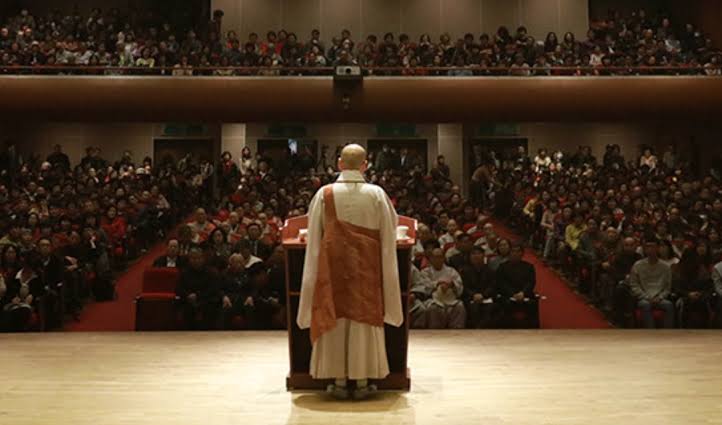
1. Members are not just “believers” but practitioners
Jungto draws a strong distinction between a believer who visits a temple and a practitioner. According to an official explanation in 2026, attending for many years, donating a lot or doing many good deeds does not automatically make someone a core member. They must keep up morning practice, take part in the 100-day cycles and gradually take on responsibility for guiding, organising or serving the community.(Source 8)
This is a stepped mechanism for movement-building: newcomers come in through a course or a dharma talk; learners become practitioners; practitioners become volunteers; some of them go on to be trained to coordinate and train others. Jungto therefore does not merely “attract an audience”; it tries to turn beneficiaries into co-creators.
2. Practice, giving and service form one unified rhythm
According to the peer-reviewed MDPI study, when the 10,000-day programme began in 1993, members were encouraged to set aside time each day for prayer or meditation, contribute a small amount and take part in at least one social project; every 100 days they met again to review, receive assignments and renew their commitment.(Source 2) What matters here is repetition: Jungto does not rely entirely on momentary moral inspiration; it turns values into habits, meeting schedules and concrete responsibilities.
3. “Work is practice”
In Jungto, cooking, cleaning, doing the accounts, running a class or going on a relief mission can all be practice. Work becomes the place where participants observe their own discomfort, desire for recognition, conflict and tendency to blame.(Source 9)
This helps Jungto erase some of the symbolic hierarchy between “sacred work” and “logistics”. But it also raises an important question: if every discomfort at work is interpreted as something to be corrected in oneself, might legitimate grievances about workload, gender, power or governance be individualised? This is a point to observe on the ground; the slogan should not be taken as proof that every relationship in the organisation is equal.
4. An operating infrastructure based on volunteering
Jungto states that all of its internal operations are run by volunteers. The organisation's reasoning is that in a community of practitioners, the employer–employee relationship should not be brought into the shared space; the wealthy must also cook, clean and share responsibility like everyone else.(Source 10)
Its finances, according to Pomnyun Sunim, come mainly from membership fees and members' contributions. He says Jungto has financial headroom not because its income is especially large, but because personnel costs are low thanks to volunteering.(Source 11) This is the explanation of the organisation's leader, not a substitute for audited financial statements.
This model is both a strength and a risk. It lowers costs, creates a sense of ownership and challenges professional hierarchy. But it can exclude those without the time or resources for unpaid labour; blur the line between commitment and pressure; and create a risk of burnout. Jungto itself acknowledged at the end of 2025 that its full-time resident lay workforce is only around 100 people, while the organisation believes it needs at least 500 to run its current scale of projects stably.(Source 12)
5. Organising in three-year cycles with reflective practice
The 1,000-day rhythm is not only for individuals. Jungto says projects, rules and terms of office are usually set within cycles of roughly three years, followed by a period of around 90 days for review, reflection and preparation for the next cycle.(Source 3) This is a way of building “non-attachment” into institutional design: a structure is not assumed to be permanent just because effort went into building it.
The decision to close around 200 physical centres when moving online is a powerful example. It reduced dependence on physical facilities and widened access, but Jungto has also said publicly that the rapid shift weakened face-to-face interaction, community vitality and the ability to attract the younger generation; the old structure was only moved online, not completely redesigned.(Source 13) This admission is notable because it shows the organisation is capable of self-criticism, though it does not prove that every dissenting voice carries equal weight.
6. A specialised ecosystem rather than one organisation that does everything
Jungto turns values into action through four affiliated organisations:
Welfare and humanitarian work: Join Together Society (JTS). Education, healthcare, relief and community development in India, the Philippines, Bhutan and crisis regions. JTS reports four branch offices, consultative status with the UN's ECOSOC, volunteer-run operations and 97% of resources delivered to those in need. The 97% figure is self-reported.(Source 4)
Environment: EcoBuddha. “Empty bowls”, fewer single-use items, zero waste, ecological education and moderate living. The environment is not treated only as an outward campaign: how members eat, buy and dispose of waste is part of internal discipline.(Source 4)
Human rights and peace: Good Friends. Support for North Korean refugees, research and reporting on life in North Korea, peace and history education. Formed in response to the North Korean famine of the mid-1990s; its work in sensitive areas shows an ability to operate in the gap between humanitarian and political work.(Source 4)
Research and peace-building: the Peace Foundation. Research, public education, dialogue and policy proposals on peace, security and reunification of the peninsula. Declares itself independent and non-partisan; provides a policy-research space complementing advocacy and relief.(Source 4)
This division of roles is an organisational innovation worth learning from: one shared foundation of values, but each issue has its own legal entity, capacity and method. Humanitarian relief is not conflated with policy research; environmental advocacy is not a side task of a general charity.
The organisation currently operates in more than 15 countries, with more than 10,000 active members and four NGOs.(Source 1) The opening ceremony of the 1,000-day cycle in March 2026 drew around 8,000 online participants, according to Jungto's newsletter.(Source 6) Academic research from 2022 records that before the pandemic the organisation had around 200 sites in Korea and 30 abroad; that figure reflects the old model, before the physical centres were closed and activity moved heavily online.(Source 2)(Source 5)
On social impact, the strongest evidence available lies not in a single total of beneficiaries but in four kinds of impact:
1. Institutional impact: sustaining four specialised organisations for 20–30 years, working from ecological living to humanitarian aid and peace research.(Source 4)
2. Impact on participants: creating a pathway for lay people to become practitioners, volunteers and organisers. Independent research from 2018 finds that Jungto has sustained social action systematically and continuously and expanded the role of lay people beyond the monk-centred model of Buddhism.(Source 7)
3. Cultural impact: bringing the idea that eating, consuming, working and everyday relationships are moral and social matters into mainstream life; opening Buddhism to people not drawn to ritual or technical vocabulary.(Source 1)(Source 7)
4. Cross-border impact: JTS delivers education, healthcare, village development and relief in many Asian countries; Good Friends and the Peace Foundation bring North Korea, refugees and peace on the peninsula into research and public education.(Source 4)(Source 14)
However, Jungto's international site does not yet show a consolidated, independently audited impact report that would fully answer: how many volunteers each year, how many hours of labour, how many beneficiaries, the member-retention rate, the diversity of leadership, real costs and long-term impact. So 10,000+ members or 97% of resources should not be used as the sole proof that the model works. This is a data limitation to note, not a reason to dismiss the organisation's contribution.
1. De-professionalising religious power
Jungto does not merely invite lay people to assist monks. It places lay people in the position of practitioner, organiser and guide. Kim Bo-Kyoung argues that Jungto members aim to become the creators of their own happiness, rather than disciples following a particular leader.(Source 7) This is a significant reversal in a traditional context where knowledge, finance and the authority to interpret are usually concentrated among the ordained.
2. Not separating “self-healing” from structural change
Many spiritual-care movements stop at helping individuals adapt; many social movements can overlook how power and harm are reproduced within their own ranks. Jungto tries to put both on the same track: changing how one sees oneself and changing social conditions. Having a Peace Foundation doing policy research alongside meditation practice is a clear expression of this logic.
3. Turning moderation into a resource model
Jungto does not only advocate simple living as a moral message. It uses low costs, small repeated contributions and volunteer labour to build the organisation's infrastructure. A 2025 statement even described “pausing consumption” and sharing the surplus as an experiment for a future civilisation.(Source 15) What is radical here is the effort to make the means of operation consistent with the message. The downside is that the model still has to answer who has enough privilege to live on unpaid labour.
4. Using long time-frames to resist “project-ism”
A 10,000-day vow forces the organisation to think beyond campaigns, grants and leadership terms. At the same time, the 100-day and 1,000-day cycles create checkpoints short enough to adjust. This is a rare combination of strategic patience and regular reflection.
5. Willingness to dismantle infrastructure it has built
Closing around 200 centres after more than three decades of expansion shows that Jungto is able to let go of assets and structures when the context changes.(Source 5) But the online experiment also exposed an opposite lesson: efficiency of reach does not automatically create belonging, collective energy or young leadership.(Source 13)
6. Creating a “federation” of social action
Instead of forcing a single religious organisation to do relief, environment, security research and human-rights protection all at once, Jungto created specialised organisations connected by one philosophy of practice. This structure allows shared values to travel with different professional capacities.
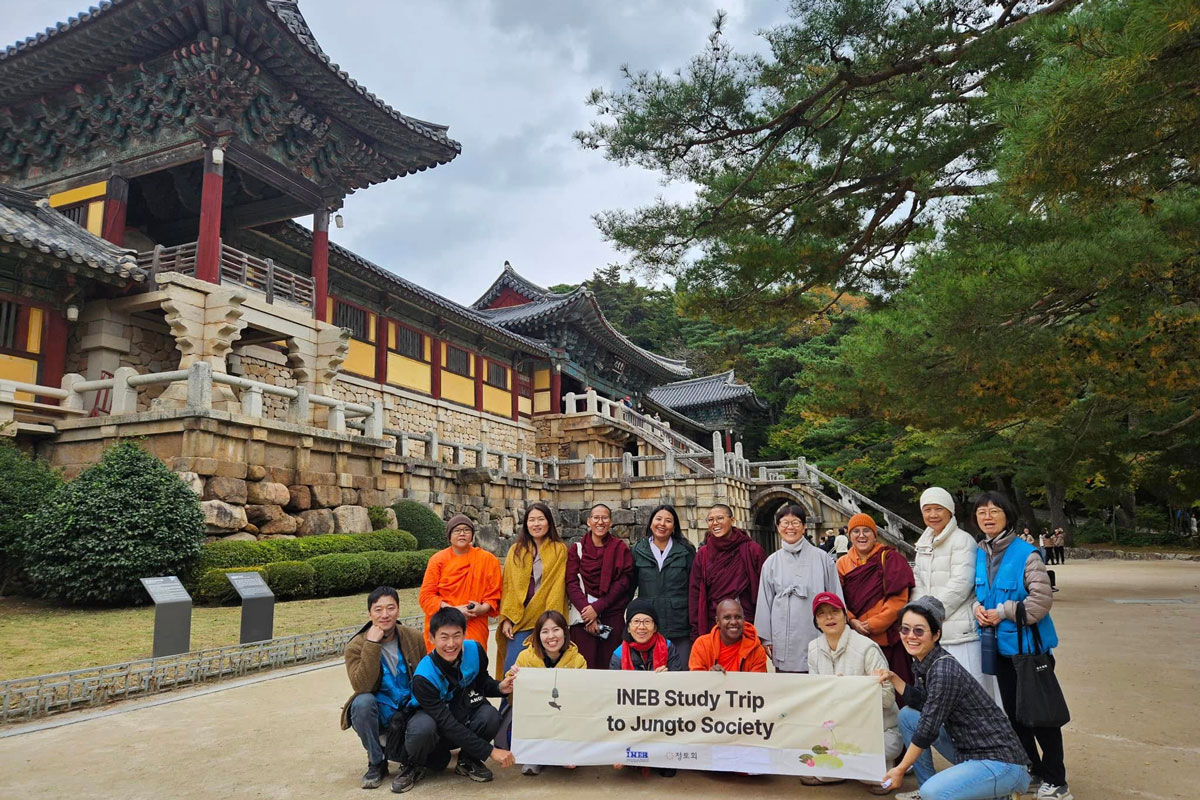
The first thing worth learning is the architecture of commitment. Many Vietnamese initiatives have beautiful values but depend on an exhausted founding group. Jungto suggests that values must be turned into a rhythm of life: a small daily practice, a peer group, a cycle of reflection, a pathway to taking responsibility, and an institution specialised enough to act.
Second, train participants to become organisers. If every programme only creates more audience or beneficiaries, the movement does not regenerate itself. A more durable community needs to give newcomers a path to learn, try things out, lead and eventually train others.
Third, bring values backstage. An environmental organisation cannot simply run green events while operating on wasteful consumption; a community organisation cannot talk about equality while care work always falls on the same group of people. Jungto is worth observing precisely in its meals, cleaning rotas, division of tasks and review sessions.
Fourth, design on two timescales: long enough to pursue structural change, short enough to correct mistakes. A Vietnamese group need not commit to 10,000 days, but it can set a ten-year vision with a 90-day or one-year learning cycle.
What should not be copied mechanically is the system of unpaid labour, member discipline or religious symbolism. The question to transpose is: how to create a sense of ownership while still paying fairly; create depth without becoming closed; create reflective practice without neutralising dissent; and sustain a long-term vision without depending on a single moral leader.
The days of living and working with Jungto at Dubuk should not be understood as a “tour of a Buddhist organisation”. It is a living laboratory for observing how values are turned into organisation.
Look at the seemingly small details: who gets up early and why; who prepares the meals; whether work is chosen or assigned; whether newcomers may refuse; whether there is space for reflection at the end of the day; how coordinators handle disagreement; what the organisation says about money; what long-term volunteers receive in return; and whether the voices of the communities being supported appear in the way Jungto tells its story.
Three layers should be held side by side throughout the trip:
1. Spirit: what does Jungto believe about people, suffering and society?
2. System: how is that belief turned into schedules, roles, budgets, training and decisions?
3. Consequences: what change does the system create, for whom, and with what costs or blind spots?
If we only listen to the philosophy, we may idealise Jungto. If we only look at the processes, we miss the moral energy that keeps the system alive. The value of this destination lies precisely in the ability to see both at once.
1. What steps does a newcomer go through to become a member, a coordinator and a decision-maker?
2. Who decides the priorities for the next three years? By what mechanism can an ordinary member object to or change a decision?
3. How does Jungto measure the health of the organisation beyond membership numbers and activity counts?
4. How many volunteer hours are contributed each year? What is the rate of leaving, and why do people leave?
5. How does Jungto prevent burnout and distribute care work across genders?
6. How does “work is practice” help handle conflict? Is there a mechanism to ensure a structural critique is not reduced to a personal psychological problem?
7. How is power currently distributed among Pomnyun Sunim, the president, the executive council, full-time lay workers and the membership community?
8. What is the succession plan for the founder?
9. After moving online, how is Jungto rebuilding local relationships and attracting young people?
10. How far do the communities receiving support take part in designing, budgeting and evaluating projects?
11. What impact figures and financial reports can be made public for outside verification?
12. Which parts of the Jungto model could survive in a completely non-religious community?
Jungto Society is special not because it has found a perfect formula. What is remarkable is that it has persistently tested a big hypothesis for nearly four decades: that people can cultivate inner freedom and build the capacity for collective action at the same time; that a social movement can be nourished by daily practice and not only by outrage or inspiration.
Jungto's achievement lies in creating an ecosystem with depth of time, a volunteer infrastructure, a training pathway for lay people, and specialised organisations for the environment, human rights, welfare and peace. Its weaknesses also stem from that very structure: high commitment, unpaid labour, incomplete impact data and the risk of symbolic power concentrating in the founder.
So the best lesson from Jungto is not “do it like them”, but: learn how to turn values into practice, practice into community, community into institutions, and keep asking who holds power, who bears the cost and who really benefits.
1. Jungto Society, “About Jungto Society”: https://www.jungtosociety.org/about
2. Mark A. Nathan et al., “Korean Buddhist International Aid Work: A Critical Comparison of the Join Together Society and the Global Community Association (Good Hands),” Religions, 2022: https://www.mdpi.com/2077-1444/13/9/815
3. Jungto Society, “The Final 100 Days: Closing One Cycle and Preparing for the Next”: https://www.jungtosociety.org/pomnyun_251201/
4. Jungto Society, “Our NGOs”: https://www.jungtosociety.org/about/ngo
5. Jungto Society, “Buddhism Should Adapt to People Rather Than Lead People”: https://www.jungtosociety.org/buddhism-should-adapt-to-people-rather-than-lead-people/
6. Jungto Society, “Opening Ceremony of the Second 1,000-Day Practice”: https://www.jungtosociety.org/pomnyun_260315/
7. Kim Bo-Kyoung, “Social Participation Movement of the Lay Buddhist Community ‘Jungto-Society’,” Social Thought and Culture, 2018, DOI 10.17207/jstc.2018.3.21.1.135: https://www.kci.go.kr/kciportal/ci/sereArticleSearch/ciSereArtiView.kci?sereArticleSearchBean.artiId=ART002329007
8. Jungto Society, “Not Everyone Who Attends a Temple for a Long Time Becomes a Practitioner”: https://www.jungtosociety.org/pomnyun_260308
9. Jungto Society, “The Process of Creating a Good Society Is Practice”: https://www.jungtosociety.org/pomnyun_250310-2
10. Jungto Society, “Why Is Jungto Society Run Solely by Volunteers?”: https://www.jungtosociety.org/pomnyun_250518
11. Jungto Society, “When Anger Rises at the World's Injustices, How Should We Manage Our Minds?”: https://www.jungtosociety.org/pomnyun_250629
12. Jungto Society, “Caring for Sentient Beings Transforms You into a Bodhisattva”: https://www.jungtosociety.org/pomnyun_251206/
13. Jungto Society, “Balancing Stable Operations with New Explorations”: https://www.jungtosociety.org/pomnyun_241026/
14. Jungto Society, “What Kind of Education Can Help People Escape Poverty?”: https://www.jungtosociety.org/pomnyun_250630
15. Jungto Society, “What Should I Do When I Don't Feel Like Doing Something?”: https://www.jungtosociety.org/pomnyun_250608
16. Jungto Society, “Facing a Storm of Allegations: How Should We View Confirmation Hearings?”: https://www.jungtosociety.org/pomnyun_250721
Nội dung đầy đủ của bài viết này chỉ dành cho Hội viên Vcil. Đăng nhập để đọc tiếp phần còn lại.
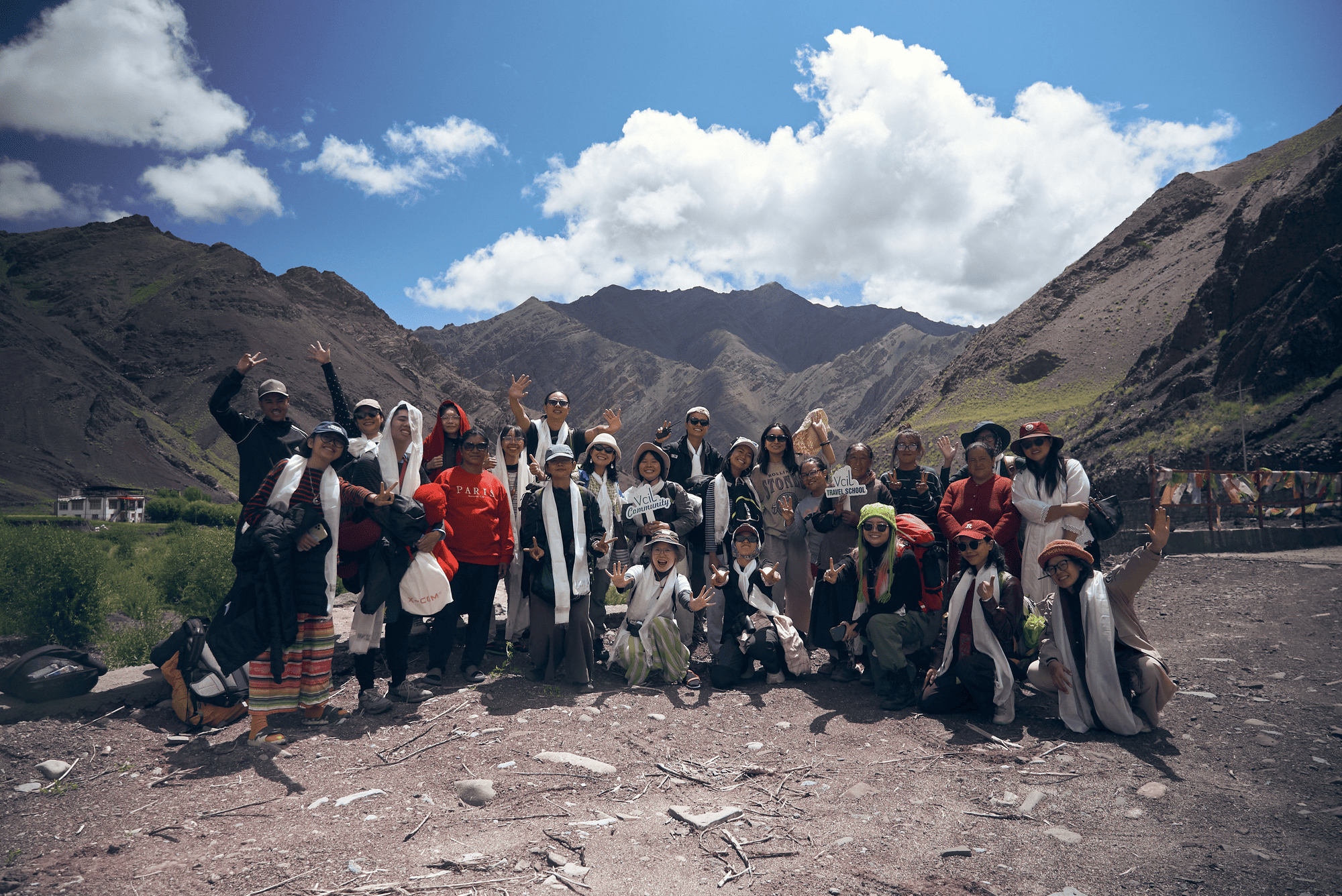

International Travel & Experiential Learning Program Uses Context-Based Learning Methods in a Multicultural Environment