You are using the member interface.
Log out of the member interface →

 ← Bản tin
Thông tin dưới đây chỉ dành riêng cho Hội viên Vcil
Để đảm bảo quyền lợi của bạn cũng như cộng đồng Hội viên Vcil, mong bạn đừng chia sẻ thông tin này nhé!
Bạn có thể chia sẻ thông tin về dự án dành cho công chúng bằng cách sao chép link này:
In society, we often describe people with disabilities using terms like "vulnerable," "in need of support," or "in need of protection." Consequently, charitable programs, support initiatives, and social welfare policies are often designed with the desire to help them lead better lives. But what if we tried asking a different question? What would happen if people with disabilities were not just recipients of support, but active creators of value?
What can a job provide beyond an income? How can a work environment change the way we perceive a person? And can a business both generate profit and create positive shifts in how society views those who are often pushed to the margins?
These are the very questions prompted by the story of Journey of The Senses – an ecosystem of creative restaurants and services in Saigon, where people with disabilities are not only given employment opportunities but are also placed on the front lines, working and interacting directly with customers. Instead of starting with the question “What can’t people with disabilities do?”, Journey of The Senses asks a different question: “What can they do, and how can we create an environment where those abilities can flourish?”
Nếp Mới #17 explores this story to rethink social impact businesses: a place where difference is not necessarily a limitation, but can become a strength; where work does not just provide an income, but also fosters dignity, autonomy, and human connection.
Journey of The Senses is an ecosystem of creative restaurants and services in Saigon, built with a clear social goal: to create meaningful employment opportunities for people with disabilities while contributing to changing how society perceives them.
Germ, the founder of Journey of The Senses, shares that people with disabilities in Vietnam still face many barriers, such as limited social awareness, stigma, and a lack of support, leading to high unemployment rates. According to his data, approximately 90% of blind and visually impaired people and about 65% of deaf and hard-of-hearing people are unemployed. While many social initiatives seek to support people with disabilities, very few businesses are willing to put them on the front lines, working and interacting directly with customers.
Journey of The Senses chooses a different approach: placing people with disabilities directly on the front lines, where they can work, serve, and interact with customers. Through this, the model not only creates jobs but also challenges social prejudices, turning what is often seen as a disadvantage into a unique advantage. Notably, this is achieved without compromising the quality of products or services.
The journey began in 2014 with Noir Dining in the Dark, a restaurant where guests dine in complete darkness and are served by visually impaired staff.
Guests are served a “mystery” menu. Without sight to identify the food, they are invited to focus on taste, smell, and texture. Normally, when we eat, our eyes tell us almost immediately what we are consuming. But in the dark, identifying ingredients becomes a real challenge. Pork might taste like chicken. A guest might wonder: “What kind of fish is this?”, “Is this white or red wine?”, or “Is this passion fruit or orange juice?”.
Phones and light-emitting devices are also put away so that guests are not distracted. As a result, they can focus more on the meal, the conversation, and the people present with them.
But this experience is not just for the customers. For the visually impaired staff, it is a meaningful employment opportunity. More importantly, Noir Dining in the Dark creates a space where sighted guests and visually impaired individuals can meet, interact, and learn from one another. Through such everyday encounters, prejudices about people with disabilities can be re-examined, and awareness of the visually impaired community can be broadened.
Drawing from the story of Noir Dining in the Dark, Germ shares insights into how we utilize our senses.
According to his presentation, when discussing the familiar senses, humans possess five: sight, touch, hearing, taste, and smell. He also notes a broader classification that includes senses related to pain perception, balance, proprioception, and thermoception.
It is noteworthy that we rely heavily on sight. Germ cites a figure of approximately 83% for vision, while hearing accounts for about 11%, smell 3.5%, touch 1.5%, and taste about 1%.
Because of this heavy reliance on sight, sighted people often struggle to experience the world without it. For example, when we see a piece of broccoli, we can almost imagine how it will taste. But in the dark, a familiar dish can become difficult to identify when relying solely on taste and smell.
Meanwhile, the loss of sight does not mean the loss of the ability to perceive. The remaining senses can be used in different ways and, in some cases, may become more acute.
Germ mentions the concept of cross-modal neuroplasticity – to explain how the brain can adapt when one sense is no longer functional. As he explains, the brain regions typically used for processing visual information do not simply disappear when a person is blind; these areas can be repurposed to process information from other senses.
He uses an easy-to-understand metaphor: when one "tenant" moves out of a house, another "tenant" can move in. This helps explain why visually impaired individuals may develop different ways of using their hearing, smell, touch, or memory compared to sighted people.
The point of this story is not to focus on what a person with a disability cannot do, but to recognize the unique capabilities they can cultivate. As Germ emphasizes, a visually impaired person still possesses all their senses and is capable of doing many things—they simply perform those tasks in a different way.
Following Noir Dining in the Dark, Journey of The Senses continued to develop new models. In 2017, Blanc Restaurant was launched with a staff of hearing-impaired employees.
"Noir" means "black" in French, while "Blanc" means "white." Since the Journey of The Senses locations are housed in old French-style villas and homes, Germ and his partners felt that French names would suit their space and narrative.
At Blanc, rather than requiring staff to adapt to the customers, guests are invited to learn sign language to communicate with the staff. The menu includes illustrations that guide guests on how to order and communicate basic phrases. For instance, guests can learn how to sign "I'd like another drink," ask "Where is the restroom?", or wish someone a happy birthday.
Following that, Là Hoa Flowers Speak created opportunities for hearing-impaired individuals to work in the floral industry.
Beyond simply providing jobs, this model seeks to integrate sign language into the customer experience itself. Each bouquet can come with a QR code that leads to greetings expressed in sign language.
Here, flowers are more than just a product. They become a way to connect and communicate between people who use different languages.
While Noir Dining in the Dark taps into the heightened sensitivity of the senses in the dark, Noir Spa focuses on the tactile expertise of visually impaired massage therapists.
According to Germ, the absence of sight allows therapists to focus more intensely on their sense of touch and their ability to perceive the client's body. Instead of following a fixed routine, they can identify areas of tension and adjust their techniques accordingly.
Journey of The Senses also uses herbal bath products sourced from the Dao and Red Dao communities in Northern Vietnam, particularly around Sapa. The supplier of these products is also a social enterprise, thereby extending the model's social impact beyond the Journey of The Senses team itself.
Not every Journey of The Senses model was an immediate success. They once experimented with Coffee in the Dark, a shorter, more affordable version aimed at local customers and young people. However, this model did not yield the expected results.
During the COVID-19 pandemic, Journey of The Senses explored another direction with Du Du Xanh, a vegetarian restaurant serving Vietnamese and Asian dishes, targeting the local market more directly.
These experiments demonstrate that Journey of The Senses is not just a social impact model, but a business that continuously learns, tests, and adapts based on real market needs.
One of the most notable aspects of the Journey of The Senses story is how the founder views the relationship between social impact and profit.
According to Germ, many people believe that social enterprises struggle to make money, but that is not necessarily true. A sustainable model requires a combination of passion, professionalism, and a social purpose.
A business must still generate profit, as financial resources are essential for paying salaries, maintaining operations, and continuing to create impact. If a business cannot remain financially viable, the very people it aims to support will ultimately be affected.
Therefore, for Journey of The Senses, creating social value does not mean compromising on product or service quality. On the contrary, quality and professionalism are the key factors that allow the model to endure.
The social impact of Journey of The Senses is viewed on two levels.
The first is the number of people with disabilities employed within the team. The second is the daily interaction between staff and customers—encounters that have the power to change prejudices and raise social awareness.
With its focus on job creation and promoting economic growth, this model aligns with SDG 8 – Decent Work and Economic Growth.
After more than a decade, Journey of The Senses has built a team of approximately 65 employees, received numerous accolades and awards, and had the opportunity to collaborate with organizations such as MISC (Merry Year Social Company) in Seoul, CSIP, KOICA, and the UNDP.
Looking at the bigger picture, the story of Journey of The Senses is not just about restaurants, flower shops, or services operated by people with disabilities. It is an approach to empowerment through work and human-to-human connection.
Instead of starting with the question: "What can this person not do?", Journey of The Senses poses a different question: "What can this person do, and what kind of environment can we create to help those abilities flourish?"
When people with disabilities are given the opportunity to stand on the front lines, directly creating value and interacting with customers, these everyday experiences become a bridge that helps people understand one another better. From there, long-standing societal prejudices can gradually be re-examined.
Perhaps the most important thing Journey of The Senses suggests is not how many jobs people with disabilities can perform, but how we choose to perceive their capabilities. When the right environment is created, what was once considered a "disadvantage" can become a strength—and difference is no longer a reason for separation, but a new way to connect people.
Answer: When asked about how Journey of The Senses manages and responds to risks in its business operations, Germ shared that running any business is inherently risky. No one can know for sure whether a business model will truly succeed.
However, Journey of The Senses understands that it operates a unique model and accepts a certain level of risk, while believing that this model can create positive social impact. So far, the business has not encountered any serious issues that have derailed its operations, as the team is always diligent in its management and execution.
Currently, Journey of The Senses has a team of nearly 70 people, and their work here is their source of income. Therefore, the business must ensure that operations are run professionally and stably. Additionally, agencies such as fire safety, police, and food safety authorities conduct periodic inspections and assessments, approximately once a year. This helps ensure a safe environment not only for customers but also for employees.
According to Germ, the biggest challenge Journey of The Senses has ever faced was the COVID-19 pandemic. At that time, business operations were almost entirely shut down for a year because international guests could not travel to Vietnam. The business was forced to shift its focus to the domestic market, at a time when everyone was fearful and limiting their time outdoors.
When asked how Journey of The Senses prepared for such a major situation, Germ candidly shared that they really had no preparation in advanceIn his view, it is incredibly difficult to prepare for a major, unprecedented event like COVID-19, as no one could have truly known the pandemic would occur or the extent to which it would impact businesses.
Fortunately, the business had some savings. Germ and his co-founder used their entire savings to keep operations running and help the business weather the difficult period. As a result, Journey of the Senses did not have to lay off any team members. Those who wanted to continue working were able to stay.
Germ also shared that many other businesses did not survive the pandemic. For Journey of the Senses, being able to make it through that period and continue operating was a stroke of luck, as well as a major lesson in business resilience and adaptability.
Answer:
According to Germ, one of the factors that made building a business in Vietnam easier for him was the combination of an international perspective and local insight. His business partner is Vietnamese, from Hanoi, so the business was built on the partnership between a Dutchman and a Vietnamese. Germ brings the international perspective, while his Vietnamese co-founder has the advantage of navigating tax authorities, local government, and handling HR and financial matters.
From his experience, Germ believes that foreigners can absolutely start a business in Vietnam. However, he emphasizes that having a Vietnamese partner on the team is a significant advantage, especially when it comes to understanding and handling issues related to government agencies, taxes, and local procedures.
When discussing the strengths of the business environment in Vietnam, Germ particularly values the people. In his view, Vietnamese people are curious, entrepreneurial, and have a strong work ethic. They are enthusiastic, honest, hardworking, and eager to learn. From his own experience working in Vietnam, Germ finds it quite favorable to work with Vietnamese people, especially when compared to what he has heard from those who have lived and worked in other countries.
For Germ, this is one of Vietnam's greatest advantages. He believes that having a Vietnamese team by his side has been a tremendous support in building and operating the business.
Germ also shared that one of his most important lessons came from choosing to do something new. Dining in the Dark, the sensory dining experience he and his partners developed, is a prime example. When they started, it was an idea that few had implemented in Vietnam. After 12 years, their model remains a unique case in the market. Germ believes that to create a difference, businesses sometimes need to take risks and dare to choose paths that no one else has tried.
He believes that if you only choose models that already exist in the market, you will face intense competition. Therefore, the international perspective he brings has also helped the business build a model that stands out from what is currently common in Vietnam.
However, Germ emphasizes that this difference does not come from his international perspective alone, but from the combination of his viewpoint and the capabilities and insights of his Vietnamese team. It is this synergy that has made building and running the business much smoother.
Therefore, I would like to learn more about how Journey of the Senses designs the Dining in the Dark experience. With a customer base that is primarily international but increasingly includes more Vietnamese, how do you build an experience that caters to differences in culture and palate?
When guests enter the Dining in the Dark space, how is the experience structured? Is there an element of storytelling, sensory exploration, or a specific message that Journey of the Senses wants to convey? And specifically, do visually impaired individuals participate in the process of designing the experience and the menu?
Germ explains that Journey of the Senses designed Dining in the Dark as a personalized, step-by-step experience. He noticed that not every guest feels comfortable immediately when dining in total darkness. For many, the dark is a new environment, which can even trigger fear or anxiety because they don't know what to expect.
Therefore, rather than leading guests directly into the dark, Journey of the Senses uses a preparation process to help them gradually adjust. At the start, guests participate in a small game, wearing blindfolds to solve a puzzle without sight. Through this activity, they slowly get used to the loss of vision and mentally prepare for the Dining in the Dark experience. This is also a time for the team to share their story and introduce the experience that guests are about to enter.
After 12 years of operation, Journey of the Senses has accumulated significant experience in designing this journey. The team has a clear understanding of what makes guests feel comfortable, what they enjoy, and which factors might make the experience more challenging.
Regarding the menu, Germ notes that the entire development process is handled by the kitchen team. When changing the menu, he and his business partner primarily participate in tasting and providing feedback, while the kitchen team is responsible for preparation and development. Over the years, they have learned which types of dishes are suitable—and which are not—for consumption in the dark.
According to Germ, Dining in the Dark is not just a meal, but a carefully designed journey. Guests arrive, enjoy a welcome drink, participate in a game, and are then guided and prepared before entering the dark space. They dine in the dark for about an hour and have the opportunity to interact with the visually impaired staff who accompany them throughout the experience.
After the meal, guests return to the lounge area. Here, Germ and his colleagues show guests images of the dishes they just enjoyed on an iPad. This is also a time for guests to ask questions and chat with the team about the experience, such as why Journey of the Senses built this model, the role of the visually impaired staff, or the philosophy behind Dining in the Dark.
Because of this, Germ believes it is a highly personal experience, where each guest truly goes on a journey from the moment they enter, adjusting to the darkness and enjoying the food, to reflecting on and better understanding what they have just experienced.
As for the clientele, the majority of participants in Dining in the Dark are still international guests. However, the proportion of Vietnamese guests is gradually increasing. While it has not yet reached a 50-50 split, Journey of the Senses now has a significant number of Vietnamese customers. Notably, Germ has observed that many Vietnamese guests tend to return for a second experience, something he is very proud of.
This leads to the question of whether Journey of the Senses has plans to expand opportunities for these employees to work in other departments and take on different roles within the business. Diversifying job positions not only creates more employment opportunities but also expands the ability of people with disabilities to participate in various fields.
Germ shares that Journey of the Senses has already had employees with disabilities working in positions outside of service. For example, the business once had a visually impaired bartender; at their vegetarian restaurant, some of the baristas are hearing-impaired or hard of hearing. The business has also employed a hearing-impaired security guard who assisted with organizing motorbikes and welcoming guests.
According to Germ, the kitchen team is currently composed primarily of people who can hear and see. However, that does not mean that the visually or hearing-impaired cannot work in a kitchen environment. What matters more is how the business and management team design the work, organize the environment, and create the conditions for people with disabilities to participate.
If a business truly has an inclusive mindset and is willing to adapt the work environment, people with disabilities can absolutely take on many different jobs and roles.
Germ also believes that working in restaurant service is a relatively new career opportunity for the visually and hearing-impaired in Vietnam. Based on his observations, the hearing-impaired often work in office jobs, hairdressing, or makeup, while the visually impaired have fewer options, most commonly massage, selling lottery tickets, or playing music.
By building a restaurant with a service team consisting of both visually and hearing-impaired individuals, Journey of the Senses has created a new career path for this group.
One thing Germ emphasizes is the perception of people with disabilities. According to him, the visually and hearing-impaired staff at the restaurant first and foremost see themselves as ordinary workers. They also have needs for a salary, fun, drinking milk tea during breaks, singing karaoke, having romantic relationships, family stories, as well as their own hopes and dreams.
Germ believes that society sometimes focuses too much on the differences of people with disabilities and inadvertently views them primarily through the lens of their disability. Meanwhile, what they need is sometimes very simple: a job, an income, and the ability to build their own lives.
From that perspective, Journey of the Senses does not want to create an environment where employees become overly dependent on the business. Instead, the business wants to help them become self-reliant. With their own income, they can rent homes, take care of their own lives, and step by step build their own families.
Another question raised concerned the income levels of employees with disabilities. Germ explained that their base salaries are generally in line with market rates for hotels and restaurants. However, the business provides additional support, such as meal and transportation allowances, as some staff require assistance with their commute. Consequently, their total income may be slightly higher than the base salary.
Germ also emphasized that the business's goal is not to create a system where people with disabilities are paid more simply because they have a disability. He does not want to foster a sense of dependency or set a precedent that people with disabilities should automatically receive higher wages.
Instead, Journey of the Senses chooses to provide additional support at a level deemed reasonable and fair, aiming to help employees earn enough to live independently.
What Germ ultimately emphasizes is not just creating jobs for people with disabilities, but building an environment where they can work, earn an income, and live an independent life just like any other employee.
Answer: When asked about the work environment at Journey of the Senses and how he builds team culture—particularly in handling conflicts, providing performance feedback, and respecting differences in communication—Germ believes that the first priority is finding people who are truly a good fit for the job and the team.
According to Germ, not everyone is suited for restaurant work. Even for the service team at Dining in the Dark, which includes many visually and hearing-impaired staff, the recruitment process is quite thorough. Some candidates may lack prior service experience, especially those who are visually or hearing impaired. Therefore, beyond skills and experience, Journey of the Senses places special emphasis on a candidate's motivation, communication abilities, and social skills.
The nature of restaurant work requires staff to not only work with customers but also coordinate constantly with other team members. Thus, teamwork and interpersonal interaction are crucial. Germ stresses that if someone lacks these skills, it does not mean they are inadequate or have a problem. However, Journey of the Senses does not hire someone just because they are visually or hearing impaired. They must still meet the basic requirements of the job and align with the team's culture.
Germ believes this is part of a fair and inclusive approach. While he may want to create more opportunities for people with disabilities, hiring someone simply out of a desire to help—if they are not truly a good fit for the role or the team—could create more problems in the long run. This affects not only the individual hired but also other team members and the quality of service the restaurant strives to maintain.
So far, Germ finds the experience of working with the team to be quite positive. Other staff members, especially those with experience in the hospitality industry, understand the job requirements and the standards the team must uphold. Therefore, it is not just Germ alone who is responsible for creating and maintaining this work environment; it is the result of the entire collective.
Another point Germ wants to emphasize is that whether an employee stays long-term or leaves is not necessarily related to whether they have a disability. There are visually or hearing-impaired staff who have worked there for a long time, while others have left after about a year to pursue other opportunities. Some get married, become pregnant, move away, or simply enter a new phase of life.
Germ shared the story of a visually impaired female employee who once worked at Journey of the Senses. She later got married and moved to the U.S., where she now lives in California. For Germ, stories like these show that people with disabilities experience the same life changes and choices as anyone else.
Therefore, he does not expect visually or hearing-impaired employees to have a special level of loyalty just because they have a disability. First and foremost, they are human beings with their own needs, desires, relationships, and life milestones. While it sometimes saddens him when a member leaves the team, it is a natural part of the work and growth process.
Germ shares that Journey of the Senses organizes team-bonding activities quite frequently. Once a year, the entire staff goes on a trip together, usually lasting one or two nights, depending on the destination. One of the photos Germ included in his presentation shows the Journey of the Senses team during a beach trip in Phan Thiet.
During these trips, everyone participates in team-building activities, plays games on the beach, enjoys dinner, and wraps up with a party featuring music and dancing. What Germ particularly appreciates is that all departments have the opportunity to participate, from accounting, the kitchen, and security to the service staff, including visually and hearing-impaired employees.
According to Germ, such activities help the differences between members become a natural part of working and bonding together. He shares that sometimes he even forgets a colleague is hearing-impaired and starts talking naturally, or finds himself using sign language with them. Such moments are quite interesting to him, as these differences are no longer a barrier in daily communication.
Beyond fostering professional cohesion, this environment has also become a place where some employees meet and build personal relationships. Germ mentions that there have been several cases where employees began romantic relationships after meeting at work. For example, a female employee in the marketing department is now engaged to one of the restaurant's chefs. Among the visually impaired service team, there are also a few couples who started their relationships while working together.
Germ believes this is quite natural. When people work together every day, they have the opportunity to meet, talk, and understand each other better. Therefore, the workplace is not just a space to complete tasks, but can also become a place where meaningful relationships and connections are formed.
In addition to the summer trip, Journey of the Senses also organizes other activities throughout the year, such as Christmas parties and year-end celebrations. For Germ, these activities play a crucial role in providing opportunities for members from different departments and backgrounds to meet, have fun, and connect outside of work.
Through this, he believes that building a team is not just about working effectively together, but also about creating spaces where people can understand each other better and feel that they truly belong to a collective.
Question:
Journey of the Senses is a truly unique and transformative model. It goes beyond the traditional approach of a social enterprise by focusing not only on creating job opportunities but also on shifting perspectives and mindsets. Instead of viewing people with disabilities as those in need of support or charity, Journey of the Senses sees them as individuals with capabilities and talents who can fully thrive in roles that are valuable and dignified.
I would like to delve deeper into this philosophy of yours: In your opinion, how should we change the way we perceive and work with people with disabilities? And what life experiences have shaped your profound approach to the dignity and value of every human being?
Answer:
Germ strongly agrees with the perspective of viewing people with disabilities not as subjects in need of support or charity, but as capable, talented individuals who can thrive in meaningful and dignified work. According to him, this is the very approach Journey of the Senses has strived to build throughout its operations.
From Germ's perspective, change must first start with those who create jobs, especially business owners. If a business is truly open and proactively creates suitable positions for people with disabilities, it can provide a tremendous opportunity for those who previously never had the chance to earn an income, build a livelihood, or have a stable job. When welcomed and given the opportunity to work by a business, they can gain the motivation to develop and become more self-reliant in life.
However, Germ also emphasizes that an inclusive work environment does not mean the business lowers its recruitment standards. Journey of the Senses has had a few employees who were not truly comfortable working with visually or hearing-impaired colleagues. For Germ, if someone does not agree with this operational approach, they have the right to leave, because the business needs members who are truly ready to work in a diverse and inclusive environment.
After 12 years, Journey of the Senses has gradually formed a culture where everyone understands that visually and hearing-impaired individuals are a natural part of the team. Everyone needs to learn how to work together, and that very process has created many friendships and even romantic relationships among the staff.
Germ also views this as a learning process for those without disabilities. For him personally, Journey of the Senses was the first place where he had the opportunity to truly sit down, talk, and work alongside visually and hearing-impaired people. Many of the restaurant's staff with full sight and hearing have had similar experiences when working with disabled colleagues for the first time.
According to Germ, after working together for a while, people gradually realize that differences in hearing or sight do not define a person. They still have personalities, emotions, interests, and the ability to connect just like anyone else. From there, friendships form naturally, and working together becomes more comfortable.
This change is also reflected in communication. Currently, some hearing staff at Journey of the Senses have learned basic sign language skills to communicate better with their hearing-impaired colleagues. For Germ, witnessing such small changes is something to be cherished, as it shows that inclusion is happening in the daily lives of the team.
Of course, working with people with disabilities also requires businesses to make appropriate adjustments. At Dining in the Dark, for instance, the space operates in darkness, so changing the position of tables, chairs, or furniture requires careful consideration. Small adjustments in space layout or work organization are necessary to ensure everyone can work safely and effectively.
Based on his experience, Germ believes that if a business owner has a clear and open mindset from the start, the necessary changes will gradually take shape during operations. Once that mindset becomes part of the organizational culture, the team will also adapt and work together to build a suitable work environment.
Finally, Germ wants to emphasize that people who are visually or hearing impaired still have a great capacity to contribute. A disability may prevent someone from performing certain tasks, but that does not mean they cannot work or create value. The important thing is for businesses to look at what a person can do, rather than focusing only on what they cannot do.
For Germ, shifting this perspective is one of the first steps toward building a work environment that is truly inclusive and respects the dignity of every individual.
Sharing the reason for starting Journey of the Senses, Germ explained that from the very beginning, he and his co-founder were determined to build a business in the hospitality sector, specifically a restaurant. Both had experience working in the hotel and restaurant industry, so starting a restaurant was a natural choice.
However, Germ did not want to create just another restaurant like the models already on the market. With their existing experience, they could easily have opened a traditional Vietnamese restaurant and run it well, but Germ wanted to find a more distinct idea—one that was both experiential and meaningful.
The turning point came when Germ had the opportunity to experience the Dining in the Dark concept in Kuala Lumpur, Malaysia. This model originated in Switzerland in 1999 and was later developed in many other countries. The experience at the restaurant in Kuala Lumpur left a deep impression on Germ: the food was delicious, the service was excellent, and more importantly, the experience was thought-provoking.
When Germ left his job at a hotel and his co-founder left their position in tour operations, they both began to think about their next steps. At that time, Dining in the Dark had not yet appeared in Vietnam. Germ realized this could be an idea distinct enough to create an impact, and he decided to pilot the model.
After 12 years of operation, Journey of the Senses continues to exist and grow. Looking back on that journey, Germ believes that the decision to establish the business was a combination of experience in the hospitality industry and a desire to build a more meaningful business model.
What Germ particularly appreciates about Dining in the Dark is the combination of social value and the customer experience. It is still a restaurant where guests come to enjoy a meal, but at the same time, they participate in a unique experience and have the opportunity to see the world from a different perspective.
According to Germ, this creates a difference compared to traditional charitable approaches. Instead of just one side giving and one side receiving, in this model, both sides gain value. Employees have the opportunity to work and build a livelihood, while customers receive a meaningful experience in return. It is this combination that makes Germ feel the model is so special.
In addition to Dining in the Dark, Germ also shared about Dialogue in the Dark, another experiential model he once considered developing in Vietnam.
Unlike Dining in the Dark, Dialogue in the Dark is more of an exhibition and experiential concept. Participants navigate a series of completely dark spaces, guided by visually impaired individuals. These spaces can simulate familiar settings such as a park, a living room, a marketplace, or a boat. Unable to rely on sight, participants must use their other senses—touch, smell, and hearing—to explore their surroundings.
For instance, at a location in Seoul, South Korea, there are spaces that simulate a park, a living room, a market, and a boat. Participants move through these areas in total darkness without knowing exactly where they are. They must use their other senses to perceive and explore the environment around them.
Germ believes this is an engaging way to foster interaction between the visually impaired and the community. Instead of just hearing about the lives of people with disabilities, participants have the opportunity to directly experience a part of their world under their guidance. The dialogue that takes place in the dark is precisely why this model is named Dialogue in the Dark.
According to Germ, Dialogue in the Dark is closer to an exhibition or franchise model, whereas Dining in the Dark operates as independent restaurants in many parts of the world. Journey of the Senses once considered developing Dialogue in the Dark in Ho Chi Minh City, particularly as an experiential program for students. Through this, they could enter dark spaces and interact directly with visually impaired individuals.
However, implementing this model requires a fairly large space with multiple interconnected rooms. Germ and his partners had considered the idea before the COVID-19 pandemic, when business conditions were still favorable. After the pandemic, financial challenges forced the project to be temporarily moved to a long-term plan.
Nevertheless, for Germ, it remains an idea worth pursuing, especially given its educational potential and its ability to create direct encounters between people with disabilities and the community.
Specifically, how can new businesses balance social impact and financial performance, especially when seeking capital in a context where traditional investors often expect high returns?
And how can founders connect with impact-aligned investors, co-founders, and suitable partners/collaborators?
Answer:
For those starting a social impact business, Germ believes the first priority is to just start if you truly have an idea you believe in. In his view, there aren't enough social enterprises in the world yet, so if you have an idea and are truly passionate about it, just go for it.
Germ believes that when a business is built on genuine motivation and passion, customers can feel it. If customers, consumers, or partners see that the founder is truly dedicated and driven by what they are doing, it builds trust and encourages them to stay involved and continue using the business's products or services. For Germ, that is a crucial factor.
Additionally, he suggests that one of the top priorities in the early stages is having a relatively clear plan, especially regarding finances. A business needs to visualize how it will generate revenue, how much investment is required, and how long its funds can sustain operations.
Unless you have nearly unlimited funds or support from a very wealthy family, a business still needs money to keep running. If capital runs out after a year or two, it becomes a very unfortunate problem. Therefore, according to Germ, founders need a basic business plan that accounts for necessary investments, when money will be needed, and how much is required.
In this regard, cash flow is a particularly critical factor. A business might start by purchasing equipment, materials, or products, but it must then continuously cover various expenses like salaries, rent, and payments to suppliers. Even if revenue isn't high enough to cover all costs yet, the business still needs a reserve to maintain operations. Thus, Germ suggests that for at least the first year, a business should have enough cash to keep running even if business performance doesn't meet expectations.
Regarding fundraising, Germ believes that angel investors or investors who share a similar focus on social impact can be the right fit. He values investors who are not just interested in high returns, but are also willing to provide guidance, think alongside the founders, and genuinely want the business to succeed.
So, how do you find such people? According to Germ, an effective way is to join networks of people who share the same interests or are building similar businesses. He cites CSIP in Hanoi as an example, an organization that supports and promotes enterprises, which Journey of the Senses has worked with. Through such networks, founders can meet like-minded individuals, expand their connections, and thereby find more opportunities to secure investment or partnerships.
Germ also mentions several accelerator and incubator programs for social enterprises in Vietnam, such as Seed Planter, CSIP, and Hatch. These networks can serve as useful connection points for founders. Additionally, events, community groups, and people organizing meetups in this field are also great places to get to know others and build connections.
The experience of Journey of the Senses itself is a clear example of this. When they joined the CSIP network in Hanoi, they were introduced to other groups and organizations. From CSIP, Journey of the Senses connected with MISC in South Korea; through MISC, they continued to connect with other partners like Lane. Relationships expanded from one connection to the next, creating a “snowball effect”, because the more people you know, the more new opportunities you have.
Ultimately, Germ believes that while building a business on your own is commendable, working together and leveraging each person's strengths is often more effective. Everyone has different expertise, experience, and networks. Therefore, finding like-minded people to share resources and collaborate with can help a social enterprise thrive.
For Germ, sometimes the most important thing is proactively connecting. If you have a good idea, motivation, and a genuine passion for what you are doing, get started and reach out to like-minded people. From those initial connections, many other opportunities can gradually unfold.
Question: Looking ahead at the next chapter for Journey of the Senses, what are your directions or strategies for growing the business in the coming time?
Answer:
Germ shared that before the pandemic, Journey of the Senses had plans to expand operations to several other cities in Vietnam. They had considered developing a vegetarian restaurant model combined with a spa in locations such as Hoi An, Phu Quoc, and Hanoi. At that time, CSIP in Hanoi was also very excited about the idea of bringing some of Journey of the Senses' business models to Hanoi and developing them there.
However, the COVID-19 pandemic significantly altered these plans. Financially, the business faced many difficulties and had to use its savings to maintain operations. Therefore, at the moment, Journey of the Senses needs to focus on rebuilding a solid financial reserve before it can think about expansion.
The ideas that were set out before the pandemic are still there, but for now, the business needs to go back to the "drawing board" and patiently wait a little longer. Germ believes that sometimes an idea seems very feasible, but when actually entering business, entrepreneurs must also admit that luck plays a significant part in the startup journey.
In the long term, Germ still believes that the idea of developing Dialogue in the Dark is a path that Journey of the Senses can continue to pursue. However, regarding other expansion plans, he believes the business needs more time and a stronger financial foundation before it can start again.
—--
The story of Journey of The Senses is not just about creating jobs for people with disabilities, but also suggests another way to look at ability and difference. When given the opportunity and the right environment, what were once considered "disadvantages" can become strengths, creating value for individuals, businesses, and the community alike.
Perhaps change begins with a very simple question: Instead of focusing on what a person cannot do, what can we see in what they are capable of?
Imagine stepping into a room of total darkness. There is no light to identify the person sitting next to you. You struggle to eat, feeling clumsy and unsure. You don't know where your utensils are or what your food looks like. Suddenly, your eyes are no longer useful. To continue your meal, you need guidance and support from someone else. These are the visually impaired, people who have long been accustomed to the dark. And to your surprise, they navigate, guide, and tell stories as if the dark room were perfectly illuminated for them.
You also begin to realize something quite unexpected: perhaps we are not as good at identifying food by taste as we thought. A familiar dish can become unrecognizable when you cannot see it. Very faint sounds become clearer. Movements we usually ignore become important signals. And perhaps, that experience makes us more humble in the face of our own limitations.
And perhaps, from that humility, we can also become more tolerant of those who are different from us. Because when we experience the feeling of "not knowing what to do" ourselves, we begin to understand that if someone cannot do something in our way, it does not mean they lack ability. They may simply be in an environment that is not suited to how they perceive and interact with the world.
This organizational approach forces us to ask: Does disability truly lie within a person, or does it lie in the way our environment and society are designed?
These are the experiences diners have when eating at Noir.Dining in the Dark, a restaurant founded by Vu Anh Tu and Germ Doornbos in Ho Chi Minh City in 2014. At Noir, guests dine in complete darkness, while visually impaired staff are responsible for guiding and serving them. In a space designed differently, those whom society often views as "disabled" become the most proficient, confident, and capable of caring for others.
In many past medical and social policies and practices, disability was primarily approached through themedical model of disability. This model views disability as a problem residing primarily within the individual, stemming from illness, injury, or physical conditions; therefore, solutions often focus on treatment, rehabilitation, or helping the individual better adapt to the existing environment.
Additionally, another perspective places people with disabilities in the position of the less fortunate who need pity and help. This has led to many well-intentioned charitable activities, but people with disabilities often remain mere beneficiaries rather than skilled workers, value creators, or decision-makers.
In recent decades, thesocial model of disabilityhas opened up a different perspective. This view does not deny physical, mental, or sensory differences or impairments. However, it argues that the extent to which a person is limited is also created by barriers in the living environment: stairs without ramps, information lacking accessible formats, employer prejudices, training methods suited only to one group of people, or work processes built around the image of a "normal" human being.
Therefore, instead of focusing on a person's deficits or limitations, we need to ask, "How can we create an environment where a person can participate, develop their potential, and create value?" Instead of forcing everyone to adapt to a pre-existing structure, we need to reconsider and redesign that very structure if it is marginalizing other groups of people.
These principles form the foundation of Noir. Noir has fundamentally restructured the experience: darkness becomes the workspace; orientation, spatial memory, and the use of other senses become professional skills; and visually impaired individuals take on the roles of interacting with, caring for, and guiding customers.
This is the difference between creating a space for those who are different within an existing system and redesigning the system based on that very difference.
From Noir, the two founders continued to develop Journey of the Senses as an ecosystem of impact-driven businesses in the hospitality and service industry. Blanc creates an experience where diners order and communicate with hearing-impaired staff using sign language. La Hoa combines the art of floral arrangement with messages expressed in sign language. Noir. Spa develops services featuring visually impaired technicians. Models like Du Du Xanh and Cà Phê in the Dark continue to expand this ecosystem of inclusive experiences and employment.
In these models, people with disabilities do not stand outside the business as recipients of support. They use their own unique abilities to create value for customers.
Journey of the Senses once reinterpreted PWD not just as Persons with Disabilities but also as Persons with Different Abilities — people with different capabilities. This terminology reflects a more holistic view of a person: while there may be areas where they are not perfect, they also possess unique strengths that no one else has.
However, this also raises a question that needs to be discussed: how can we value different abilities without "normalizing" impairments, denying real challenges, or placing pressure on an individual to possess a "special talent" in order to be accepted? In other words, how do we balance these factors?
Everywhere we go, we carry a definition of "the norm": a person who can see, hear, read, speak, move, learn, and work in the same way; who can keep up with a common pace; who is ready to express themselves according to common rules; who shares common customs; and who holds common beliefs. Those who do not fit this image are often viewed as lacking capability (or even labeled as incompetent or useless), antisocial, or a poor fit for the organizational culture.
But capability is not a fixed attribute residing solely within an individual. It is formed in the relationship between a person and their environment, tools, work, and the people around them. A person might be seen as "incapable" in one system, job, or environment, yet thrive or become a leader in another environment or a differently designed organization.
Therefore, an organization that values diversity does not just ask how to help those who are different integrate. It must also ask how their presence can help the organization see its own limitations, opening up new ways of communicating, new methods of working, and values that the organization previously did not know how to recognize or lacked. Ultimately, inclusion is not just physical; it is about perspectives, viewpoints, culture, and capabilities in a highly diverse world. The journey of Journey of the Senses is an invitation to reflect together on building a fair, inclusive, and happy world for everyone.
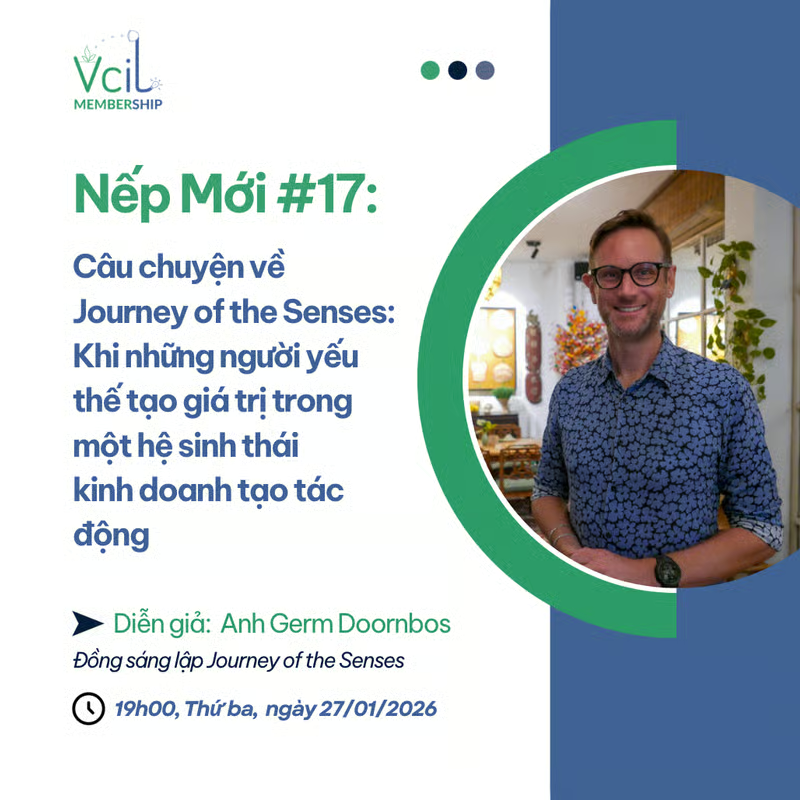
In this month's issue of New Perspective, we meet Germ Doornbos, co-founder of Journey of the Senses and Noir. Dining in the Dark, to explore a decade-long journey of building an impact-driven business through unique capabilities.
This conversation will go beyond the story of how a unique restaurant was founded. We will also hear Germ share insights on the following questions:
Time: 7:30 PM, August 25, 2026
Format: Zoom
Language: English (with Vietnamese interpretation)
Exclusive event for Vcil Community members
Germ Doornbos is a Dutch social entrepreneur, hospitality expert, and co-founder of Journey of the Senses alongside Vu Anh Tu.
In 2014, they founded Noir. Dining in the Dark in Ho Chi Minh City, creating a unique dining experience in total darkness led by a team of visually impaired staff. Building on the success of Noir, they expanded into service models such as Blanc, La Hoa, Noir. Spa, Du Du Xanh, and Cà Phê in the Dark, gradually forming an ecosystem of impact-driven businesses that employ individuals who are visually impaired, hearing impaired, and from other diverse backgrounds.
In 2020, Germ Doornbos and Journey of the Senses were recognized at the Asia Pacific Social Innovation Partnership Awards in the field ofinclusive business.
Drawing on his experience in experience design, training, and managing diverse teams, Germ explores a central question: how can businesses identify capabilities often overlooked by society, place them at the heart of value creation, and contribute to changing how we perceive one another?
Inspired by the Vietnamese word "Nếp"—which signifies the established patterns of culture, habits, and daily life—Vcil Community launched Nếp Mới to create a space that nurtures new ways of living: prioritizing sustainable well-being and the regeneration of true wealth.
Each month, community members dive deep into a different theme. Nếp Mới invites scholars, experts, and practitioners to share insights and experiences on essential, life-relevant topics. Participants have the opportunity to engage in dialogue, deepen their understanding, find solutions to personal and collective challenges, or initiate meaningful projects.
- Email: vcil.group@gmail.com
- Hotline/Zalo: 0836 243 541 (Huy) · 0918 580 257 (Trinh)
Nội dung đầy đủ của bài viết này chỉ dành cho Hội viên Vcil. Đăng nhập để đọc tiếp phần còn lại.

New Ways will invite scholars, experts, and people with practical experience to share about essential and familiar topics in life