You are using the member interface.
Log out of the member interface →

 ← Bản tin
ARTISTS USING ART FOR SOCIAL DIALOGUE - FROM PERSONAL CREATION TO COMMUNITY PRACTICE
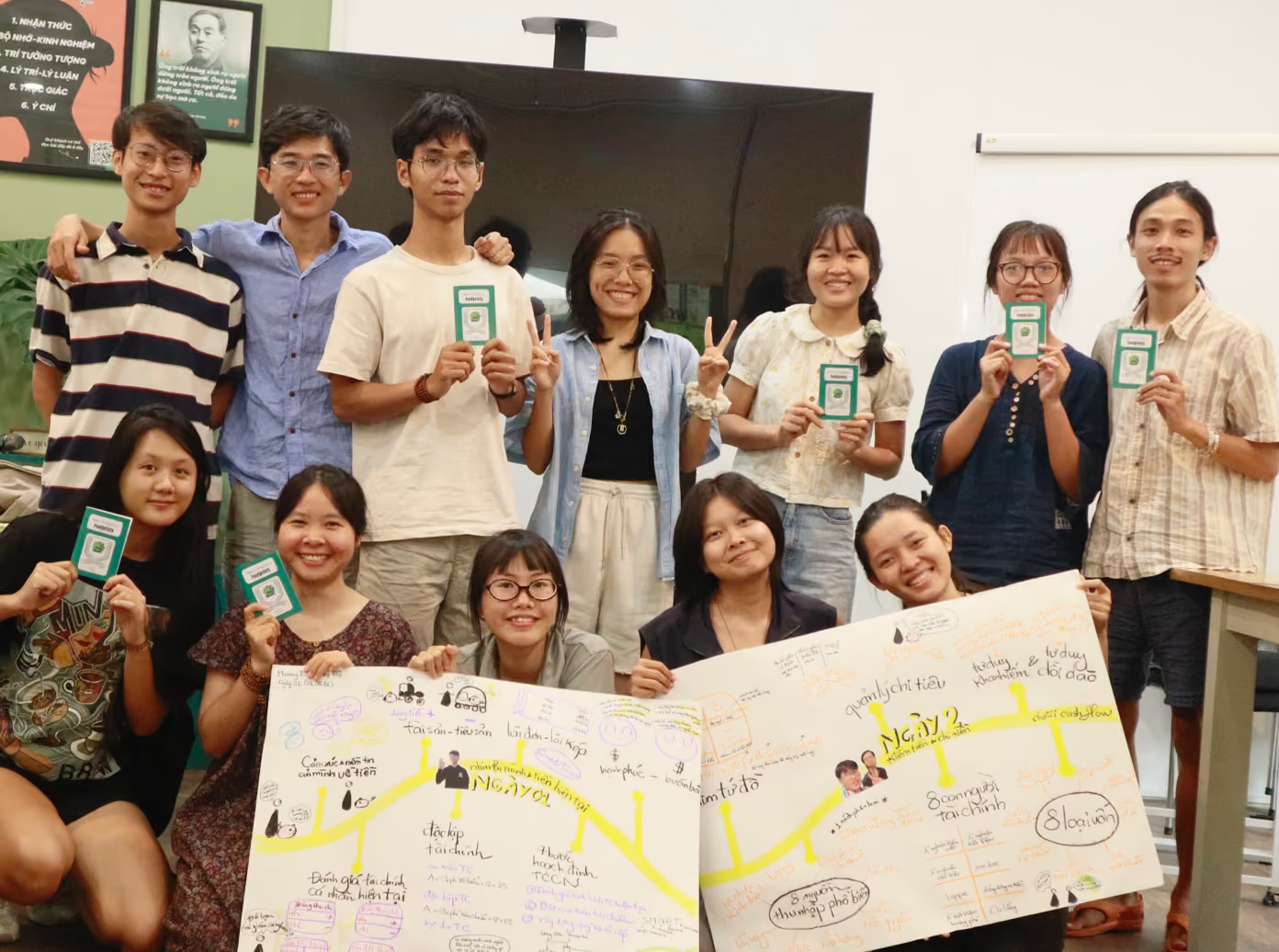
On the evening of August 21st, the sharing session Vcil Members’ Talks #12: How do artists use art to open up current social issues? took place with guest speaker Xuan Ha - a visual artist, co-founder of A Song (Art Collective), and a member of the Vcil Community.
In her artistic practice, Xuan Ha focuses on stories of migration, environmental and social issues, and "micro-histories"—the narratives often overlooked in grand historical accounts. Starting from questions deeply rooted in everyday life, she begins to travel, research, and conduct fieldwork to trace the stories behind a landscape, a dish, an object, or a memory. This journey leads her to various sources of inspiration and materials, such as rice paper and wartime camouflage uniforms.
Upon returning to Da Nang in 2019, during a visit to her hometown of Thang Binh (Quang Nam), Xuan Ha was moved by the poetic sight of graves resting on white sand, which sparked a question within her: “Why is our hometown covered in white sand?”.
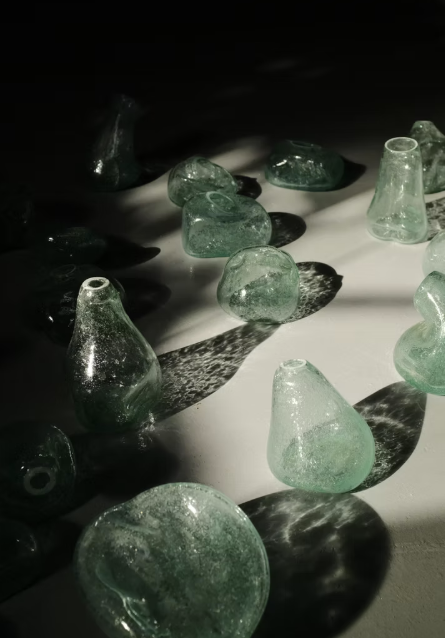
After researching, she realized that the local white sand was being over-extracted for export to produce high-end glass for developed nations. The consequences were damaged groundwater tables and precarious livelihoods for the local people. While walking along the beach, she encountered glass bottles washed ashore from annual storms. These moments made her reflect on how her homeland was being stripped away to become luxury goods, only to return in the form of trash. During her exploration, she stumbled upon an article about a woman from Thang Binh selling white sand at a market in Saigon. The article described grains of sand from home clinging to the worn-out soles of her sandals. The sandals carried the person away, while the sand carried the identity and soul of their homeland. Ultimately, she created the work The White Sand in Exile (2020) as a way to tell the story of her homeland.
Besides the white sand from her hometown, rice paper is also a familiar material that frequently appears in Xuan Ha's personal artworks. She discovered that rice paper is essentially a type of "paper" and became curious why this ingredient is more prevalent from Central Vietnam southward. In her research, she found no official answer but encountered theories suggesting that because rice paper is lightweight and dry, it was convenient to carry during long journeys. From there, she realized that even everyday food can tell us about the migration history of a group of people. Rice paper itself has appeared in stories dating back to the Tay Son - Nguyen Lords era. Inspired by these connections between food and history, Ha began to ask: if rice paper is not just food but an object capable of recording history, what could we write on this "sheet of paper"?
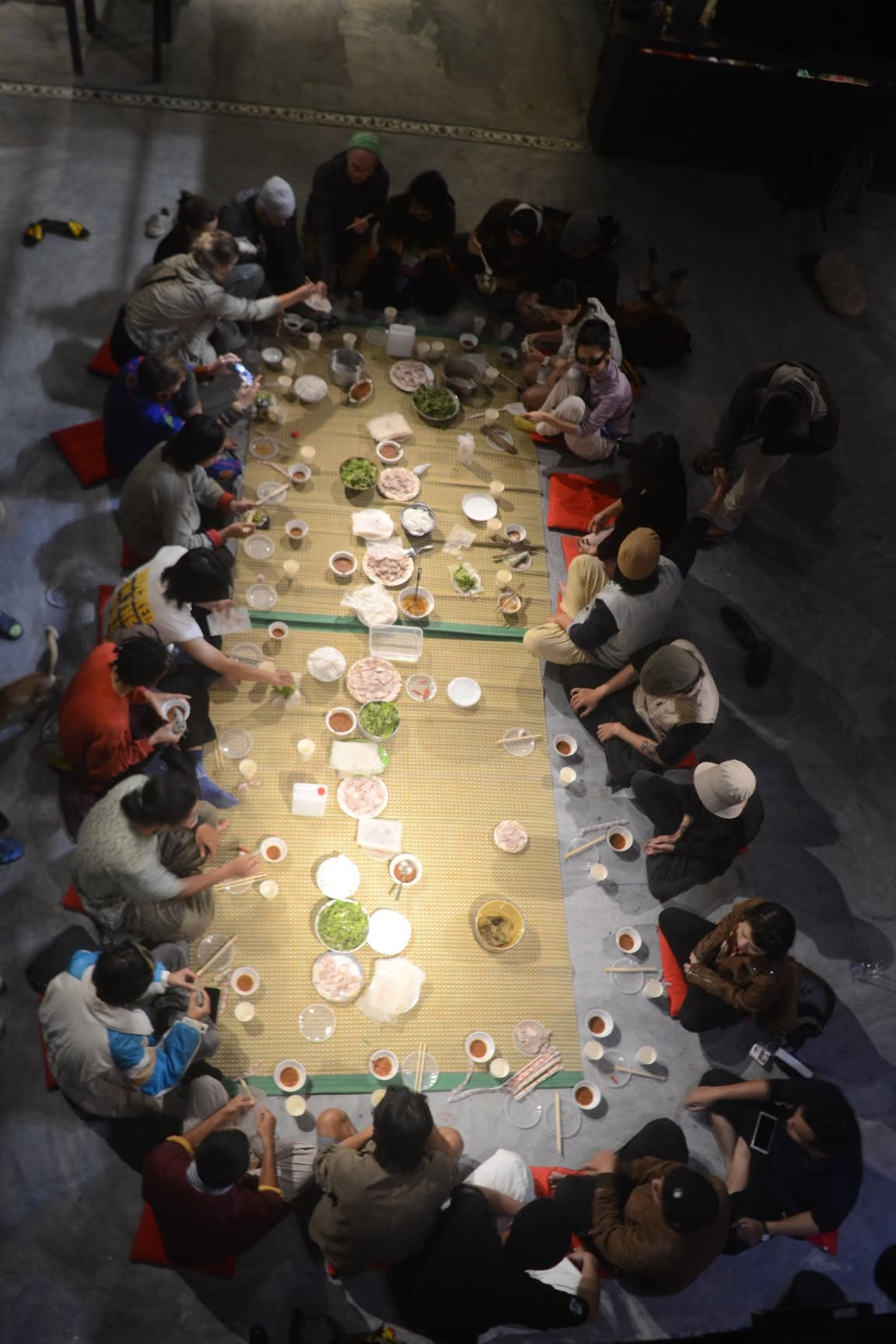
‘What can we write on rice paper?’ is a follow-up practice based on that question. This activity is a discussion session that begins with writing and drawing on rice paper based on a theme set by Xuan Ha. After writing, everyone eats the rice paper and sits together at the table. For her, this is a way to open up more intimate conversations, where people can share without being in an overly formal space that might create distance between the speaker and the listener. From a material tied to life in Central Vietnam, rice paper becomes a medium for connection: to write, to eat, and to talk together.
Furthermore, rice paper plays the role of a historical record in another work, A Ferry Man. The title was inspired by the project of Mr. Nguyen Sy Ho, who traveled across Vietnam photographing every tombstone in cemeteries to build an online archive, hoping to help families who lost contact with their loved ones find them. That story inspired her to create an artwork: a performer sits and records the names and hometowns from each tombstone onto rice paper, then eats each piece. The dissolution of the material becomes a source of continued life; the sacrifice of the previous generation transforms into silent nourishment for the generation of today.
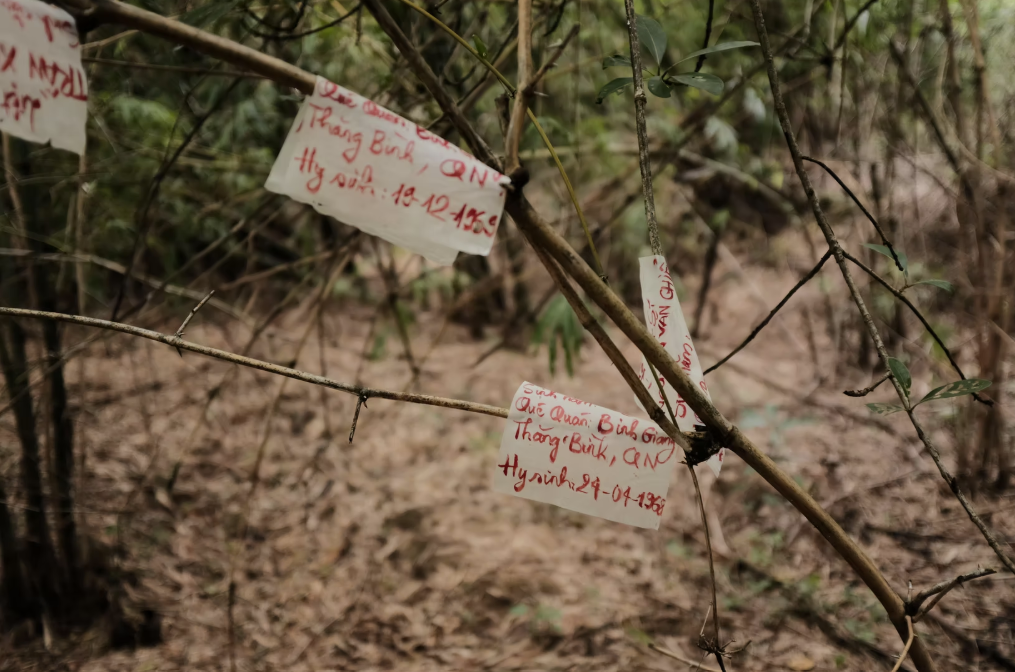
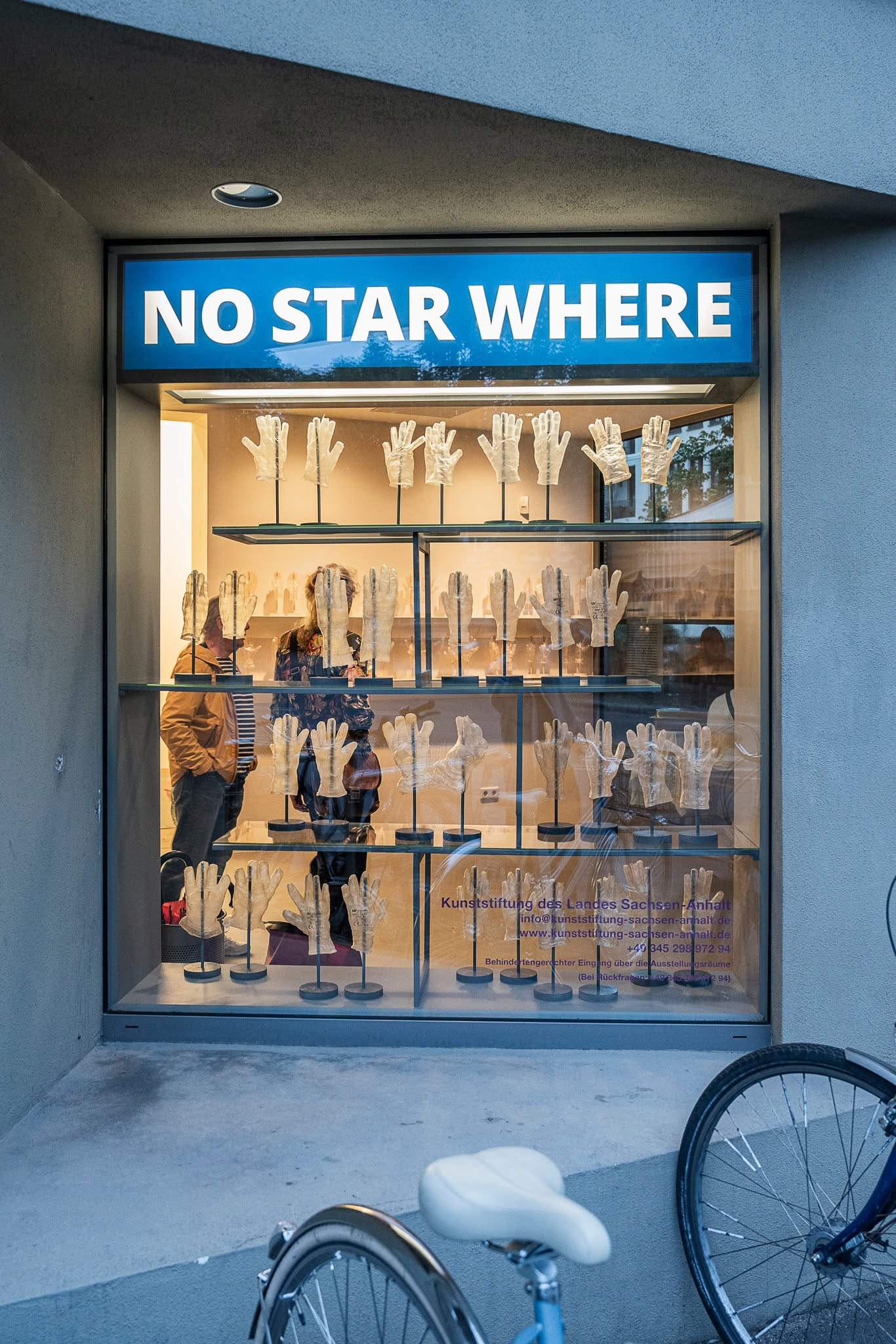
When placing the works *Handful of Sand from Afar* and *A Ferry Man* side by side, we see a common thread in her artistic practice: a focus on migration and the connection to familiar, deep-rooted values. Continuing her interest in the narrative of migration, she created the work No Star Where (2023) following a three-month residency in Germany.
There, she met Vietnamese people who had migrated to Germany long ago and chose gloves as a symbol for her work. Gloves evoke hard work and labor, while also protecting the hands of those working in a foreign land. Through her conversations, she realized that alongside stories of success, there remain challenges that the Vietnamese community must face while adapting to a new environment. The very nameNo Star Where - a play on the Vietnamese phrase "không sao đâu" (it's okay) is used as a pun to express the resilience of the Vietnamese people. The name evokes an image of the Vietnamese diaspora as being flexible and adaptable in how they navigate new circumstances. The gloves are displayed in a shop-like space, meticulously decorated as a gesture of respect for the labor of the Vietnamese living abroad.
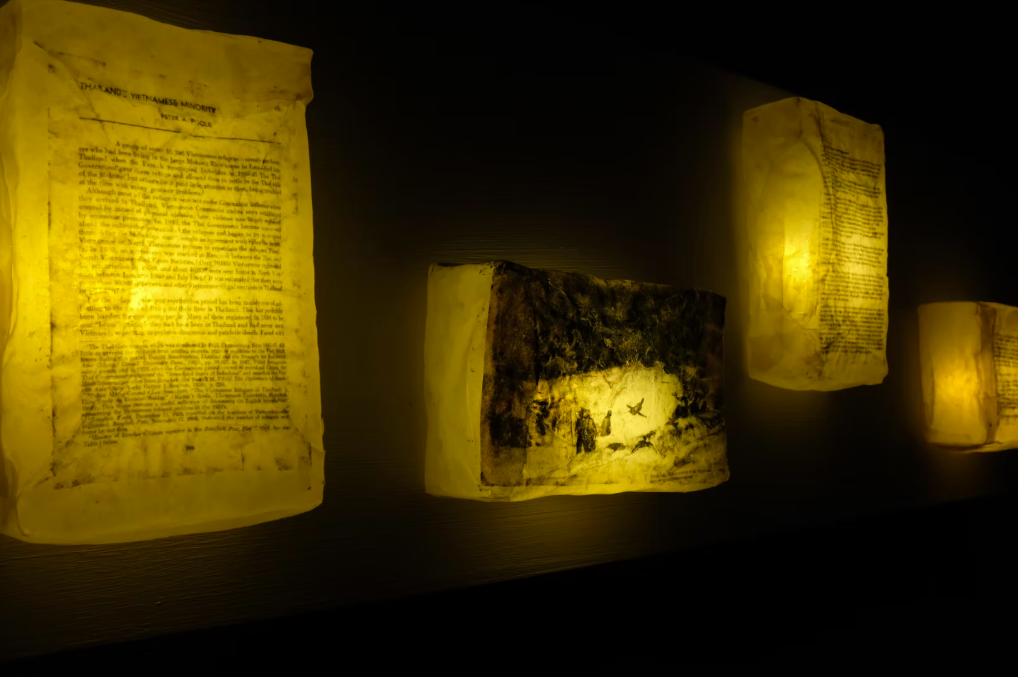
Xuan Ha continues to explore the theme of migration through the stories behind the work The Letter Y (2024). This piece shifts the focus to the Vietnamese community in neighboring Southeast Asian countries—stories that are less frequently discussed compared to those of the Vietnamese in Western Europe. The research journey began in Da Nang, traveled through Laos, crossed the Mekong, and reached Northeast Thailand. Along the way, she learned about the waves of Vietnamese migration to Thailand that began as early as the 18th century, through the upheavals of the Nguyen Dynasty and the French colonial period, up to the years of the Vietnam War. She was particularly struck by the letter "Y" that was once marked on the identification papers of Vietnamese people in Thailand during a specific historical period—a label that carried a discriminatory and disrespectful connotation. From that trace, she used rice paper as a medium to print images of these migratory journeys, transforming a staple of daily life into a vessel for preserving a historical narrative.
When sharing her perspective on "resistance" in artistic practice, Ha believes that "resistance is the act of love," rather than a term with negative connotations. Resistance does not necessarily mean being "against" something. Resistance begins with asking questions, challenging what is taken for granted, engaging in critical debate, and then taking real action.
This spirit also permeates her artistic practice.
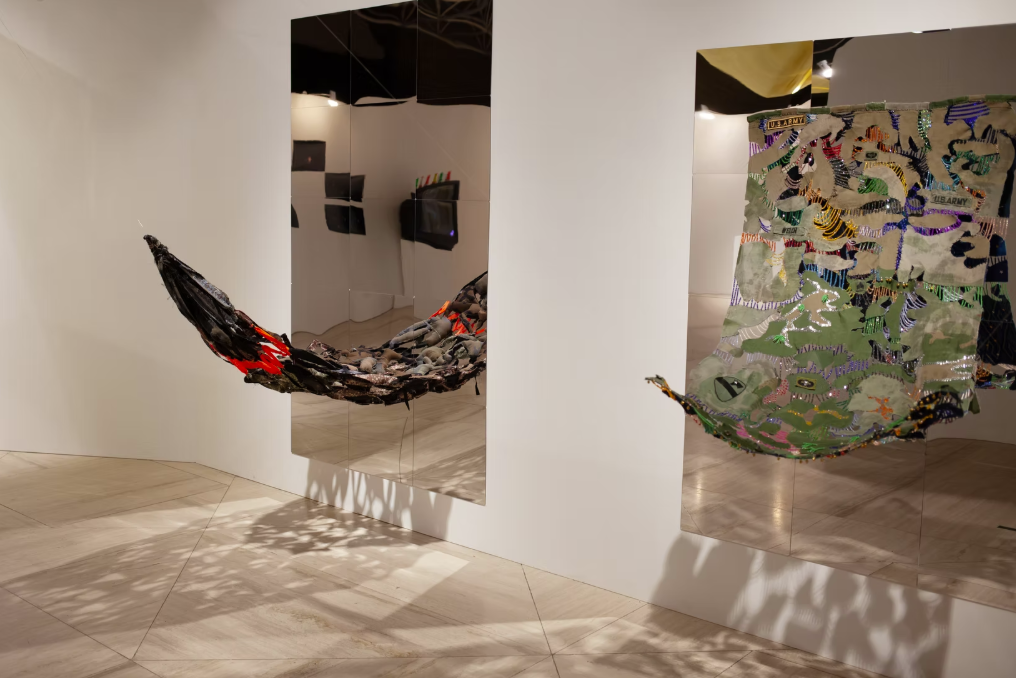
Stemming from questions and inquiries about migration history, material memory, and forgotten historical narratives, she delved into the "hootchie"—a type of shelter used during wartime to protect soldiers and conceal them under tree cover. While researching the camouflage patterns on these military uniforms, she discovered a fascinating detail: the ERDL pattern, a design created by the Engineer Research and Development Laboratory in 1948. It was first used during the Vietnam War and subsequently refined and utilized in other conflicts. Researchers had to study the tropical forests of Southeast Asia, including those in Vietnam, to create the appropriate colors for the camouflage.
From there, she deconstructed the military uniforms, separating the four colors that compose the pattern to strip away its original function. “This intervention reimagines camouflage—no longer as a tool for concealment, but as a method to reveal the stories hidden within the material itself…” Using old military uniforms from American soldiers during the war, she invites the audience to reflect on history and war through the work Who once lay down here? (2025).
Building on that work, she is currently researching monoculture forests in Vietnam, posing the question: how is the forest's color palette shifting, and what color would a camouflage uniform designed today take on?
Xuan Ha’s practice reveals an artistic style rooted in materials and objects deeply familiar to everyday life, which then unfold into broader narratives about history, migration, memory, and identity. White sand, rice paper, gloves, or traces on documents are not chosen merely for their aesthetic qualities, but because they carry a social history and a human connection. Through these accessible materials and the layers of meaning behind each work, she aims to bring art closer to life and people, rather than creating a distance between the artwork and the viewer.
Xuan Ha shares that at a certain point, she felt the need to build an art practice community to exchange ideas and learn from one another. At that time, she felt the art scene in Da Nang specifically, and the Central region in general, lacked broad access to contemporary art, while the city also lacked spaces or specialized training programs in this field.
At the same time, witnessing the social transitions taking place in her hometown, she also wanted to encourage young people to observe their living environment more closely and question what is happening around them.
Consequently, alongside her individual practice, Ha co-founded A Song in Da Nang in 2019. Back then, A Song operated as an art "club" to be more accessible to the public, rather than using the potentially ambiguous term "collective." It wasn't until early 2023 that A Song formed a full-fledged collective, and members began to think and collaborate more deeply on projects. A Song is now an interdisciplinary collective of six members with diverse practices in visual arts, ranging from filmmaking, photography, and curating to contemporary dance performance.
The common ground for A Song members lies in the desire to practice art together at a community level, rather than stopping at individual practice. A Song aims to build multi-dimensional dialogues, raise community awareness about local social and environmental issues (grassroots practice), and support bottom-up initiatives.
To achieve these goals, A Song’s activities are quite diverse, ranging from organizing workshops, seminars, and exhibition curation to programs like CNN – Cinema Con Nha Ngheo, which introduces films by independent filmmakers; Da Nang Art Fair, which creates a space for artists in the Central region to showcase their work and connect with the public; and the community learning program The Multifaceted Forest, which began with questions about how forests west of Da Nang are gradually shifting from natural forests to acacia monocultures, and how those changes are impacting the soil, water, ecosystems, and the livelihoods of indigenous communities.
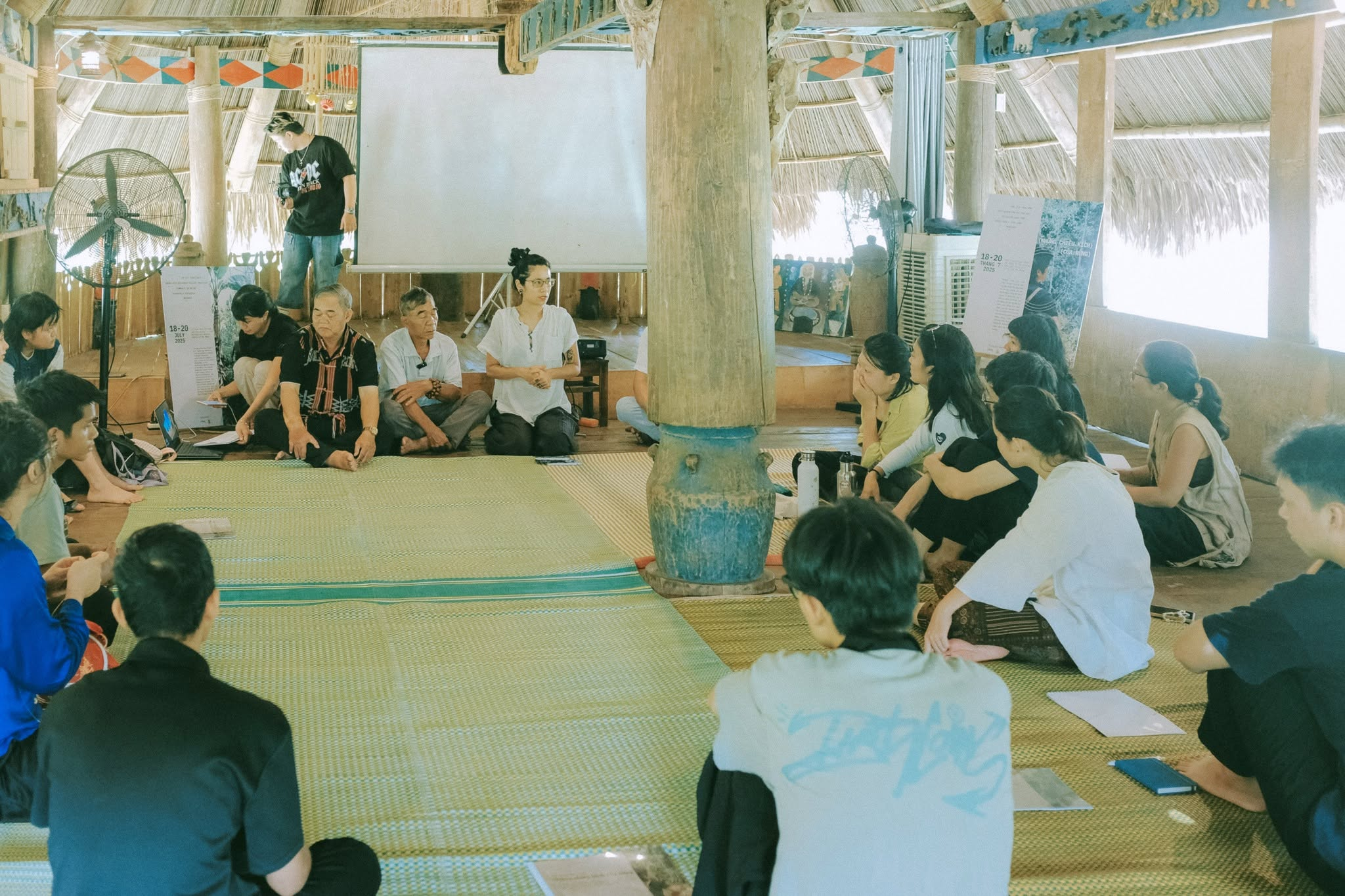
One of the questions Xuan Ha often receives is: what is the use of art for life and society?
From her own practice, Ha believes that artists and activists may care about the same issue, but their approaches and roles are not entirely the same. Activists often need to aim for specific actions and clear results. Meanwhile, artists have a different privilege: they can pose difficult questions about life without necessarily providing an immediate solution or a specific action. Art allows the artist to maintain a space of freedom to reflect, to question, and to view an issue from a different perspective.
For example, when faced with the story of a Co Tu people's primary forest being lost, an activist might ask: how can we solve the livelihood issues for the community living there? Meanwhile, an artist might ask a different question: as the forest disappears, what sounds are humans losing?
While both speak to a loss, the two questions open up different approaches. The materials created during the artistic process can also become a form of documentation for future research. A film, an artwork, or a creative process can help people at a different time look back at the social context of a past period, adding another perspective to the collective story.
We invite you to continue listening to some of the standout questions from the Q&A and more of Xuan Ha's insights in the photos below!
__
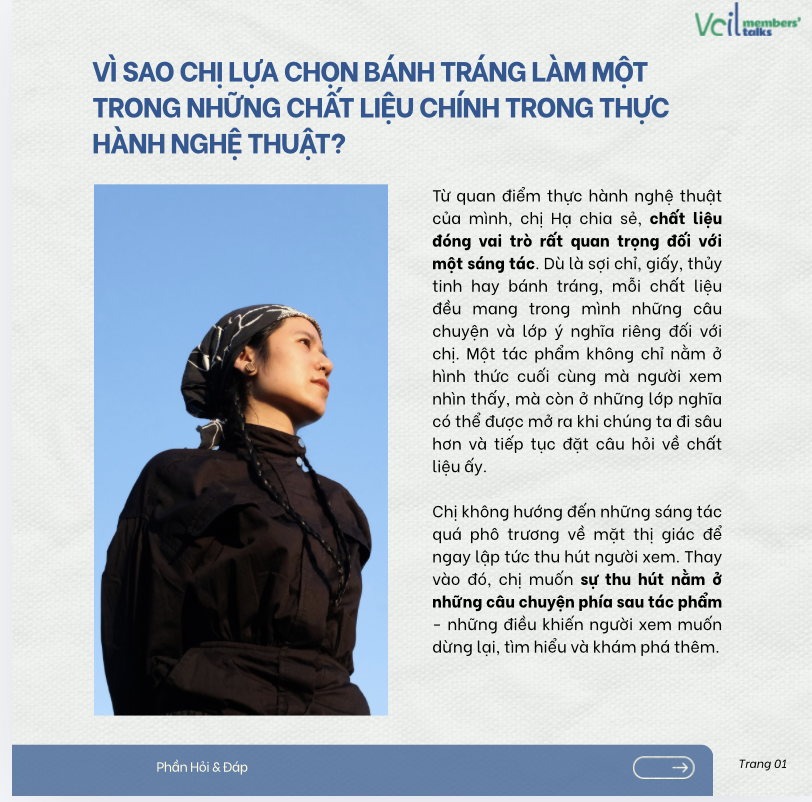
From her perspective on artistic practice, Ha shares that material plays a very important role in a composition. Whether it is thread, paper, glass, or rice paper, each material carries its own stories and layers of meaning for her. An artwork does not just lie in the final form that the viewer sees, but also in the layers of meaning that can be uncovered when we delve deeper and continue to question that material.
She does not aim for visually ostentatious works designed to grab immediate attention. Instead, she wants the appeal to lie in the stories behind the pieces—the elements that make viewers pause, reflect, and explore further.
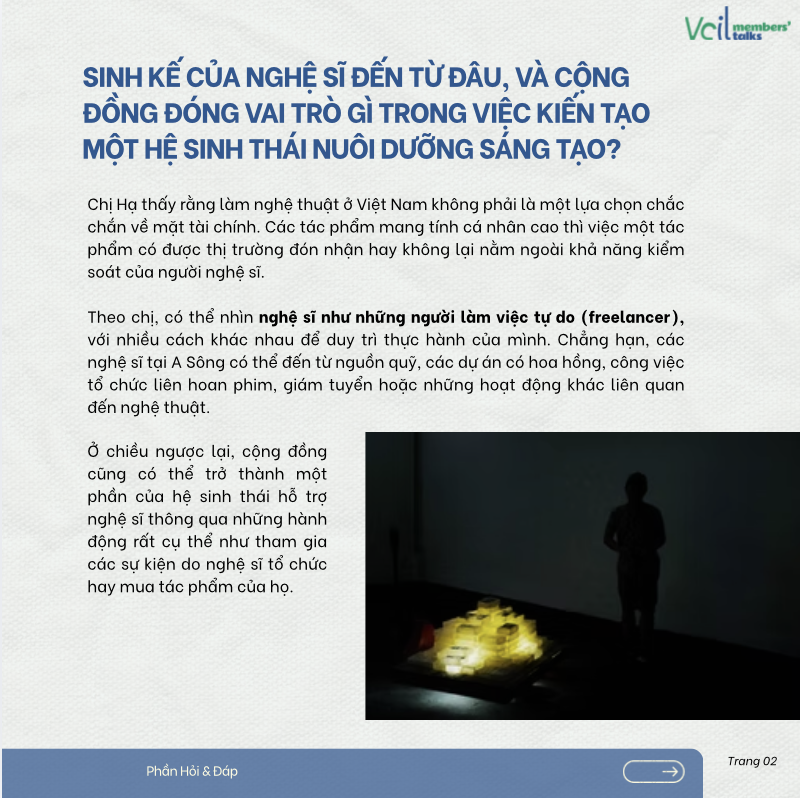
Ha finds that pursuing art in Vietnam is not a financially secure path. For highly personal works, whether or not they are embraced by the market is often beyond the artist's control. In her view, artists can be seen as freelancers who use various methods to sustain their practice. For instance, artists at A Song might rely on grants, commissioned projects, film festival organizing, curating, or other art-related activities.
Conversely, the community can also become part of the support ecosystem through very concrete actions, such as attending events organized by artists or purchasing their work.
In Ha’s view, an artist is first and foremost an observer who responds to what is happening around them. The artist does not need to stand in a position of judging an issue as right or wrong, black or white.
Social issues are often complex, with multiple causes and interconnections, and they unfold over long periods. Therefore, she believes one should not place the entire burden of a collective issue on one's own shoulders. Doing so is not only unreasonable but can sometimes create pressure that discourages artists during the creative and project-execution process.
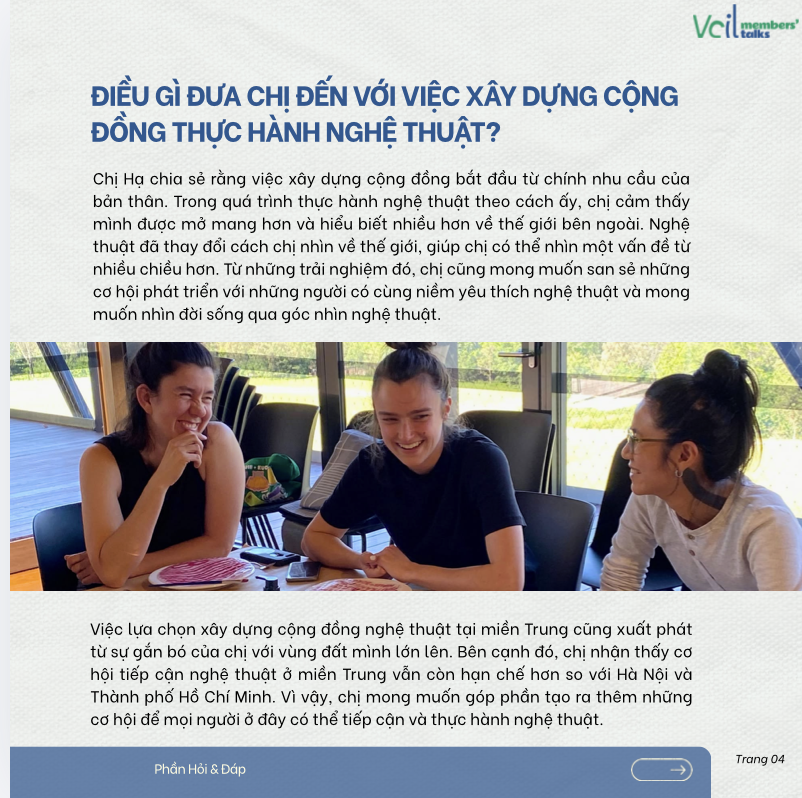
Ha shares that community building began with her own personal needs. Through this way of practicing art, she felt she became more open-minded and gained a deeper understanding of the world. Art changed her perspective, helping her view issues from multiple angles. From those experiences, she also wanted to share development opportunities with others who share a love for art and a desire to see life through an artistic lens.
The decision to build an art community in Central Vietnam also stems from her deep connection to the land where she grew up. Furthermore, she noticed that opportunities to engage with art in the Central region remain more limited compared to Hanoi and Ho Chi Minh City. Thus, she hopes to contribute to creating more opportunities for people there to access and practice art.
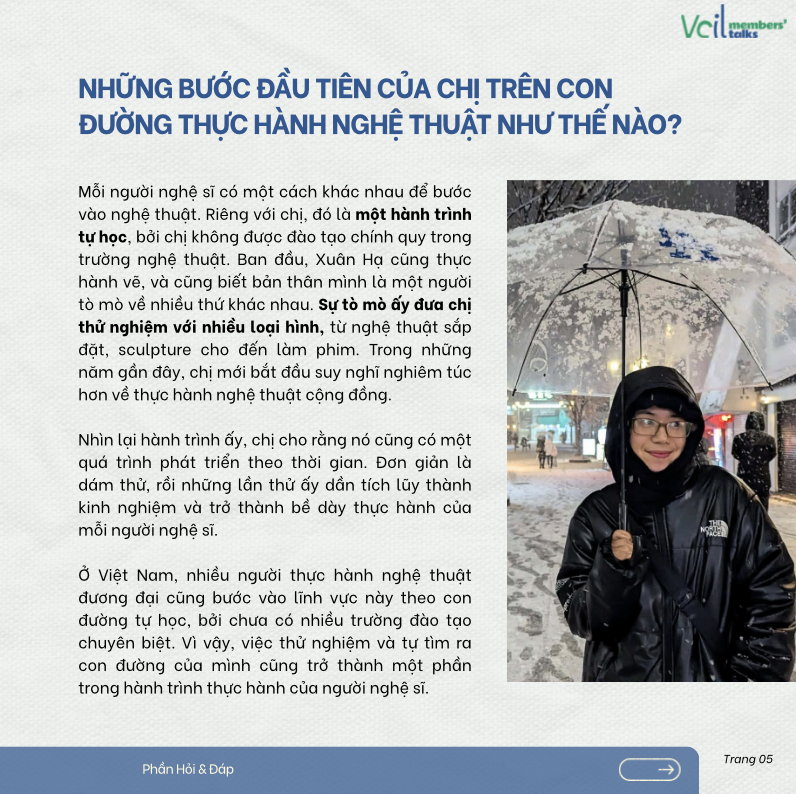
Every artist has a different way of entering the art world. For her, it was a journey of self-teaching, as she did not receive formal training in an art school. Initially, Xuan Ha practiced drawing and realized she was curious about many different things. That curiosity led her to experiment with various forms, from installation art and sculpture to filmmaking. Only in recent years has she begun to think more seriously about community-based art practice.
Looking back, she believes this journey has evolved over time. It is simply about daring to try, and those attempts gradually accumulate into experience, forming the depth of an artist's practice. In Vietnam, many contemporary artists enter the field through self-study because there are not many specialized training institutions. Therefore, experimenting and finding one's own path becomes an integral part of an artist's journey.
_______
Vcil Members' Talks is a monthly event series open to the public, where stories, initiatives, and regenerative models from the Vcil community ecosystem are shared. Vcil Members' Talks is not just a place to listen, but a space to learn together, expand networks, and foster a spirit of collaboration for a regenerative future.
Information about the Vcil Members' Talks session #13 will be announced soon on our Fanpage. You can follow our Zalo group, Substack, or Facebook page to stay updated with the latest information.
If you are interested in sustainable/regenerative production models, or in connecting with individuals, organizations, and communities that are building a flourishing and regenerative society, the Vcil Community invites you to learn more and join us Vcil Community Membership for the opportunity to live, learn, work, and collaborate with members who share the same values.
#VcilMemberTalks #VcilCommunity #CommunityDevelopment #Artcollective #Asongcollective #visualart
Nội dung đầy đủ của bài viết này chỉ dành cho Hội viên Vcil. Đăng nhập để đọc tiếp phần còn lại.