You are using the member interface.
Log out of the member interface →
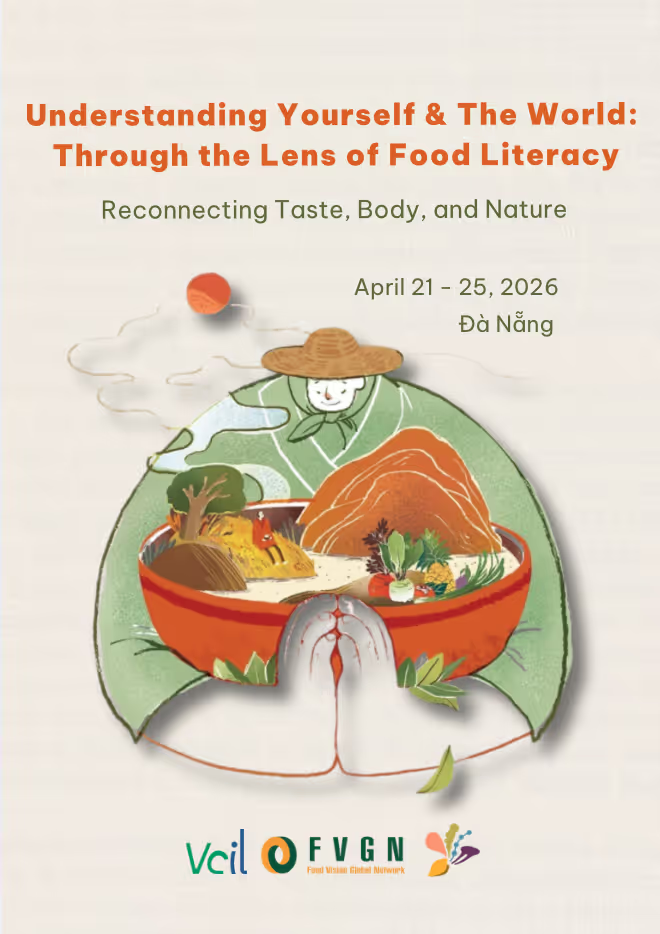
Understanding Yourself & The World: Through the Lens of Food Literacy
Reconnecting Taste, Body, and Nature
We are living in a time of overlapping crises: climate change, biodiversity loss, soil degradation, pollution, economic instability, and the fragmentation of communities. Though they appear as separate problems, they are deeply interconnected. At the center of many of these crises lies something profoundly simple and deeply human: food. Today’s industrial food system is responsible for nearly one-third of global greenhouse gas emissions, driven by monocultures reliant on chemical inputs, methane from livestock, and deforestation for farmland.
Every day, through what we eat, we participate in shaping the world around us. Food connects soil, water, ecosystems, farmers, markets, culture, and the human body. What we choose to eat does not only influence our personal health—it also shapes landscapes, economies, and the future of our planet.
Yet in the modern industrial food system, this connection has largely disappeared from our awareness. Most of us encounter food only as packaged products on supermarket shelves, far removed from the soil that nourished it, the farmers who grew it, and the ecosystems that made it possible. Eating has gradually become a routine act rather than a conscious relationship with life.
The Food Literacy & Sensory Education Program invites participants to rediscover this relationship—beginning with the most fundamental human ability: the ability to taste.
“Tasting” is more than a sensory pleasure. It is one of the oldest forms of human intelligence. The scientific name of our species, Homo sapiens, derives from the Latin verb sapere, which carries two meanings at once: “to taste” and “to be wise.”
This linguistic root reminds us that understanding the world does not come from intellect alone. It also emerges from our capacity to sense, experience, and feel the subtle qualities of life.
From early human evolution, taste helped our ancestors distinguish nourishment from danger. The discovery of fire, the transformation of raw ingredients through cooking, and the exploration of flavors shaped cultures, communities, and even the development of the human brain.
To become a good taster is therefore not merely about appreciating delicious food. It is about restoring a deeper sensitivity—one that allows us to recognize the authenticity of food, reconnect with nature, and rediscover the stories hidden within every ingredient.
True flavor is never created by factories. It begins in living ecosystems.
The richness of taste reflects the vitality of soil, the diversity of plants and microorganisms, the purity of water, and the care of the people who grow and prepare food. When agriculture works in harmony with nature—when soil is alive, crops grow in balance with their environment, and animals are raised with respect for natural rhythms—food develops complexity, depth, and nutritional richness.
The celebrated French chef Alain Ducasse once wrote:
“Before cooking, I never forget there is nature; real taste comes from clean nature.”
In this way, taste becomes a language through which nature speaks to us. When ecosystems are degraded by chemical-intensive farming, monocultures, and pollution, food loses both its vitality and its flavor. Poor soil leads to poor taste—and ultimately to poorer health for both people and the planet.
Learning to taste attentively is therefore also a way of learning to listen to nature.
Food is the most intimate bridge between our bodies and the natural world. Every meal is a biological conversation between ecosystems outside us and the living systems within us.
Inside the human digestive system lives a vast microbial community—our gut microbiome—an ecosystem that influences metabolism, immunity, and even mental wellbeing. What we eat shapes this inner ecology.
When diets become dominated by highly processed foods grown in depleted soils, our bodies gradually lose the diversity of nutrients needed for resilience and health. This imbalance contributes to the growing prevalence of chronic diseases such as diabetes, cardiovascular disease, and metabolic disorders.
Understanding food therefore means understanding how our bodies are ecological systems deeply intertwined with the food systems around us. Through this journey, we begin to awaken our unique senses and gradually discover ways of living in balance with nature—breathing together with the natural world as part of a living ecosystem.
The "Understanding Yourself & The World: Through the Lens of Food Literacy" is a Food Literacy & Sensory Education program which is designed as an experiential learning journey that reconnects participants with food through taste, knowledge, and ecological awareness.
Cultivating food literacy means understanding the full journey of food: how it is grown, how it is processed, how it is distributed, and how it becomes part of our daily lives. When we begin to see this entire web of connections, eating is no longer an unconscious act but becomes an informed and mindful choice.
From this foundation, food literacy gradually expands into food citizenship. This means that each food choice is not made solely for personal health, but also contributes to nurturing a more just and sustainable food system—one in which farmers are fairly rewarded, ecosystems are respected, and communities are cared for and strengthened.
Day 01 & 02:
Day 03:
Food culture & Eco system
Day 04 & 05:
Food literacy citizenship facilitation
Who Should Join?
This program is for anyone curious about the deeper relationships between food, health, culture, and the environment. It is especially suitable for local community leaders, educators, chefs, food entrepreneurs, sustainability practitioners, students, and conscious consumers who wish to develop a more mindful and meaningful relationship with food. No prior background is required—only curiosity and openness to learn through the senses.
1. Ms. Hyun-Sook Kim (Loto) is a “taste philosopher” and a specialist in developing culinary education programs, with many years of experience working in Japan and Korea. For more than a decade, she has conducted in-depth research on the role of taste, food, and sensory experience in education.
Loto is also an author of books on gastronomy (the study of food and culture) and serves as a team coach at the alternative university Mondragon Team Academy (MTA) in Seoul. MTA is an educational model focused on team-preneurship and learning-by-creating, where students learn entrepreneurship by starting and running real businesses as part of their learning process.
2.Butground is a sustainable food culture platform that promotes conscious food consumption and restores the connections between fields, tables, and people. Through education, community programs, and eco-gastronomy field trips, we create meaningful first experiences of regenerative eating. We also design diverse food culture projects that transform everyday meals into shared and connected experiences.
April 21 - 25, 2026, Da Nang
Sliding scale from 0 vnd to 10,400,000 vnd (for membership)
- Fanpage: Vcil Community
- Email: vcil.group@gmail.com
- Phone/Zalo/Whatsapp: 0918580257 (Trinh)

Hyun-Sook Kim (Loto) is a “taste philosopher” and a specialist in developing food-education programmes, with long experience working in Japan and Korea. For more than a decade she has researched the role of taste, food and sensory experience in education. Loto is also the author of a book on gastronomy and a team coach at Mondragon Team Academy (MTA), an alternative university in Seoul. MTA is an education model centred on teampreneurship and learning-by-creating, where students learn entrepreneurship by founding and running businesses as part of their studies.