You are using the member interface.
Log out of the member interface →

Money is an important topic that everyone cares about. Even children in primary school already sense how much money matters. So what to study to get a good job, and what to do to earn more money, become the compass for many of life's decisions for many people.
Yet our lives are colourful and multi-dimensional. We do not live only to earn money; we also have interests and passions to nurture, relationships to care for, and contributions to make towards a better society. That is why work-life balance is something many people dream of, and still find very hard to achieve. Spaces and opportunities to talk about life, work and money are therefore a very real and essential need.
Even so, we badly lack spaces that are open, safe and inclusive enough for quality, in-depth conversations about money and finance, or that offer finance and personal-finance training of sufficient quality. This directly affects the overall well-being of society and the sustainability of the economy as a whole.
As a result, in Vietnam, individuals in general and young people in particular face real challenges in managing their finances effectively, leading to uncontrolled spending, mounting debt and insufficient savings. A survey by the State Bank of Vietnam shows that the financial literacy of Vietnamese students is generally low, and many cannot save or manage money effectively. Vietnam ranked 26th out of 28 countries in the OECD financial literacy survey. The lack of focused research on the financial literacy of young people, who are especially vulnerable as they begin to manage their own finances, is worrying. [1]
We believe this is not the fault of individuals but of the education system: finance education revolves mainly around public finance or corporate financial management, fields that serve management at the macro or corporate level rather than helping a real person manage their own life. In other words, learning that builds the foundational knowledge for a happy life is still sorely lacking.

Given this reality, each of us needs to take responsibility for educating ourselves, and for educating others, about personal finance, instead of passively waiting for guidance from outside. Personal finance, however, is not a simple topic for many people. Many have told Vcil Community that they feel confused and overwhelmed when they start their own personal-finance self-education journey, facing a vast sea of information that is often fragmented and disconnected; not to mention that work and daily life take up most of their time and attention, leaving little room for something as “dry” as personal finance.
Understanding this, and recognising how urgent and important personal finance is, Vcil Community is running the learning programme “Money IQ - Money EQ: Personal finance for well-being and regeneration” to create a healthy learning space and to offer a systematic approach to personal finance. The goal is not only to provide technical knowledge, but also to share systemic ways of thinking, to understand the nature of money and finance, and to build a healthy relationship with money; ultimately so that each person feels more confident on their journey to nurture their own happiness. And, more importantly, to make the language of finance and economics accessible, so that it becomes a common language for the great majority of people.

People rarely have a direct relationship with money. What they really have is a relationship with their “story about money”. Money is only a tool, a technology for storing and exchanging value. But the way we earn, spend, save, invest, give away or worry about money is decided by the beliefs, emotions and experiences we have accumulated.
In financial psychology these unconscious beliefs are called Money Scripts [2]. The term describes how a person's financial behaviour is shaped not primarily by financial knowledge, but by “scripts” about money formed very early, often before we are old enough to understand what money is. Someone may believe that “rich people are all greedy”, “earning a lot of money will cost you your friends”, “I don't deserve to have much money”, or the opposite, “spending money is how you show you've made it”. These beliefs are usually not chosen consciously; they come from family, school, culture and early life experiences. They are what quietly drive our financial decisions as adults.
Understanding the different money scripts is the crucial first step in reshaping our relationship with money, because it is these images and assumptions about money that determine our financial behaviour and attitudes, not financial knowledge. We call this emotional intelligence about money: Money EQ.
In any economy, individuals, households, businesses and the state are key actors that interact with one another. A change in one factor can affect the functioning of the whole system. Personal finance therefore cannot be separated from the macro movements of the economy.
A basic understanding of how the banking system, stock markets, insurance and the macro-economy work is thus very useful for individuals to anticipate, prepare, build reserves and make effective financial decisions. We can decide and own our micro-decisions every day, but we cannot control macro shifts.
Changes in bank interest rates affect the cost of a mortgage and the return on savings. Inflation erodes the purchasing power of money over time. Exchange-rate movements affect the price of imported goods and the cost of travel and study abroad. Changes in the labour market make some professions short of workers while others are replaced by technology. Tax policy, social insurance and urban planning all affect the finances of every family.
Money IQ - Money EQ will therefore provide a shared, systemic understanding, so that each person has an overall and connected picture of today's economy and financial system, an important foundation for making suitable financial plans and taking action.
Vcil Community sees personal finance not only as the ability to manage money, but also as the ability to understand the system within which money operates. Besides learning to use the financial tools of the modern economy effectively, we will look back at the foundational assumptions of today's economic system and recognise its limits in the face of problems such as inequality, ecological crisis and declining quality of life.
With nearly 10 years of researching economic systems and accompanying a network of new-economy initiatives around the world, plus more than 3 years of directly experimenting with community economic models within our membership ecosystem, the programme will open up other possibilities for a new economy that is already being realised in the world and within the Vcil Community ecosystem itself.
We want to explore with you the models that are genuinely operating right now, around the world and within the Vcil Community ecosystem. Here are some typical examples:
- The Economy for the Common Good (ECG): a global movement that measures businesses and individuals by their contribution to human dignity, solidarity, ecological sustainability, transparency and co-determination
- Kate Raworth's Doughnut Economics, which holds that the economy must operate within planetary boundaries
- Thailand's Sufficiency Economy philosophy, based on moderation, self-reliance and immunity/resilience to external shocks.
- Ethical banks, community banks and credit cooperatives: Triodos Bank, the Hansalim and iCoop consumer cooperatives in South Korea, large-scale community/cooperative economy models.
- Impact investing, slow investing and socially responsible investing: alternatives to the traditional stock market that aim to contribute to ethical, regenerative and socially impactful economic practices
- The gift economy and community finance: experiments initiated by Vcil Community through the Vcil ecosystem: the Lúa community resource-exchange system, the Gift Bank, the Pay-it-Forward Fund, the Offers & Needs Market, the Consumer Club, and more.
With this new content, Vcil Community hopes we can co-create a kinder, more generous, cooperative and regenerative economy, one that is already becoming reality, where true wealth is counted in meaningful relationships, in people and businesses that contribute to society, and in real assets such as land, rivers and forests.
Who are we in our relationship with money?
Everyone has their own money story. The way we earn, spend, save or invest comes, to a greater or lesser extent, from experiences, beliefs and emotions formed very early in our family and environment.
The first session helps each person look back on their own journey with money through early memories, in order to recognise the unconscious beliefs (Money Scripts) that drive their current financial decisions. The programme also introduces an overview of personal finance, the six pillars of personal finance (income, spending, saving, protection, borrowing and investing), the model of levels of financial freedom, and the two kinds of capital that make up a person's wealth: Human Capital and Financial Capital.
How can you see your whole financial picture?
One reason many people always feel short of money is that they have never seen their overall financial situation. This session guides each person in building a “personal financial map” through a balance sheet of assets, an income-and-expenses statement and financial tracking tools.
From there, participants learn to set short-, medium- and long-term financial goals using the SMART method, and get to know the concept of the Asset Pyramid as a guide for building a solid financial foundation over time.
Where does money come from, and where is it going?
Managing money is not just about saving more; first of all it is about understanding your own cash flow. This session explores the different sources of income through the Cashflow Quadrant model, the mindsets of employees, the self-employed, business owners and investors, and introduces basic principles of tax and how to build multiple income streams.
On the other side, we look at the unconscious drivers behind spending behaviour. Why do some people shop when stressed, lonely or celebrating? What creates the loop between the compulsive spender and the obsessive saver? Through the concepts of “Happy Money” and “Unhappy Money”, participants practise distinguishing needs, wants and the spending that truly reflects their values.
What happens if the worst comes to pass?
Life always holds unforeseeable events. A good financial plan not only helps us grow our assets but also protects what we already have.
This session introduces the common financial risks in life, how life insurance, health insurance, social insurance and property insurance work, and how to determine the level of protection that suits each person's circumstances.
More importantly, this is also a session about emotions. We explore why people tend to avoid preparing for illness, accidents or death; the link between anxiety, control and the feeling of safety; and we practise gratitude and sufficiency as a foundation for reducing financial decisions driven by fear.
How is money created in the banking system?
Behind every loan, every savings account and every credit-card swipe lies a complex financial system that most of us were never taught.
This session helps participants understand how banks work, how money is created through credit, the role of the central bank, personal credit, simple and compound interest, credit scores and how to use credit cards strategically.
The programme then widens to community finance and alternative banking models practised around the world, such as Triodos Bank, Beneficial State Bank, credit cooperatives, Hansalim, iCOOP… as well as Vcil Community's own experiments such as the Gift Bank, the Pay-it-Forward Fund and the Lúa system. Through a community-currency design activity, participants imagine financial systems that can be built on cooperation, trust and the common good.
How do we make money work for us, and what should it work for?
Investing is not simply chasing the highest return. It is also how we choose what deserves to be nurtured in the future.
This session introduces the basic asset classes such as cash, bonds, stocks, real estate, businesses and investing in yourself; the principles of asset allocation, risk management and building a long-term portfolio suited to each level of risk tolerance.
Participants also learn about the stock market, index funds and the limitations of the stock market, leading into alternative investment approaches and philosophies such as Slow Investing and investing in the real economy, as a balanced approach between return, values and social impact.
Why can personal finance not be separated from the economy?
Every individual's financial decisions take place within a much larger economic system. Understanding the system helps us make wiser choices and feel less powerless in the face of social change.
This session introduces the characteristics of the modern capitalist economy, the process of financialisation, the role of banks, capital markets and insurance; and looks at the limits of indicators such as GDP, the problem of inequality, infinite growth on a finite planet, and their effects on human life and ecosystems.
Are we working to live, or living to work?
Money is not only about how we consume; it is also tightly bound up with how we make a living.
This session introduces Vicki Robin's concept of “life energy” to calculate the real value of each hour of work, and explores impact-oriented enterprise models such as post-growth entrepreneurship (PGE), cooperatives, employee-owned companies and the Economy for the Common Good.
Through the concepts of Alivelihood and Deadlihood, participants get the chance to look at their current work, locate themselves on the Alivelihood–Deadlihood spectrum and reflect on a life in which money is no longer the only limit on career choices.
What if the current economy is not the only option?
More and more economic experiments aimed at fairness, happiness and regeneration are emerging around the world. This session introduces models such as Doughnut Economics, the Economy for the Common Good, the Sufficiency Economy, Ethical Banking, Community Finance, Impact Investing, the Gift Economy and many other community economic initiatives that Vcil Community has had the chance to research, experience and collaborate with in many countries.
More importantly, we discuss: as an individual, a family or a small community, what changes can we begin today to help co-create a more humane and regenerative economy?
What kind of life do you want money to serve?
The final session is a chance for each participant to look back over the whole journey and connect their understanding of themselves, of money and of the system into a concrete action plan.
Each person will build their own financial life design, including financial goals, directions for developing income sources, an investment strategy, a learning plan and a commitment to practise after the course. This is not only the end of the programme, but the beginning of a healthier relationship with money and a life journey towards sufficiency, well-being and regeneration.
------
🗓 Dates: 5 days of in-person learning, 01–05/08/2026
📍 Location: Da Nang
🏠 Food and accommodation: participants arrange their own meals and lodging.
👥 Size: around 20 participants. THIS COURSE IS A TRAINING PROGRAMME RESERVED FOR MEMBERS. YOU CAN SIGN UP FOR MEMBERSHIP TO ATTEND
Money IQ – Money EQ is not a get-rich-quick course, nor a course on investing for short-term profit. The programme is designed for people who want to build a solid foundation for understanding money, understanding themselves and understanding the economic system they live in.
The programme may suit you if you are on one of these journeys:
- You have just started working or just become financially independent, and want to build a healthy financial foundation from the start rather than learning through costly mistakes.
- You have worked for many years but money still feels like constant pressure; your income has grown but your peace of mind has not, and you want to look again at the whole way you earn, spend and plan your life.
- You are changing careers, starting a business or looking for a new direction, and need a financial plan that gives you more agency and freedom to choose.
- You work in education, community development, social enterprise, sustainability or impact initiatives, and want a deeper understanding of economics and finance so that your projects can grow more sustainably.
- You are interested in new economic models, the regenerative economy, impact investing or other approaches beyond the traditional financial system, but do not know where to start.
- You simply want a healthier relationship with money: less worry, less avoidance and more confidence when making the important financial decisions in life.
The programme does not require any prior knowledge of economics or finance. All content is designed to be accessible to beginners while still deep enough for those who already have a foundation.
Above all, the programme suits people who are willing to question what they once took for granted: what money is, what wealth is, what a life of sufficiency looks like, and whether there are other ways to earn money, use money and organise the economy towards human happiness and the regeneration of nature.
Instead of a fixed price, Money IQ – Money EQ invites you to choose the contribution level that fits your circumstances.
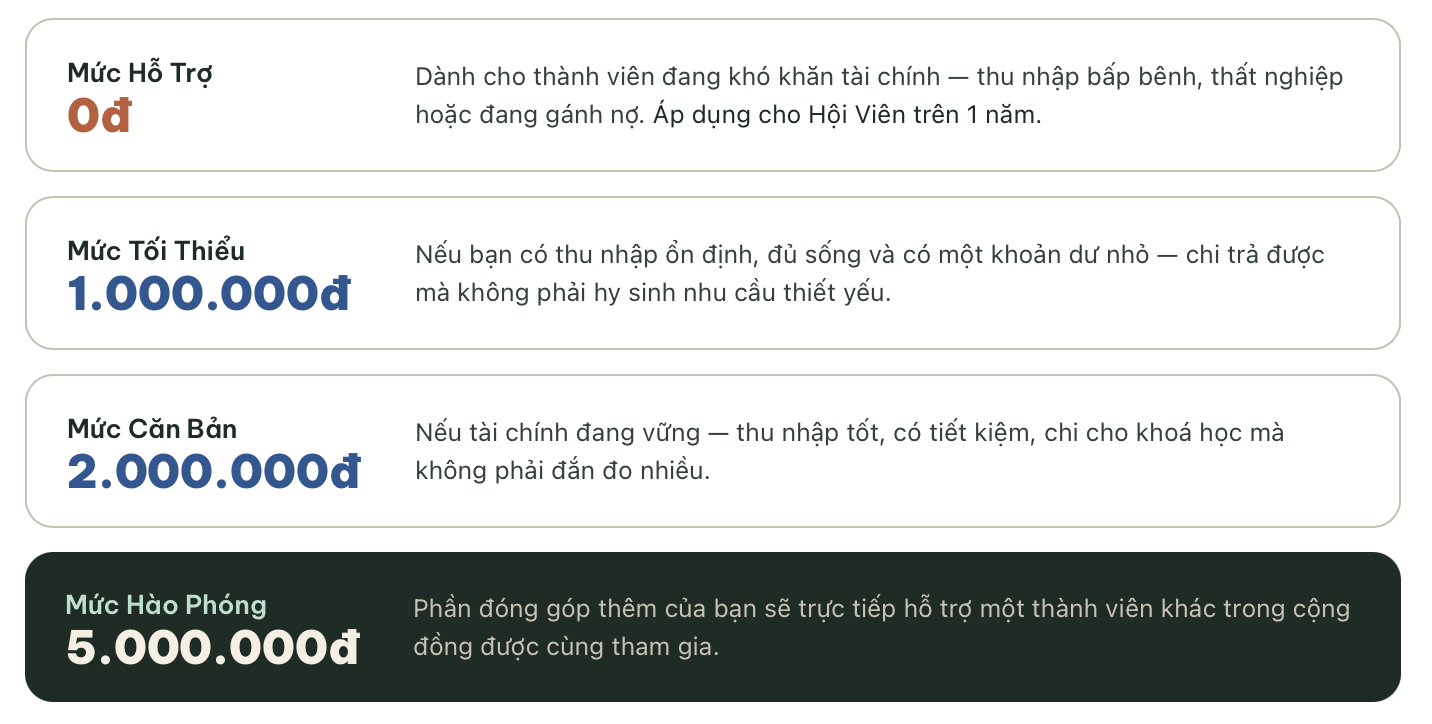
For members going through financial hardship: unstable income or not enough to cover basic needs, unemployed or between jobs, or carrying debt. If paying the basic level would mean using money meant for food, rent or the care of dependants, this level is for you.
(This option applies to Members of more than 1 year.)
For members with a stable income that covers living costs and leaves a small surplus. You can pay for the course without sacrificing essential needs.
For you if your finances are solid: good income, savings, and you can pay for the course without much hesitation.
When you choose this level, your extra contribution directly supports another community member to join.
Note: the amounts above cover only coordination, programme design, learning materials and the venue during the programme. They do NOT include food, accommodation or travel to the learning venue.
Register at: https://luma.com/p2wgs5bf
Because places are limited and fit matters, each interested person fills in a short application form so we can understand you and what you are looking for.
⏳ Registration deadline: 29/07/2026 (or until places are filled)
If you have any questions about the programme, you can reach us via:
- Facebook: Vcil Community
- WhatsApp/Phone: +84.768217586 (Vu Truong) or +84.836243541 (Huy Hoang)
- Email: vcil.group@gmail.com or Hello@vcil.education
—
Money IQ – Money EQ is a programme of the Ecoversity for New Civilization (ENC), Vcil Community's alternative university, created to foster individual and collective transformation by offering foundational courses and training programmes for understanding ourselves and the world, and practical tools for initiating and running social initiatives aligned with the principles of well-being and regeneration.