You are using the member interface.
Log out of the member interface →

 ← Bản tin
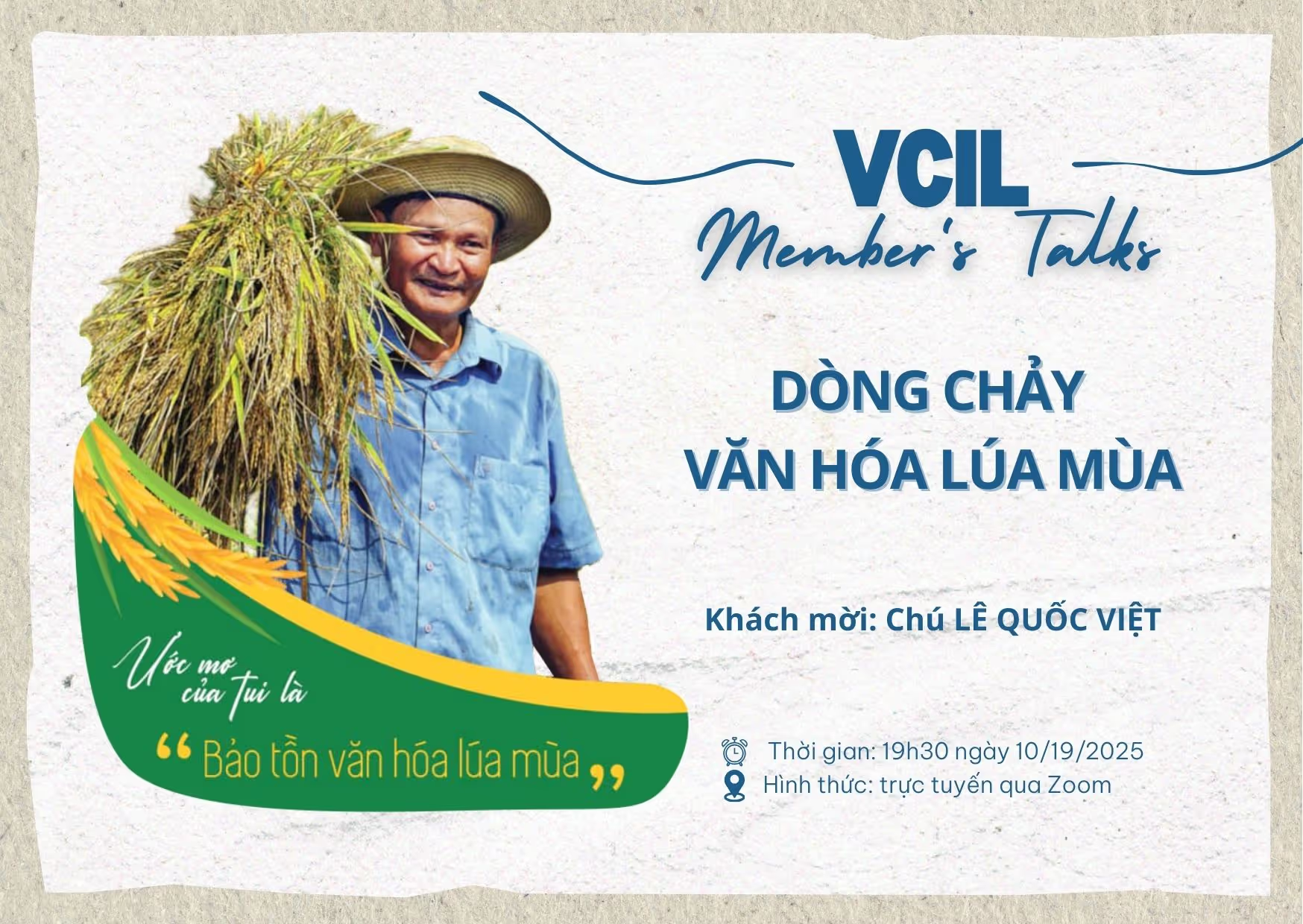
On October 25, Vcil Members' Talks #2: "The Flow of Rice Culture - Modern Agriculture's Return to Natural Farming Roots" took place successfully. With a witty and straightforward style, Uncle Tu Viet – owner of Tu Viet Autumn Rice Farm and Director of the Creative Farmers Cooperative (IFC) – shared many authentic yet profound stories about his journey preserving traditional autumn rice varieties.
In 2022, Uncle Tu collaborated with Can Tho University to grow and evaluate 850 rice varieties from IRRI. At the same time, he also worked with Dr. Nguyen Thanh Tam on a project to rejuvenate and restore 850 autumn rice varieties of the Mekong Delta collected at Can Tho University.
The conversation not only painted a comprehensive picture of natural agriculture but also planted new thoughts, connecting the speaker with participants.
The sharing began with emotional recollections about Uncle Le Quoc Viet's childhood. He recounted how he had been attached to autumn rice since age 13, officially becoming a true rice farmer at age 15 (after his father's death). Those primitive, natural memories of autumn rice became the solid "roots" in his soul.
When he turned 50, those childhood memories suddenly came alive intensely, blending with his deep love for his homeland through the melody of the song "Rural River Song":
"After half a life of wandering,
I return with my face in the rural river,
Oh river, abundant like a mother's heart,
Carrying me through the lightning and rain of the sea"
This very emotion drove him to nurture a grand aspiration: to build a space to preserve autumn rice memories – and pass on that knowledge to future generations.
After graduating as an agricultural engineer from Can Tho University and working 37 years in rural agriculture, Uncle Tu witnessed firsthand the process of intensification and multiple harvests per year (from 1 to 2-3 crops) that led to the overuse of fertilizers and pesticides. The consequence was increasingly polluted soil, water, and air, serious environmental impact, and threats to human health. All of this troubled Uncle Tu greatly.
Additionally, from the economic instability of farmers at that time, they often fell into the situation of "good harvest, bad prices." There was a time (around 2016) when rice was only 10,000 VND per 3kg.
From childhood, Uncle Tu loved reading books, especially "Chinese novels" like Romance of the Three Kingdoms and The Warring States of East and West. Later, when grown, he turned to the poetry of Nguyen Du, Nguyen Trai, and was particularly deeply influenced by Nguyen Cong Tru – who instilled in him the spirit: "Having made a name in heaven and earth, there must be something to show to mountains and rivers." It was precisely these sources of inspiration that nurtured in him a gentleman's mindset: to do something beneficial for his homeland and country.
All of this led to an "important milestone" in 2011. When visiting the Mekong Delta Rice and Grain Festival, he noticed that no province was displaying traces of ancient autumn rice culture, except for the stall at the Can Tho Development Research Institute – which still preserved a few traditional farm tools and lists of autumn rice varieties such as salt-tolerant and acid-tolerant types. At that very moment, he realized: "Ah, this is exactly what I'm looking for."
From that point on, he decided to start building a space to preserve autumn rice – because "if we don't do it now, there won't be another chance." And that was when the idea truly matured.
When he began the restoration work, Uncle Tu encountered many conflicting opinions from both family and friends. People around him thought he was "crazy" for going back from the 4.0, 5.0 era to 0.0. He didn't receive family support either, and the press said he was somewhat "presumptuous."
Alongside this stream of opposing opinion, many people supported his idea. For example, Uncle Tu – who worked at the FAO office – after visiting Uncle Tu's rice field shared: "We were once proud of a rice-water civilization thousands of years old. Now what's left but vast rice fields and the roar of Kubota engines." When people no longer plow fields with buffalo but use machines instead, the traces of rice-water civilization also disappeared. Therefore, what Uncle Tu was doing had especially important significance in preserving the thousands-of-year-old culture of his ancestors.
In 2011, Uncle Tu started building a farm to preserve autumn rice culture on his own land and began collecting traditional farm tools. This was the most difficult work – he spent a full 6 years collecting a complete set of traditional farm tools.
He joked that he had to use "special survival skills" – namely, skills developed over drinks at bars – to persuade people to give up old tools like plows, harrows, winnowers, and reapers that they kept as memories. Thanks to these "tea and wine sessions" with these "old farmers who knew the fields," Uncle Tu not only collected artifacts but also recorded countless valuable experiences and knowledge.
With characteristic humility, Uncle Tu recognized: "There's much I know, but also much I don't know." After each trip, he carried new concerns: "If farm tools are tangible culture, then what is the intangible culture of autumn rice culture?"
He began reviewing the history of the Mekong Delta, discovering that the Khmer people were the first to develop this land and bring rice-water culture into daily life. From that point, Uncle Tu decided to choose Khmer music as the intangible culture for autumn rice culture. Currently, in Uncle Tu's farm preserving autumn rice culture, alongside old farm tools, the resonant tones of many types of Khmer musical instruments – like a way to connect the present with the memories of ancestors – can be heard. In 2017, Uncle Tu and his family gathered resources and enclosed 25,000 square meters of land to build a farm preserving autumn rice culture. According to him, it was a long and challenging journey; he traveled everywhere from provinces to district capitals, research institutes to track down rice seeds that he once knew. Eventually, he obtained 6 local autumn rice varieties from the gene bank, each with only 200 seeds to start germinating again.
For Uncle Tu, autumn rice culture is not just a cultivation process, but an entire lifestyle: how people harmonize with nature, respond to weather changes, and support each other in labor. From this thinking, he taught himself to make videos to record traditional farming processes along with accompanying cultural activities – such as how Khmer people use dredges to catch fish – then shared them online, spreading local knowledge to the community.
In the development process, Uncle Tu placed biodiversity at the forefront, seeing it as the decisive factor in recreating the ancient autumn rice culture space.
Initially, this was a field he had rented out – a field that was nearly exhausted after many years of intensive cultivation, with pesticides sprayed six times per crop. Weeds and organisms were almost completely eliminated.
To restore it, he spent two full years without fertilizing or spraying, letting the soil recover on its own. When the soil began to "breathe again," he observed which weeds recovered and which had disappeared. For weeds that couldn't recover, he actively supplemented by bringing from elsewhere varieties like Dwarf Grass, Mat Grass, Centella, Morning Glory – to recreate the natural plant system.
At the same time, he bought various species of field fish to release into the paddies: catfish, striped fish, eel, yellow catfish from U Minh Thuong Forest, and even turtles and otters. According to him, only when the ecosystem becomes rich again does autumn rice culture truly revive.
For Uncle Tu, biodiversity and local seeds are two pillars of agricultural culture.
Seeds are the accumulated result of ancestors' culture and knowledge. The more local varieties planted, the deeper the cultural foundation becomes.
After just 2 years, the field transformed from barren to lush and vibrant: earthworms returned, weeds grew naturally, fish began reproducing. Particularly, the appearance of a bio-indicator fish – Striped Treble – a fish that builds complex nests – indicates that water and soil environments have stabilized. The appearance of cicadas and grasshoppers prompts Uncle Tu to raise their natural predators (ducks, geese) to maintain natural balance. Everything returned to its proper order – a field that is both an ecosystem and a culture.
Additionally, after each harvest, Uncle Tu always returns biomass to the soil – the rice stalks after harvesting. For him, preserving ancestral traditions doesn't mean clinging rigidly to the old, but knowing how to absorb and renew old values in today's context.
Therefore, Uncle Tu continually learns and explores many places to expand his knowledge. One of his most satisfying discoveries is knowledge about soil microorganisms.
He studied organic farming techniques and deeply researched soil microorganisms (bacteria, fungi). He emphasizes: "the root tip zone is the most biodiverse zone on the planet." This is where bacteria break down difficult-to-digest substances in soil so plants can absorb nutrients, through which plants develop trace elements in stems, branches, and create organic matter. Between plants and microorganisms exists close symbiosis; therefore, soil without microorganisms cannot be called organic farming.
During the sharing, Uncle Tu illustrated microscopic images of mycorrhizal fungi to participants. Under magnification, we clearly see mycorrhizal fibers are much longer than plant roots – through this, when drought comes, they extend to draw water for plants helping them withstand dry weather. Therefore, the more mycorrhizal fibers a plant has, the less drought impacts it.
From this observation, we can see that bacteria and fungi play an important role in soil. When looking at soil nutrient surveys with mycorrhiza, the nutrient composition is much richer than regular soil. Uncle Tu asked himself: "Given such a natural nutrient system already exists, why must we use chemical fertilizers?"
After completing his studies, Uncle Tu immediately applied these on his fields. He applied "Thi Linh Zero" farming technique – no-till farming to protect microorganisms, using straw to cover the soil, treating weeds as friends rather than enemies, using them to create ecosystems, protect soil, and then chop them back as organic matter. Additionally, he cultivates Azolla. According to calculations, 1 hectare of Azolla covering the field surface can produce 13 tons of green manure per cycle (equivalent to over 2 tons of dry matter), supplying large amounts of organic matter to the soil. Thanks to this, after the restoration period, his field is now teeming with organisms: field fish, white spiders, swallows, birds.
Simultaneously, Uncle Tu also applies local knowledge in seed selection. In 1900, the French recorded that Vietnam had only 500 rice varieties; by 1982, Professor Vo Tong Xuan had collected 1,988 varieties – thanks to the selection experience of ancestors. They didn't need complex techniques, just keen observation, selecting and keeping "handsome" and "beautiful" plants – firm seeds, soft rice, fragrant and delicious – to propagate for the next crop. Through these very experiences and folk knowledge, they created hundreds of new rice varieties contributing to building a diverse gene source for the nation's agriculture.
During growing and rejuvenating Mekong Delta autumn rice varieties, Uncle Tu discovered that among 850 rice varieties grown, over 200 belonged to floating rice group – rice varieties that grow in deep water conditions. The remainder were mainly deep water or upland rice (rain-fed). From there, he categorized into 3 groups with the following characteristics:
- Upland rice (rain-fed): Grown in foothill and terrace areas like Tri Ton, Tinh Bien – where water only accumulates briefly after rain, then drains quickly.
- Deep water rice: Common in Hau Giang, Kien Giang, U Minh Thuong – water rises to average waist height, suitable for low-lying, acidic soil areas.
- Floating autumn rice: Grown in the Long Xuyen Quadrilateral and Dong Thap Muoi – where water rises 1 to 2 meters annually, rice plants develop according to water level, "as water rises, rice grows accordingly."
From this diversity and flexibility, we can see the seed selection and cultivation prowess of our ancestors. They understood deeply characteristics like soil and hydrology, thus selecting rice types suitable for terrain. Without modern technology, they maintained stable yields.
Additionally, during research, he realized that among 100 floating autumn rice varieties, up to 80 produced red rice (unhulled rice with red bran). Conversely, in Can Tho-Ca Mau areas – mainly growing deep water rice – among 100 varieties only 2-4 produce red rice, like Blood Dragon, Chau Hong Vo, Doc Phuong and One Bush Red. This helped Uncle Tu explain the famous folk verse:
"Can Tho has white rice and clear water, whoever goes there won't want to leave." "White rice" refers to deep water rice producing white grain grown widely in the Can Tho region downward, "clear water" because sediment decreases as sediment from the Mekong upper reaches settles in the Long Xuyen Quadrilateral and Dong Thap Muoi low areas. A folk song turned out to be a natural-cultural-agronomic map of the entire delta region.
Moreover, Uncle Tu also explained about the Blood Dragon variety and modern consumer misconceptions. On the market, many types of red rice are sold under the name "Blood Dragon," but in fact are red rice from Cambodian upland rice varieties – ripening around late October. Meanwhile, the true Blood Dragon of the Mekong Delta is a late-maturing variety, usually harvested in late December or January. Currently, this variety is very rare, hardly cultivated widely anymore. Through this topic, Uncle Tu also successfully recovered part of the original seed source, but not yet enough to expand production.
Not stopping at research and experimentation, Uncle Tu continues to sow knowledge seeds to the community: teaching organic farming classes to local farmers, introducing autumn rice culture to students and tourists, and organizing an Annual Rice Festival every year. Here, young people personally weave mats, make brooms, forge knives, make wine, go to the fields – living fully in the ancient autumn rice culture space.
Uncle Tu's Autumn Rice Farm is now included in school textbooks, welcoming many domestic and international student groups for visits – a simple yet profound joy for him. However, he still ponders: "Organic certification costs 36-50 million VND, while small farmers like me just need to do it right and genuine." Therefore, he chose the path of "certification through action" – doing it himself, letting the fields, fish, birds, and rice seeds speak.
1. Have you ever felt discouraged or wanted to give up because of the difficulty of this farming? If so, how did you persevere and overcome it?
Uncle Tu confirms he has definitely felt discouraged and wanted to give up many times. The most difficult period was New Year's Eve (around 2021 or 2022), when he expressed his feelings on social media, jokingly calling it "autumn rice anxiety," because he was extremely tired and disappointed. Ecological farming is exhausting; he's "up the bank and down in the field" all day. Sometimes he fails because uncontrollable pests attack heavily – "bugs even get into the mosquito net." What kept him going was a combination of personal willpower and encouragement from outside sources.
Uncle Tu adopts the spirit "the older the ginger, the spicier it gets" to face difficulties. He has absolute determination and persistence based on belief: "Having made a name in heaven and earth, there must be something to show to mountains and rivers." He compares himself to "a bulldozer making a path" – moving forward, lights off, brakes off – showing determination and not letting anyone stop his chosen path.
His greatest spiritual motivation is meeting people who cherish and love his autumn rice preservation work. The affection of young people, especially seeing children cry when leaving saying "I miss Uncle Tu so much" – these moments make him think "how could I possibly quit" – it's the strongest spiritual motivation, keeping him from giving up.
2. What were the initial family difficulties when you pursued rice preservation instead of growing 3-crop rice?
Initial difficulties were mainly ideological and family agreement, centered on financial risk and differences in farming methods. His mother was kind but expressed great worry about finances and risk: "Do what you want... but don't sell land to pay debt, that's enough." His siblings complained because he "did things differently," not following conventional practices (short-term 3-crop rice) but rather "raising birds and mice." His wife strongly opposed from financial and economic efficiency perspectives. He had to continue work without his family's full agreement, using his determination and confidence in his belief to continue this path.
He recounts that in the first year, his rice was eaten 100% by rats, leaving only sprouted rice (rice that regrew from buds when plants were eaten). Despite this, there was still a rice festival for the community that year.
From that failure, he learned for the next crop: plant more diversity, many different rice varieties. Whichever variety the rats ate heavily, he joked "it must be delicious," since he hadn't yet tasted it before the rats finished it.
3. Among the challenges and difficulties you've encountered in your research and practice of autumn rice cultivation, both your model specifically and Vietnam generally, what are the biggest challenges?
The biggest challenge for his model currently is lack of resources to develop post-harvest products and optimize resources. Lack of deep processing capability and untapped potential remain issues. Despite this, he doesn't see it as a major difficulty. He believes that by doing within his capacity, not losing heart, everything will gradually open up.
This very persistent belief has become inspiration for many – those who visited the farm, listened to his stories, and saw a farmer quietly reviving autumn rice culture on his homeland.
4. How can farmers become aware of pesticide harms and move away from dependency on increased productivity? How can this truly change when many have awareness but seem reluctant?
Uncle Tu affirms that farmers are actually already aware of pesticide harms. They've witnessed those hired to spray pesticides only stay healthy 5-10 years before "breaking halfway through the road" from serious illness. Many have become aware by growing "separate vegetables, separate plots" without spraying to eat.
According to him, the barrier preventing farmers from changing isn't awareness, but livelihood, because they fear failure will directly impact family life. Therefore, to change the situation, price and market issues for products must be solved.
He also emphasizes that this transformation cannot come solely from individual farmer efforts, but requires collaboration from many sides – from government policy to community support. Most importantly, must ensure farmers can "sell products at good prices, helping them live and raise their children."
5. Why preserve and develop many rice varieties? Why restore rice varieties that have been lost?
Preserving local rice varieties is extremely important. They were formed through long natural selection processes and are the crystallization of meticulous ancestor selection through many generations. Therefore, they carry persistent vitality and superior climate change resilience compared to modern short-day hybrid varieties.
Using these local varieties as genetic sources for breeding new varieties is very necessary. Additionally, by abandoning these varieties, we also lose the countless labors, dedication, and wisdom of many generations of ancestors. Each rice variety is a living cultural material, containing emotions, memories, and stories of successive generations. Autumn rice varieties like Chau Hong Vo have extremely high nutritional content and can even be used as medicine.
6. How does autumn rice culture help people connect and respect nature?
Autumn rice culture was formed over hundreds of years in the Mekong Delta through people facing, developing, and responding to harsh nature. To adapt to nature, people developed farming methods – forming respectful attitudes toward nature. In early reclamation days, strangers supported each other, collectively opening lands, thus formed cultures of treating each other with affection and righteousness.
Uncle Tu emphasizes that culture is precious heritage needing preservation, because "only understanding the past can guide steps into the future." Without understanding ancestors' cultural history, we easily "follow trends" without firm footing in life.
7. How to ensure farmers' livelihoods?
Ensuring farmer livelihoods isn't only farmers' responsibility but entire society's. Government has responsibility for comprehensive issues of millions of households. Additionally, community and social organization mutual support is very needed: "those who know tell those who don't, those who know how to do teach those who don't." Many groups and organizations are also working on preserving local knowledge, like Vcil Community, Kulavietnam, and Mekong Organics.
8. Is autumn rice more delicious than other rice? What's the market response?
Autumn rice lives naturally for 6 months over fields, gradually absorbing essence from earth and sky to form complete rice grains. For short-day rice, this process must be rapidly accelerated, usually compressed into just 100 days for harvest. Therefore, farmers must use external stimulants like chemical fertilizers.
Autumn rice grown completely naturally retains much more essence, with rice grain quality superior. Given autumn rice's quality and nutritional value benefiting human health, plus helping preserve local knowledge, many consumers now show interest, though high production and transportation costs still make it selective in buyers and requiring more community support.
9. In Vietnam, are there other places still growing autumn rice? What about other countries?
Some places still grow autumn rice, but very few. Like Ca Mau and Bac Lieu areas have some regions still growing "One Bush Red" rice. In other countries, varieties like Thailand's sticky autumn rice or Laos varieties exist. Uncle Tu observed that in high-altitude areas, Laos, Northwest Vietnam, and Thailand autumn rice varieties are similar to each other.
10. Do all Uncle Tu's autumn rice varieties grow in 6 months or longer?
Autumn rice growing time won't be fixed at 6 months for all varieties. Among these, 6 months (around 5.5-6 months) is ideal time for rice to achieve best quality. Autumn rice plants are photoperiod-sensitive (ripening based on total accumulated sunlight), so growing time is very flexible and can change depending on sowing timing. We can categorize autumn rice varieties into 3 types by ripening time: early, mid-season, and late autumn rice.
11. If you grow one crop in 6 months, what do you do during the remaining 6 months?
The 6-month dry season is used for non-production purposes to restore land, conduct cultural activities, and rest, ensuring autumn rice culture's sustainability. Dry season is when "soil dries for straw to remain," also providing space for children to play and rest to prevent losing autumn rice's nature.
12. Currently you haven't found someone to inherit your knowledge. How do you think about this if a time comes when no one inherits or your health isn't sufficient?
Uncle Tu recognizes this as a "difficult problem" but believes it's not impossible to solve. He sees the FAO's quest to build "Living Agricultural Museums" as a major opportunity. Additionally, he finds much joy from community support. These moments of genuine goodwill from people who don't seek fame bring him joy and encouragement.
The sharing brought much reflection to participants. Many expressed deep appreciation for his work and commitment to preserving Vietnamese agricultural heritage, recognizing the tremendous value it brings to culture and society.
Vcil Members' Talks is a series of monthly public events where stories, initiatives, and models of regeneration from the ecosystem of Vcil Community members are shared. Vcil Members' Talks isn't just a place to listen, but a space to learn together, expand networks, and nurture the spirit of cooperation for a regenerative future.
If interested in Uncle Tu's products, visit his website at Tuluamua.net for more information. Uncle Tu is one of Vcil Consumers Club suppliers – a model connecting farmers directly with consumers, aiming toward sustainable and fair economics.
Vcil also plans Field Trip programs in coming years for members to directly visit clean production sites like salt, rice, fish sauce, and coffee.
If interested in sustainable/regenerative production models, Vcil Community invites everyone to join Vcil Community Membership to connect with members sharing the same values.
#VcilMemberTalks #VcilCommunity #SustainableDevelopment #RiceCulture #NaturalFarming #EcologicalAgriculture #RightLivelihood #CommunityCreativeFarmers

Vcil Members' Talks are a series of public sharing event