Butground and the journey of building an alivelihood that drives change in lifestyles and the food chain
Topic Du lịch học tập
A story of pursuing sustainable values and rebuilding the relationship between people and the food system in modern life!
On this pageOn this page (7 sections)
THE CONNECTING TABLE - BRINGING PEOPLE BACK TO ONE ANOTHER AND TO FOOD
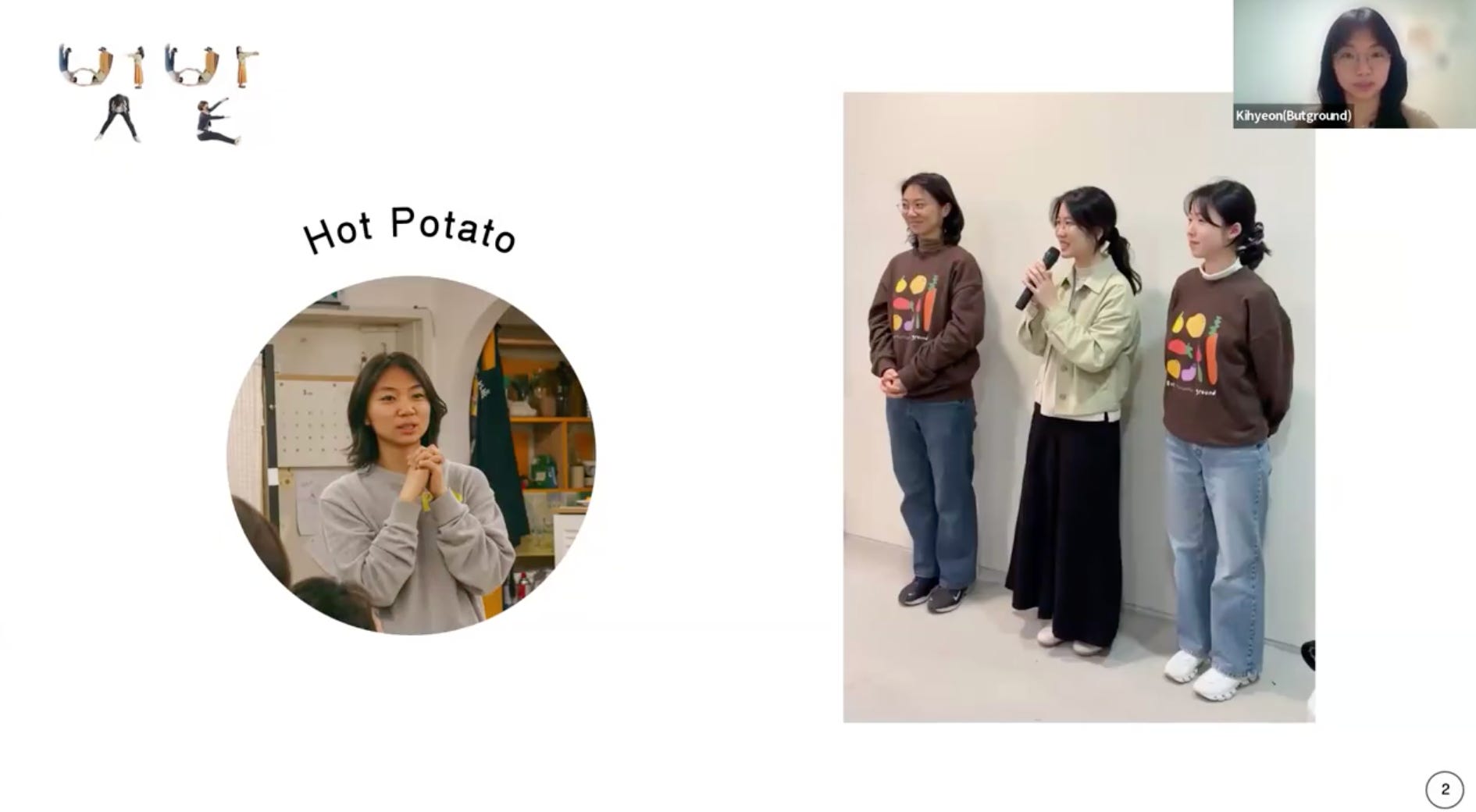
On the evening of 30/3, Vcil Members' Talks #7: The journey of building an alivelihood that drives change in Korea's food chain took place with two guests, Kihyeon & Gayoung, members of the Vcil Community and founders of Butground, a social enterprise that promotes conscious food consumption and restores the connection between farm, table and people.
The talk was a journey from personal concerns about lifestyle, eating and connection with food, through collisions with the reality of the urban food system, to the way Butground gradually took shape as a space that connects people through meals. Through experiments, failures and more experiments, Butground's story does not stop at food; it opens up a deeper approach to living consciously and reconnecting with others and with the environment around us.
Above all, it is the journey of building a meaningful alivelihood with social impact, helping to address the problems of today.
“HOW CAN A MEAL HELP PEOPLE RECONNECT WITH ONE ANOTHER, AND WITH NATURE?”
Since high school, Kihyeon has kept a diary. Those notebooks became a friend that witnessed the maturing of Kihyeon's thinking. Leafing through them, Kihyeon had asked existential questions such as:
“How should I live?
What is the purpose of going to university?
What does a happy life look like?”
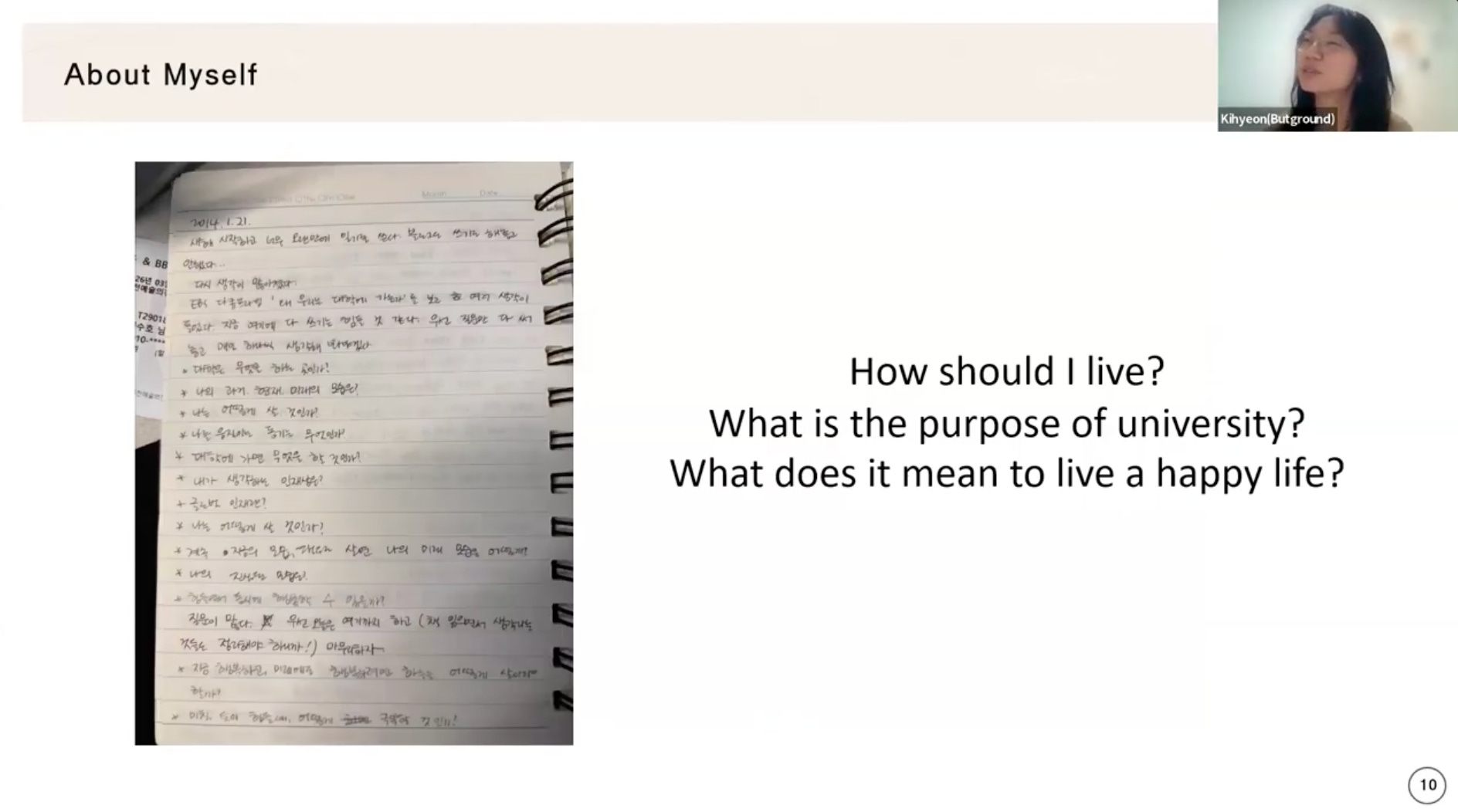
These questions came into focus around 2014, a period in which Kihyeon felt many voices pulling in different directions inside. On one side were dreams of an alternative lifestyle outside the rat race (a life that revolves around power and money); on the other, the pressure of society's well-worn paths: get into a prestigious university, have a stable career, live within a pre-drawn frame.
To understand why the second voice, society's, was so strong, Kihyeon shared more about the context of growing up. Kihyeon's parents lived through the 1997 Asian financial crisis, a major upheaval that cost many families their stability in a very short time. That experience left them with an ingrained fear, and a desire to build a life as safe and secure for the future as possible. That belief, combined with the rise of materialism and the new standards of a developed country, deeply shaped how they defined safety, success and happiness. Success was measured by grades, by the name of your school, by how stable your job was. Growing up in that context, Kihyeon absorbed these standards as self-evident, until the gap between ideals and the reality of life grew too large to ignore.
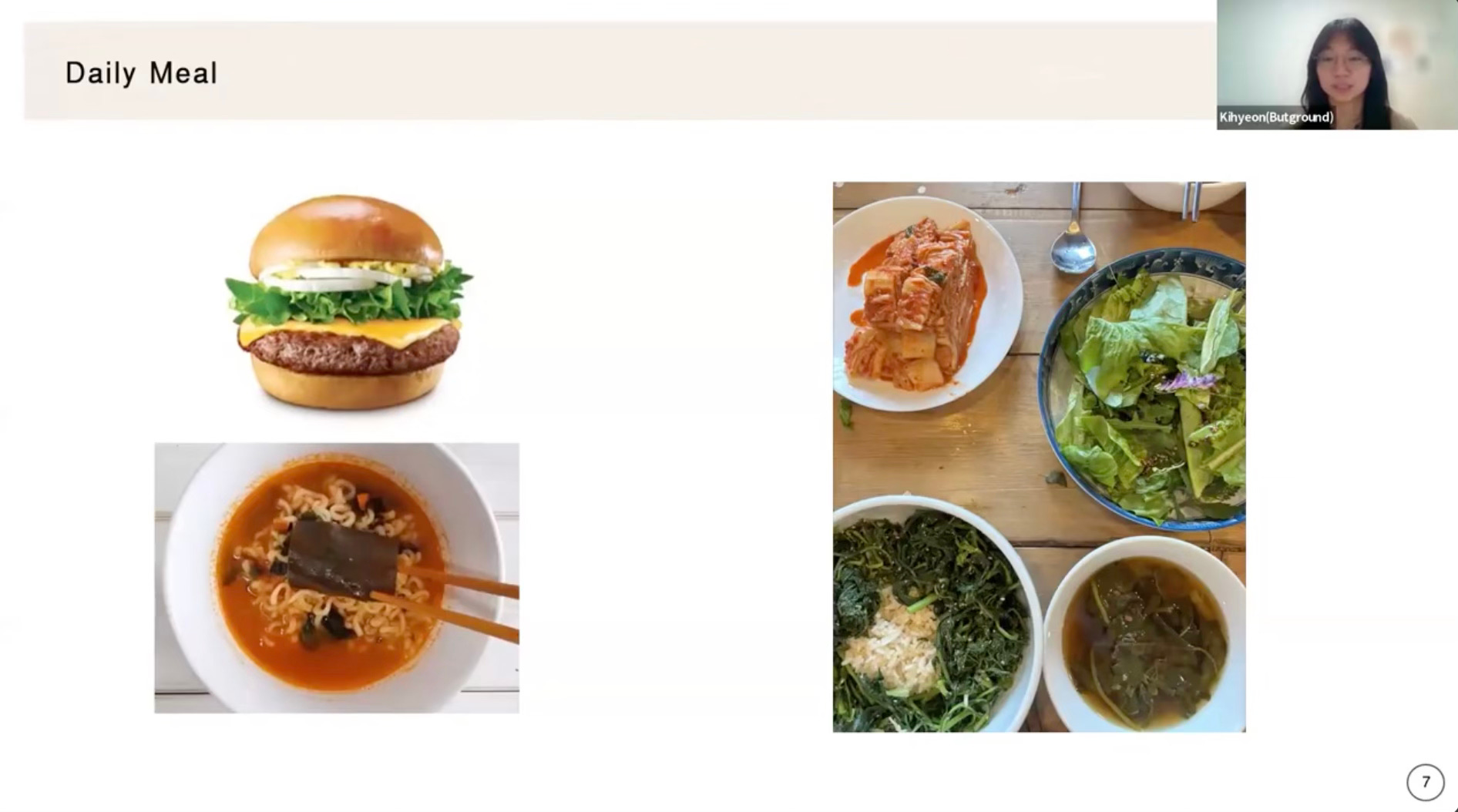
That gap showed up very concretely, even in small things like eating. Kihyeon began practising healthier food choices, but also noticed a constant drift back to fast, convenient food. That repetition was not only a matter of willpower; it led to a deeper question:
if the way I eat now is separating me from myself and from the environment around me, is there another way of eating that could do the opposite, and help me connect more deeply with myself and with nature?
And from the question about food, a bigger question gradually formed: which choices truly come from within me, and which have I unconsciously absorbed from my surroundings without ever questioning them?
Recognising that distinction, for Kihyeon, is not about judging or denying the past; it is the first step towards escaping choices made by inertia, so that you can begin to live your own life more actively.
“A TRULY HUMAN LIFE IS NOT A QUIET EXISTENCE CONTENT WITH MERELY BEING. TO LIVE HUMANLY IS TO AWAKEN TO THE OTHER, AND TO KEEP AWAKENING AGAIN AND AGAIN.”
This is the opening sentence of a book on vegan eating that Kihyeon came across by chance in the final year of university. The sentence does not speak directly about food, but it opens up another way of seeing the meaning of life. A truly human life is not merely a quiet presence. To live as a human being is to help others awaken, and to keep that awakening alive. People do not live only for themselves, but always in relationship with what lies beyond the boundaries of the individual.
Placed in the context of a daily meal, the meaning becomes very concrete. The following pages of the book offered some hard evidence: producing 1 kg of beef takes around 15,000 litres of water; every 1–2 seconds an area of forest the size of a football pitch disappears, and the total forest lost each year can be as large as the whole of Italy.
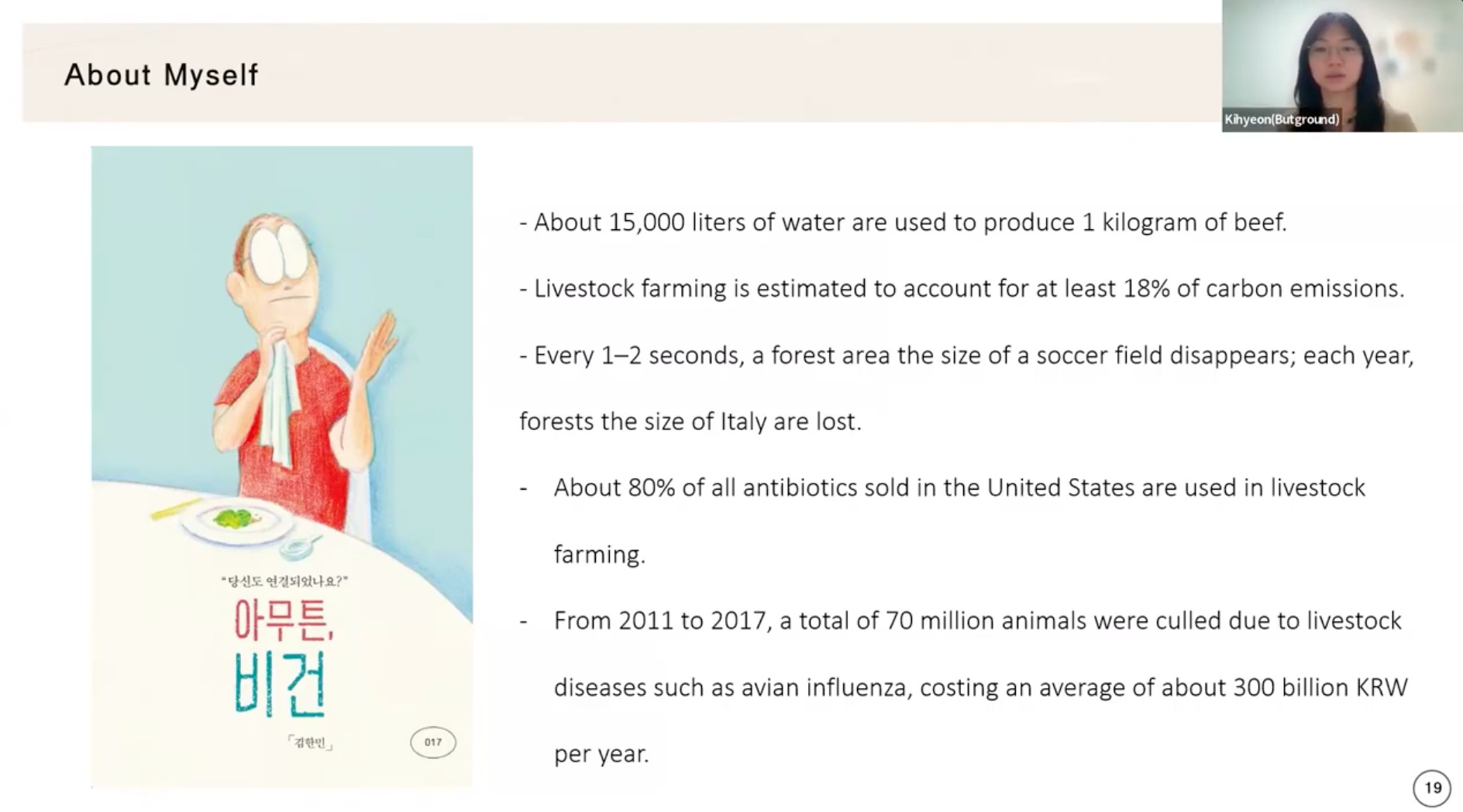
On first reading, these numbers still seemed like distant statistics, until Kihyeon looked at them from another angle: all of them are tied directly to each daily meal, to each seemingly tiny, personal choice each of us makes. That moment brought the realisation that an act that seems purely personal is linked to consequences on a global scale. But what surprised Kihyeon most was not the numbers themselves, but that hardly anyone talks about these things, as if those links have always existed yet are hidden from most of our awareness.
Kihyeon's awareness did not stop at the environment. Looking deeper into food systems and biology, Kihyeon gradually realised that many familiar foods may disappear in the future as the Earth warms and growing conditions become harsher. This changed the way Kihyeon sees food: no longer just something we consume each day, but part of a system that is changing and far more vulnerable than we thought. A meal, then, is not confined to the table; it stretches back through the production chain, through lands that are disappearing, through farmers we have never met, and forward into the future of a planet we all share.
WHEN PERSONAL IDEALS COLLIDE WITH URBAN REALITY
Once aware of all this, Kihyeon began actively seeking out friends with the same concerns, people trying to change their diets, moving towards vegan or more conscious eating, in the belief that to create change on a wide scale you must first start with yourself. Kihyeon began to notice how little space there was for vegetarians. As a student living in a dormitory, cooking was restricted, and keeping a “sustainable” diet in the context of urban life was nowhere near as easy as imagined.
These obstacles went beyond personal ideals and drove Kihyeon's group of friends to tackle the problem. With about five members, they tried running a farmers' market right next to the university, supported by Hansalim (Korea's large organic consumer and producer cooperative), so they could sell organic products at lower prices thanks to some initial funding. Many students passing by stopped out of curiosity, but very few actually bought anything; even the discounted vegetables did not sell.
Next, the group tried a “moving vegetable truck”, a zero-waste mobile vegetable van that carried food to different points in the city to sell, with the option to pre-order. The trial ran in winter, and although plenty of people stopped to ask, most did not buy.
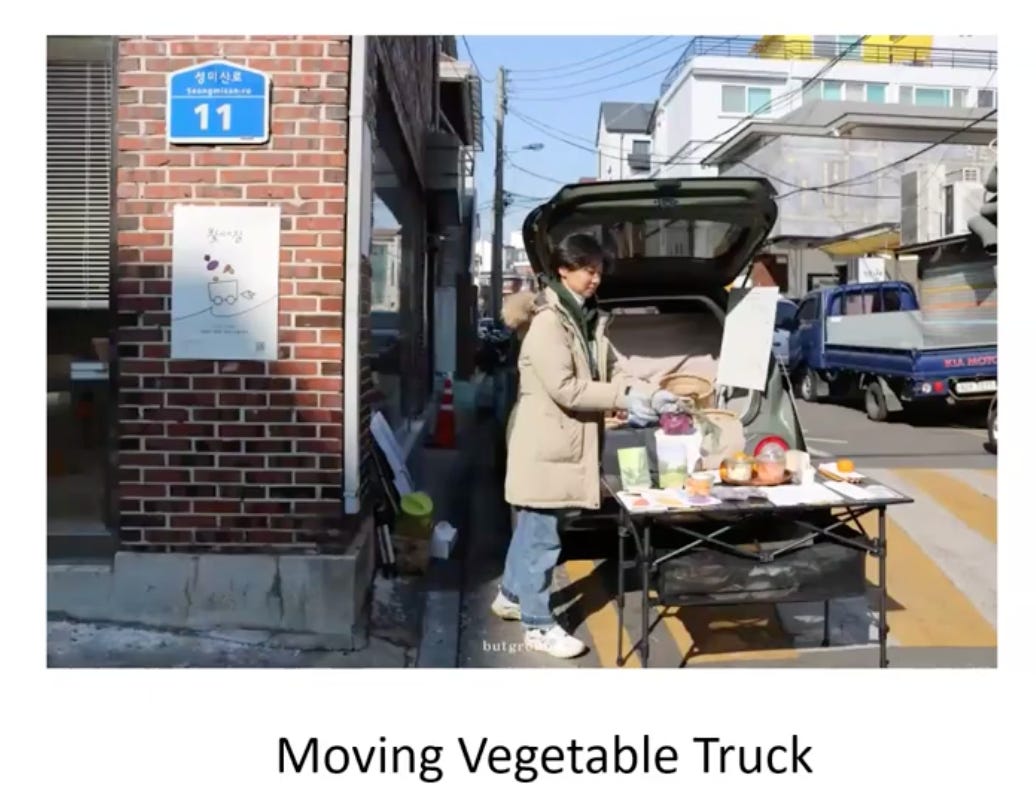
From this they understood one thing: even when an idea is sustainable, if the approach is not close or convenient enough, it is still very hard to reach customers' daily lives.
Each failure forced the group to face an uncomfortable truth: the problem lies not only in individual awareness or will, but in the very structure of the food system. For a genuinely healthy meal to travel from farm to table, it must pass through many stages, from production and harvest to transport and distribution, and each stage creates its own barriers. In the rhythm of urban life, convenience and speed almost always win, not because people do not know, but because the way the system works has made the healthy choice the harder choice.
For people on low incomes such as students, access to organic food remains quite remote, and that raises a more fundamental question: can a real change in food culture happen if it relies only on individual choices, without touching the structures that decide who gets access to what?
“LET'S EAT TOGETHER!”
The system's barriers took Kihyeon's group from one failure to the next. A core question emerged: if the system cannot be changed from the outside straight away, what is the closest point of contact with people?
The answer they arrived at was both very simple and very fundamental: meals together (Let's eat together!).
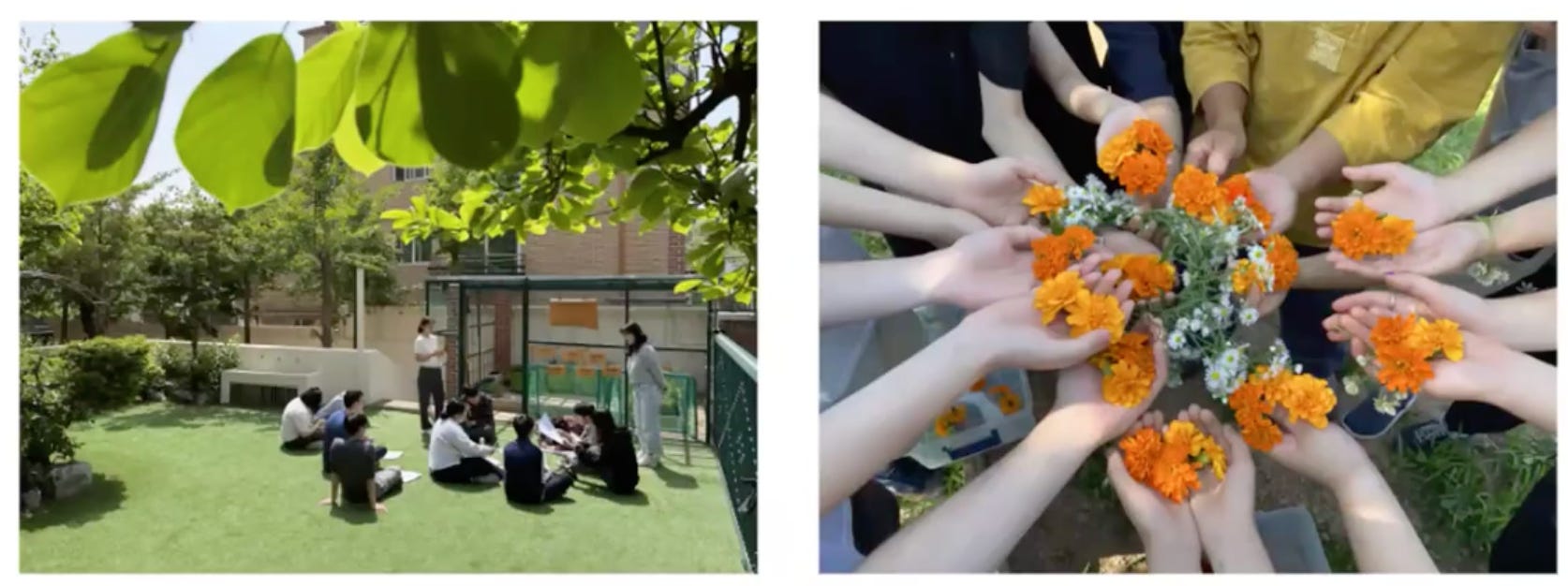
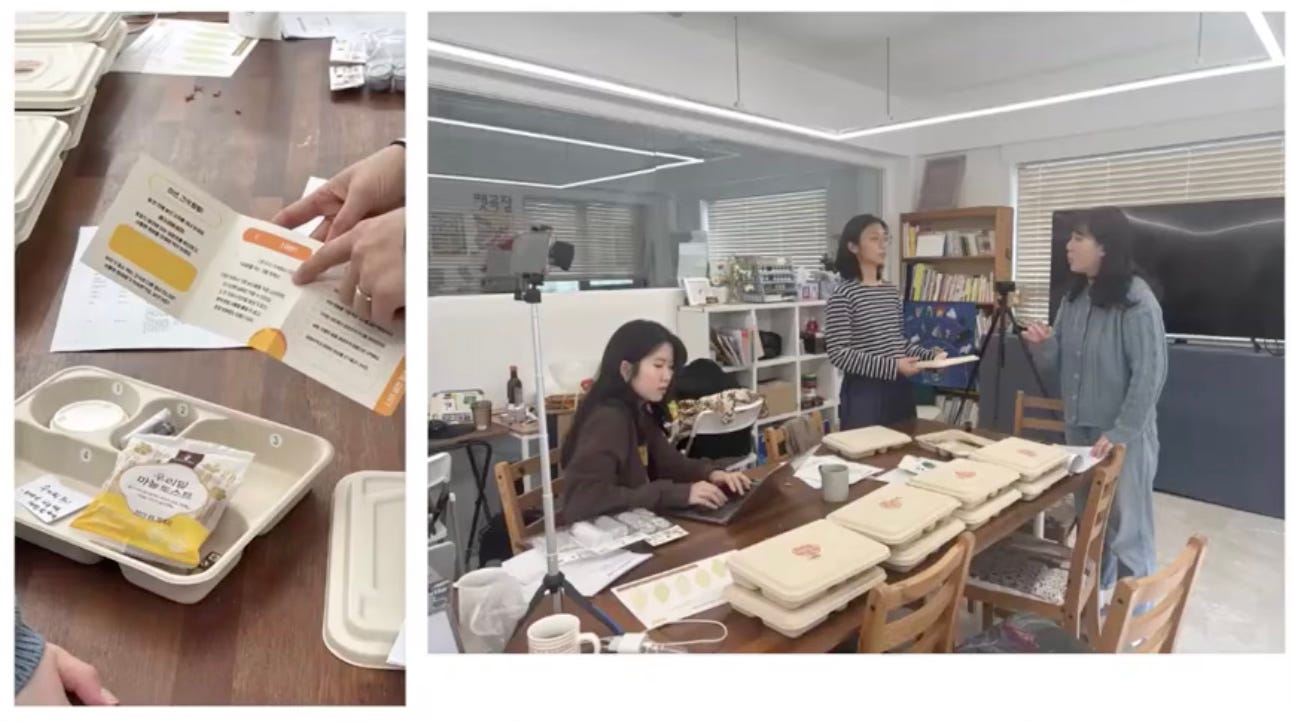
From those early experiments and failures, Butground gradually shaped its current model around one concrete image: the connecting table. In the workshops, people sit down together and learn about food: exploring where it comes from, tasting its flavours, and exchanging and talking about what is on the table.
The meal is no longer the end point of a production process; it becomes a living learning process, where knowledge is not handed down from above but discovered together. After each session, participants not only eat a healthy meal, but leave with a sense of a refreshed body, a lighter spirit, and a warmth that comes from connecting with the people sitting at the same table, people they had never known before.
Kihyeon explained that the aim of those spaces is to create a place where strangers can sit down together, share a meal, and leave no longer strangers. The COVID-19 period made clear why this matters so much: when gatherings were impossible and connection was completely interrupted, Kihyeon felt for the first time what “disconnection” really looks like, not just at the level of personal emotion but in the way all of life and the system operate. That very void became the foundation and the motivation for the group to see the value of what they were doing more clearly, and pushed them to continue even when external conditions were unfavourable.
It was also in this period that Kihyeon met Gayoung, who later became Butground's co-founder. The two began working together, organising farmers' markets or small events under pandemic restrictions, while geographical distance made it impossible to invite farmers in person.
During the talk, Kihyeon replayed a video of that activity and realised it was the first time of truly meeting farmers, and a question surfaced naturally: why, having been born and raised in the city, had I never once met people who live in another region, with a completely different way of life?
From that question, and the activities they had done together, Butground kept expanding: travelling to different regions of Korea to meet local communities, learn about traditional cuisine, record and archive knowledge that is slowly being lost, and connect it with the younger generation so it can keep spreading. They organise farming activities together as a way to experience the process of making food directly, precisely because of that first real meeting with farmers. All of these activities, whatever their form, share one goal: bringing people, and generations, closer together through the most universal language humanity has: the meal.
The spaces Butground creates, then, are not just places to eat. They are an “excuse” for each person to meet themselves again, meet others, and reconnect with the environment around them, something the rhythm of daily life rarely allows, yet which people need more than ever.
Neither Kihyeon nor Gayoung from Butground claims to have found a definitive answer to the bigger picture of “from farm to table”. They say they are still on a journey of experimenting and practising, so that every meal, every encounter, every small choice is a step towards a more conscious way of living and a deeper connection with people and the world around them.
JOIN THE COURSE CO-ORGANISED BY BUTGROUND AND VCIL COMMUNITY
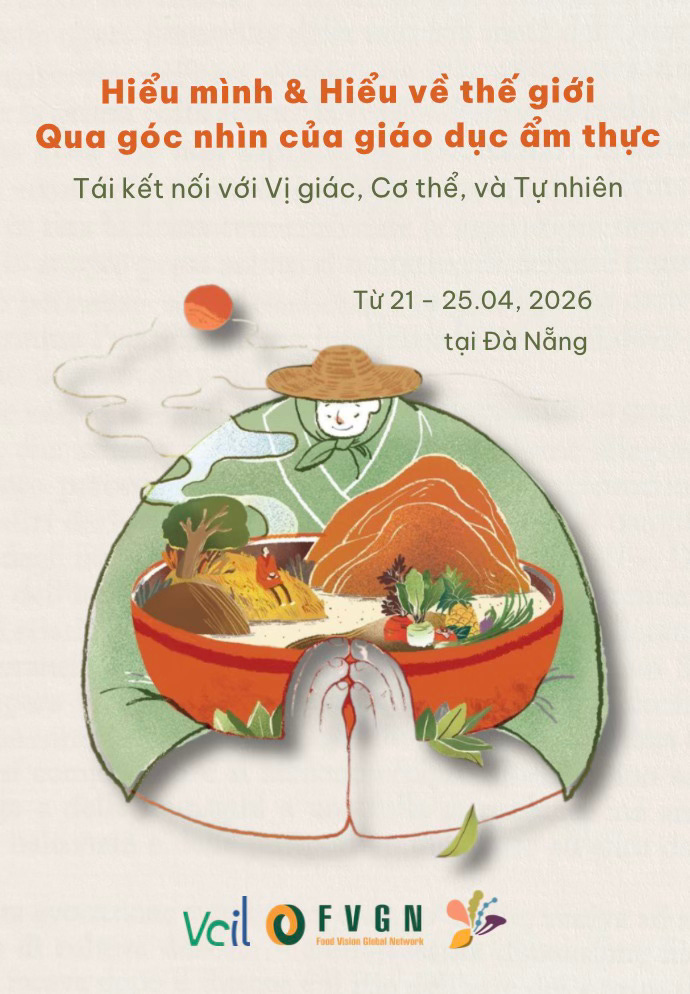
From 21 to 25 April 2026 in Đà Nẵng, Butground, Vcil Community and taste philosopher Hyun-Sook Kim will co-organise the course “Understanding yourself & the world through the lens of food education”.
The programme “Understanding yourself & the world through the lens of food education” is designed as an experiential learning journey that helps participants reconnect with food through taste, knowledge and ecological awareness.
Cultivating food literacy means understanding the whole journey of food: how it is grown, how it is processed, how it is distributed and how it becomes part of our daily lives. When we see this whole web of connections, eating stops being an unconscious act and becomes an informed, conscious choice.
From that foundation, food literacy gradually grows into food citizenship. This means that every eating choice serves not only personal health, but also helps nurture a fairer and more sustainable food system: one where farmers are paid what they deserve, ecosystems are respected, and communities are cared for and bound together.
Details and registration at: https://luma.com/w6j5wzxy
_____
☎️STAY CONNECTED
Vcil Members' Talks is a monthly event series open to the public, where stories, initiatives and regenerative models from the ecosystem of Vcil community members are shared. Vcil Members' Talks is not just a place to listen, but a space to learn together, widen networks and nurture a spirit of collaboration for a regenerative future.
Details of Vcil Members' Talks #8 will be announced soon on the Fanpage. Follow the Zalo group or Substack for the latest updates.
You can also watch Butground's talk again here:
You can also read more about Butground at the links below:
Website:
Instagram: https://www.instagram.com/butground/
If you are interested in sustainable/regenerative production models, or in connecting with the individuals, organisations and communities building a society of well-being and regeneration, Vcil Community invites you to explore and join Vcil Community Membership for the chance to live, learn, work and collaborate with members who share your values.
#VcilMemberTalks #VcilCommunity #FoodEducation #FoodLiteracy #FoodSystem #fromfarmtotable #field&friends