You are using the member interface.
Log out of the member interface →

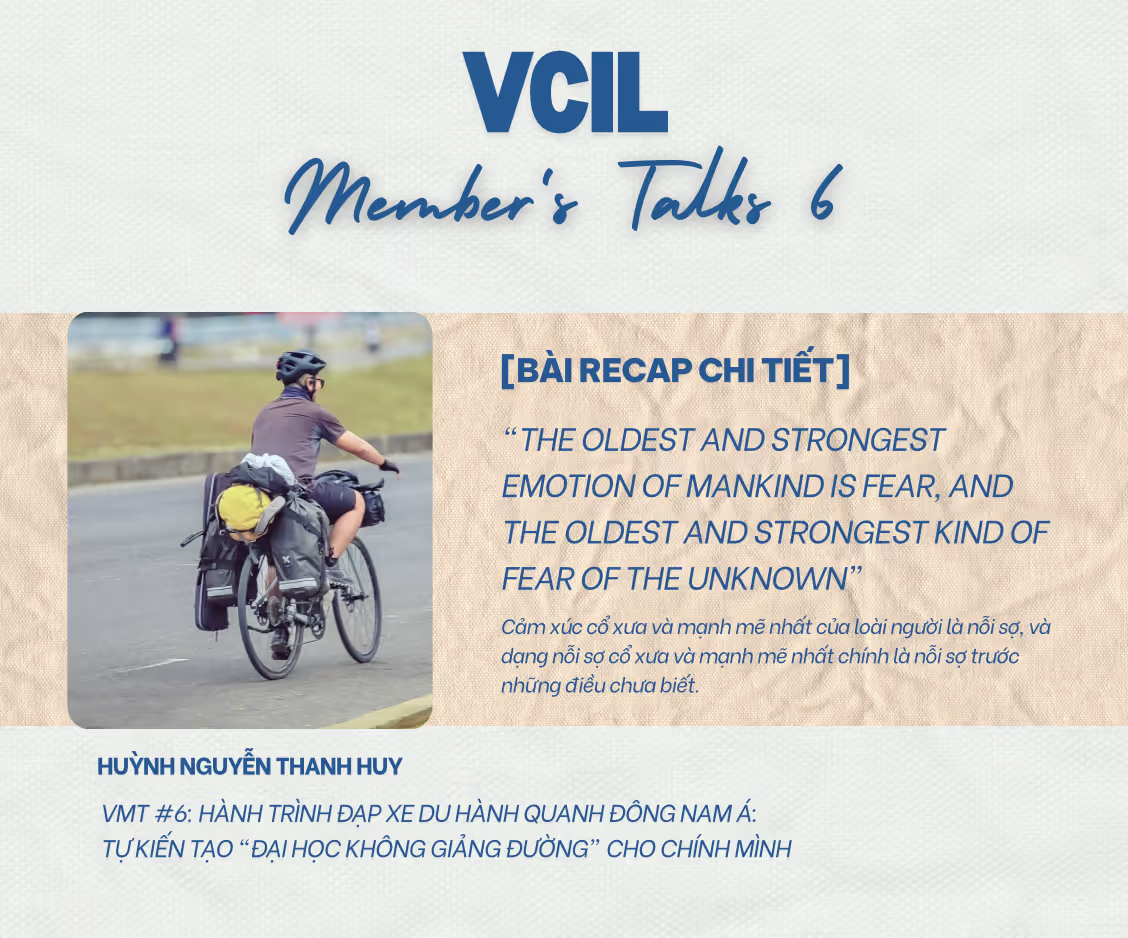
On the evening of 23/2/2026, Vcil Members' Talks #6: “Cycling around Southeast Asia - building your own university without lecture halls” took place with guest Huỳnh Huy, co-founder of EcoCupid, which connects environmental projects, and founder of the Xe Đạp Bay (Flying Bicycle) brand, which builds a bridge between art and commerce and carries the spirit of Regeneration through its works.
Describing himself as a traveller, Huỳnh Huy is a young person who has stuck firmly to his choice of building his own “university without lecture halls” through journeys across Southeast Asia, instead of accepting a conventional educational path.
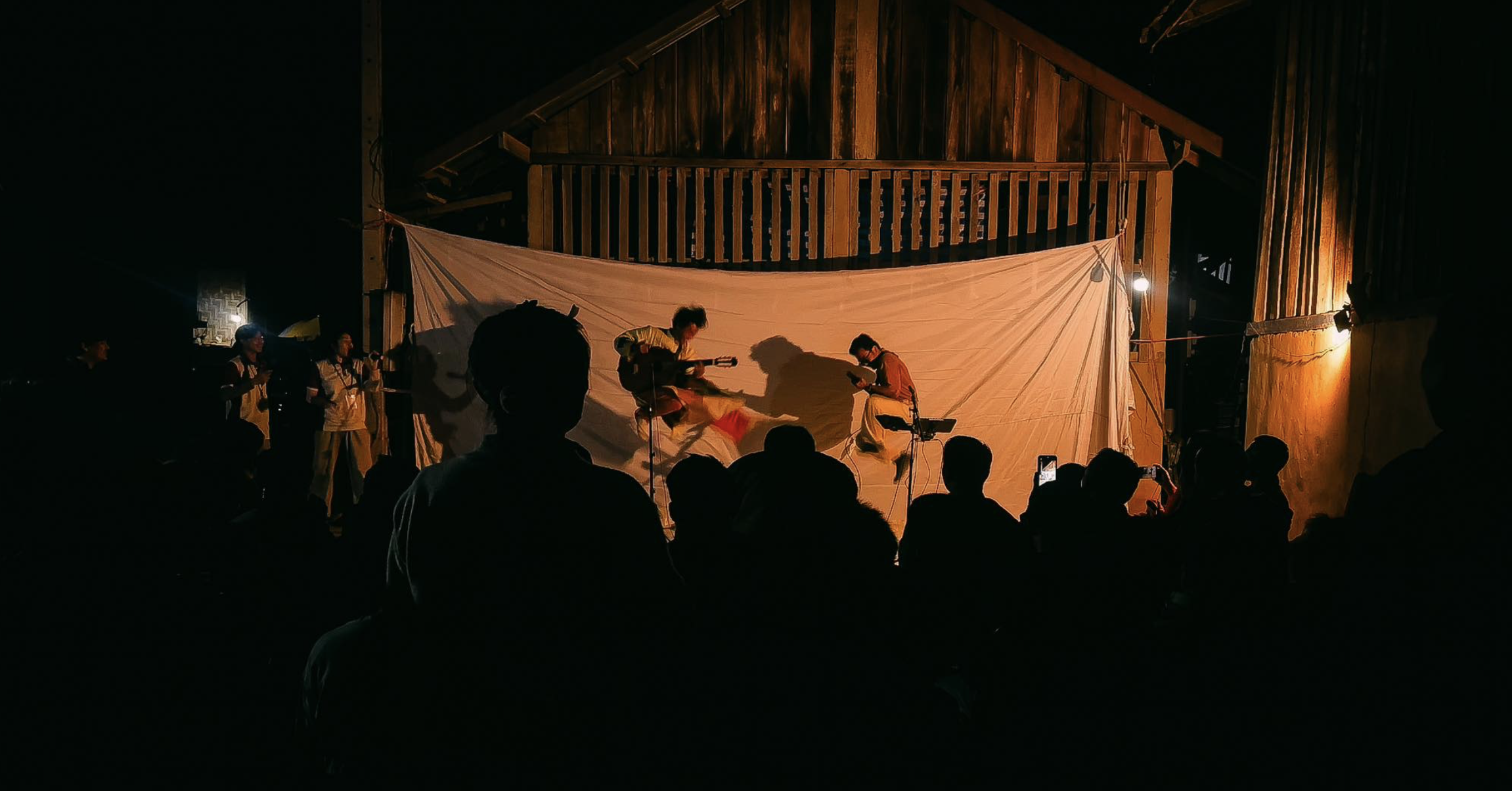
The talk opened with the sounds and colourful spaces of Huy's world: live-looped guitar carrying memories of the fundraising nights in Luang Prabang (Laos) that Huy had just played in early January, and the story of a bicycle shop with a brand from the future, built from half a tonne of regenerated scrap in his home town of Bến Tre. From those melodies and that restless atmosphere, Huy led listeners back along four solid years of cycling and walking through countless lands, to see more clearly the relationship between the desire to educate oneself, empathy with local materials, and the real courage it takes to step out of the “house inside your own mind”.
“THE OLDEST AND STRONGEST EMOTION OF MANKIND IS FEAR, AND THE OLDEST AND STRONGEST KIND OF FEAR IS FEAR OF THE UNKNOWN”_H.P. Lovecraft
The turning point came in 2022, just as Huy received his engineering degree. At that moment he seemed to have all the launch pads so many young people dream of. He was building a startup with friends in Singapore. But standing at the familiar fork society lays out, a master's degree or a career, neither path attracted Huy as much as the burning curiosity inside him about the vast world out there.
It was then that Huy began to feel a clear tug-of-war inside. On one side, the safer, clearer, recognised road; on the other, a growing curiosity about the world outside, about lands, people and experiences he had never touched. Alongside that curiosity came fear: fear of leaving the familiar orbit, fear of what he did not know, fear even of stepping out of the door of the stable rhythm he had. Huy has said that sometimes the biggest obstacle is not the long road ahead, but the first step out of your front door.
During that period, questions kept circling in Huy's head: what do I really want? who do I want to become?... and could the big questions inside him be answered by simply continuing along the familiar path? Gradually he learned to look straight at the fear and recognise it as a very natural human reaction to uncertainty, a psychological mechanism to protect us from danger. But if we let fear decide our choices entirely, we also unwittingly shrink the world we could explore. Once he saw that, Huy did not let the fear take over; he learned to step through it, even though the fear remained to some degree.
And so, when curiosity and the hunger to explore and learn grew larger than the fear, Huy decided to cross that threshold. He set out to discover the world on a bicycle around Southeast Asia. The call of new horizons and the desire to learn from real life turned that plan into a journey that has lasted four years and has not stopped yet. For Huy, the journey is not simply geographical movement; it is the way he is building, with his own hands, a “university without lecture halls” for himself, where every turn of the pedals is a precious lesson about people, about life, and about himself too.
Huy's journey began in Bến Tre, cycling north, with the first stop in the cradle of more than 2,000 years of Cham civilisation: Ninh Thuận. If the cycling was a classroom that opened along every road, Huy's deepest learning came from the days he chose to stop, to live like a true local, to work, to labour and to meet life with his own hands. He learned farming and biochar-making with the Cham people, pushing wheelbarrows of charcoal under the fierce sun of Central Vietnam. There he observed the Cham people's relationship with the land and with nature, learned their traditional ways of protecting the environment, and at the same time observed and understood his own body better: how weak his back and arms were, how to find balance when doing a task, and how to adjust it to fit his body.
Leaving Ninh Thuận, the journey continued in Phú Yên, where he lived in simple huts to learn about sustainable agriculture in the pineapple fields. He practised soil restoration and soil care with a local farmer, and realised that sustainable farming is nothing like the “romantic” picture. In Bình Định he went out to sea with fishermen and dived to build “chà”, underwater homes for fish. There were days of salt and sea wind and moments gasping for breath between the waves, but in return came a much deeper empathy with the livelihoods of coastal people.
He also spent more than a week at the Recycled Garden, a garden built almost entirely from recycled waste and run by people with disabilities. There he sorted waste with everyone, sewed bags from fabric scraps and walked with them every Friday to pick up litter around the village. That was when he thought: “If a child with a disability can protect the environment, why can't you?”
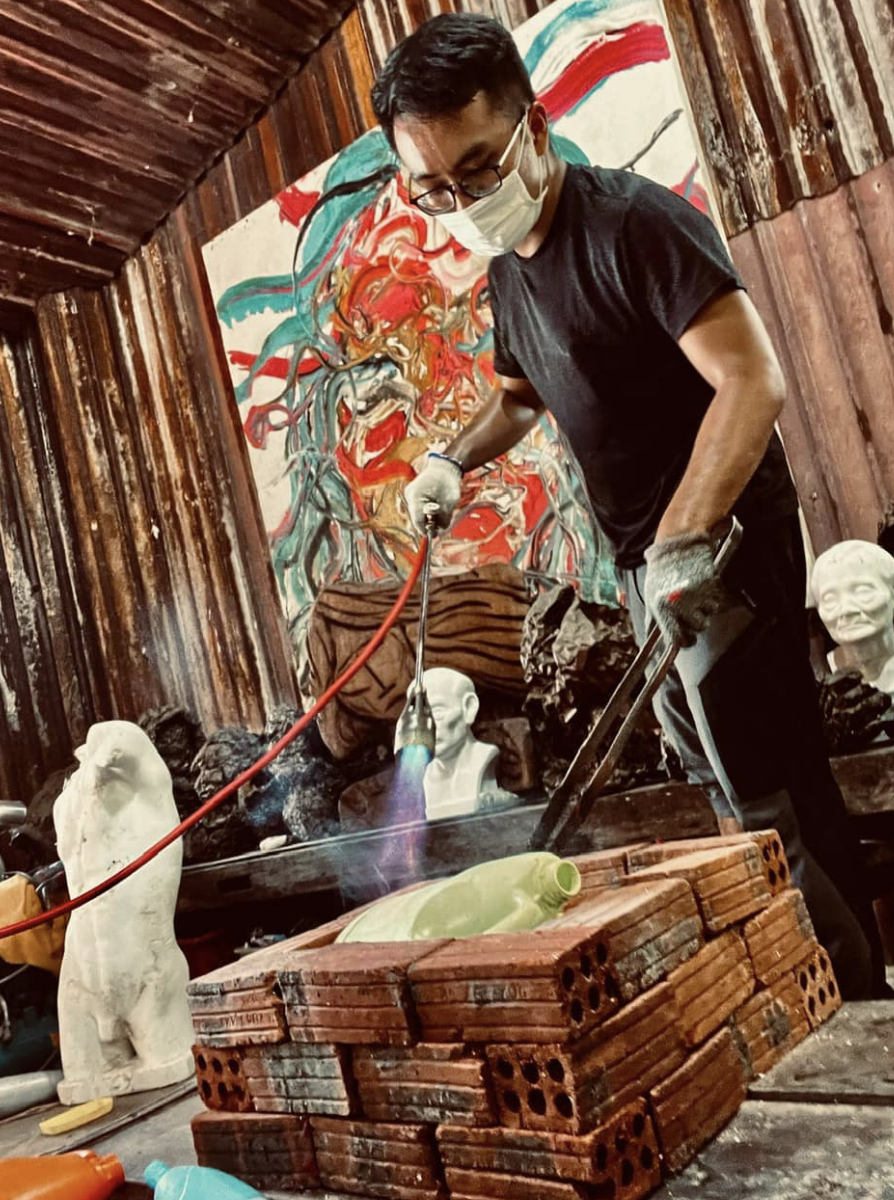
And then there was a place he meant to visit briefly but which “held” him for more than two years: the Regeneration Workshop in Hội An run by “waste doctor” Dân. There Huy learned not only very concrete skills such as welding, cutting and joining metal, and drilling into broken bicycle frames, handling every piece of seemingly useless scrap. What changed him more deeply was a new way of seeing value: the value of waste, of scrap, of the discarded things we usually consider worthless. At the Workshop, “waste” is not the end of a life cycle but the start of a new one. A broken frame, a rusty gear, a bent iron bar… can all become material for a work of art, a new structure, a different form. From there he came to believe that the future will no longer be built from freshly extracted resources; “waste” will be the raw material of creativity, gradually becoming a “regeneration movement”. Out of this experience, Huy brought half a tonne of broken bicycle frames back to Bến Tre and founded Xe Đạp Bay: an exhibition space for art regenerated from bicycle scrap, and at the same time a shop for high-quality bicycles.
In his own university, his learning is self-directed education, starting with understanding himself before seeking knowledge. Huy began with the questions: who do I want to become, what values and abilities do I want to develop; and once he understood that, he actively sought out the people, environments and experiences that could help him grow in that direction.
So at the Regeneration Workshop, Huy was free to choose his own teacher. He went to Dân not only to learn the techniques of working with scrap, but because he recognised in that teacher a way of seeing the world, a spirit of regeneration and a set of values he wanted to absorb. For Huy, learning is not confined to classrooms or degrees; anyone in society can become a teacher, if they carry a skill, a life experience or a set of values that he genuinely wants to learn.
On that journey of discovery, through lands full of human warmth, unexpected encounters and unplanned goodbyes, Huy gradually learned to step out of the “house inside his own mind”. Every stretch of road, every person he met, every experience he lived through widened the way he sees the world, deepened his understanding of himself, and brought him step by step closer to a question that seems simple but runs very deep: what am I living this life for, and what do I want to live for.
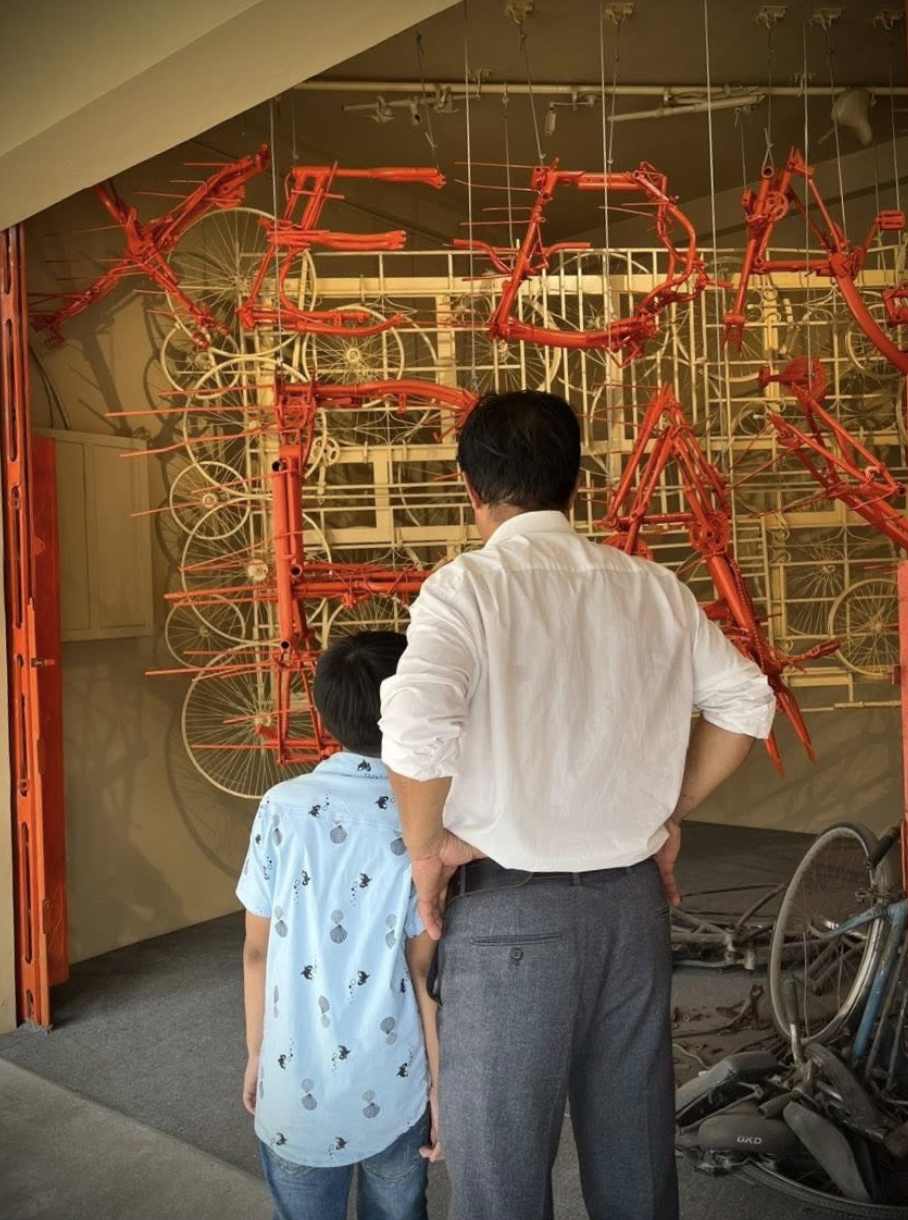
After years on the road, Huy returned to Bến Tre to begin a new experiment right in his home town. He built an exhibition space for art made from regenerated materials, called Xe Đạp Bay: a work weighing nearly half a tonne, assembled from waste and discarded metal he brought from Hội An to Bến Tre. With the longer-term vision of bridging art and commerce, Huy built the “Xe Đạp Bay” brand to sell bicycles inside that art space.
When you need a bicycle, why choose an ordinary shop when you could walk into a space that sells quality products and, at the same time, offers an aesthetic experience inside an art space? That is the very special core competitive advantage of Huy's brand.
But behind that business model is a wider hope. Through Xe Đạp Bay, Huy hopes to inspire young people nurturing a startup, or simply wanting to create a project of their own: creativity does not have to start from perfect resources or standardised models. Sometimes the discarded materials, scrap, waste, the things that seem worthless, can become the starting point for new ideas.
His contact with scrap gradually shaped a way of thinking in Huy: regenerative art is not just a creative technique but a wider approach to the world, “regenerationism”. The value of materials is turned upside down; not only are materials regenerated, but the way people see value, resources and their own creative capacity is renewed too.
Huy's view of art is also distinctive. Art should not be framed within the white walls of a museum or reserved for people with a specialist background. So he deliberately designed his space to be “open” from its very structure: wide doors, no reception desk creating distance, no rule board... Yet the way the regenerated works are displayed still has the feel of a deeply artistic space. He hopes his space becomes a place where labourers, lottery-ticket sellers or anyone from any walk of life can walk in, touch the works, ask questions, chat and find connection. There, art is no longer remote; it is present in everyday life, close by, and can be felt through personal experience.
The commercial bicycle-shop project is therefore unconventional too. The bicycles sold are high-quality and carefully selected, and the profit goes back into nurturing the project's spirit of “regeneration”: buying scrap to make art, and contributing to the fund he sets aside to buy gifts for children on his upcoming trips.
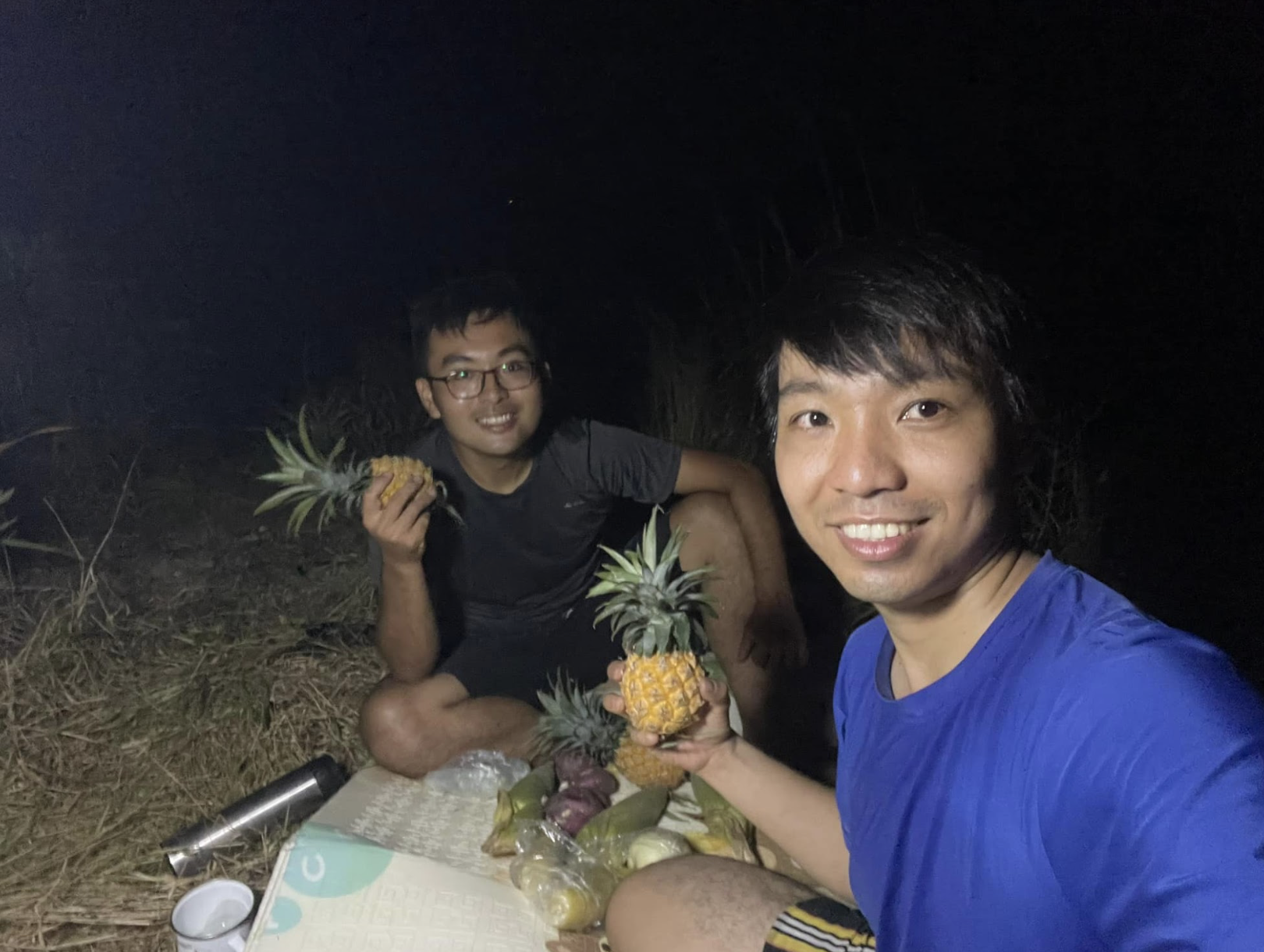
Huỳnh Huy met and joined Gia Huy, a walker who plays music to raise funds; carrying their instruments, the two set off together on the Travelling Music Fundraiser for Children. Huy uses music to connect with local communities, and it is also the way he chooses to share and give something practical to the places he arrives in.
On the first walk, in 2024, he began in the Mekong Delta with more than 400 km on foot in 45 days: from Bến Tre, along small roads, through Vĩnh Long, Cần Thơ, Sóc Trăng, Bạc Liêu… to Đất Mũi in Cà Mau. Along every stretch, Huy walked, played music, talked and connected with local people. When the journey ended, the funds raised were enough to buy 7 bicycles for children at a primary school in Bến Tre: simple gifts that make getting to school easier.
The next walk of more than 400 km ended in Luang Prabang (Laos), where Huy and his friend wandered the streets, played music under the street lights, and got to understand the Land of a Million Elephants a little better. The donations were used to buy gifts for local children; that time he also carried a projector up to Bắc Bua village (which had only had electricity for a week) to show films to the children. But the walking-music-fundraising journey does not stop there; the next goal he and Gia Huy are nurturing is a walk across Cuba.
In the Q&A with participants, Huy shared more of the thinking behind his journeys.
On whether learning depends on travelling far? Huy insisted that learning is not about how far you move, but about the desire within you. Even at home he teaches himself to build websites with AI, learns to DJ and trains his body every day. For him, travelling only really has meaning when we realise we do not yet know enough and want to widen our worldview a little further.
On the hard parts of the journey, Huy spoke of his greatest fear: watching friends he made across Southeast Asia pass away, or living in anxiety when their homelands were hit by riots or earthquakes. Those upheavals made him realise that the journey is not only a personal experience, but an emotional bond with specific places and people.
On how his family reacted, Huy sees the “first task” as understanding who you are, and only then the task of preparing your family to understand who you are and what you are pursuing. One way to help the family understand gradually is to start with short trips, in a group, with safe backing (volunteering, organised programmes...), which also shows responsibility and maturity before choosing longer journeys.
On the language barrier when meeting different communities, Huy recalled staying at the house of a Khmer village elder in Cambodia, where for many days no one understood anyone's language; he realised the biggest barrier is not vocabulary. Sincerity and the desire to understand are what create real connection. When hearts open, language is only a supporting tool.
On safety, especially for women, he said that if you are used to living in Saigon, where the risk of accidents or theft is far from low, going to rural areas is sometimes much safer and easier to breathe in; and once you go, it is exhilarating. The hardest step is not crossing forests or passes, but stepping out of your front door. So his advice is very simple: start with small steps, like cycling to explore unfamiliar roads around where you live.
Finally, on why he travels alone, Huy shared frankly that solitude forces him to open up, to actively approach people society usually labels or shuns: from illegal loggers to heavily tattooed men. Those encounters taught him to be more tolerant, less judgemental, and to see the world through many different lenses. And perhaps that is the most valuable degree the “university without lecture halls” confers.
_____
Vcil Members' Talks is a monthly event series open to the public, where stories, initiatives and regenerative models from the ecosystem of Vcil community members are shared. Vcil Members' Talks is not just a place to listen, but a space to learn together, widen networks and nurture a spirit of collaboration for a regenerative future.
Details of Vcil Members' Talks #7 will be announced soon on the Fanpage. Follow the Zalo group, Substack or Facebook for the latest updates.
You can also watch Huy Huỳnh's talk again in the comments: https://youtu.be/qXq4RJaDfkU?si=h3pZt1H-gYk4ZDqJ
You can also read more about Huy and his projects at the links below:
Huy's Facebook: https://www.facebook.com/huyhuynh30120
Xe Đạp Bay: https://xedapbayvn.com/
EcoCupid: https://ecocupid-asean.com/
If you are interested in sustainable/regenerative production models, or in connecting with the individuals, organisations and communities building a society of well-being and regeneration, Vcil Community invites you to explore and join Vcil Community Membership for the chance to live, learn, work and collaborate with members who share your values.
#VcilMemberTalks #VcilCommunity #Daihockhonggiangduong #HanhtrinhDongNamA
Nội dung đầy đủ của bài viết này chỉ dành cho Hội viên Vcil. Đăng nhập để đọc tiếp phần còn lại.

Vcil Members' Talks are a series of public sharing event