You are using the member interface.
Log out of the member interface →
Blog

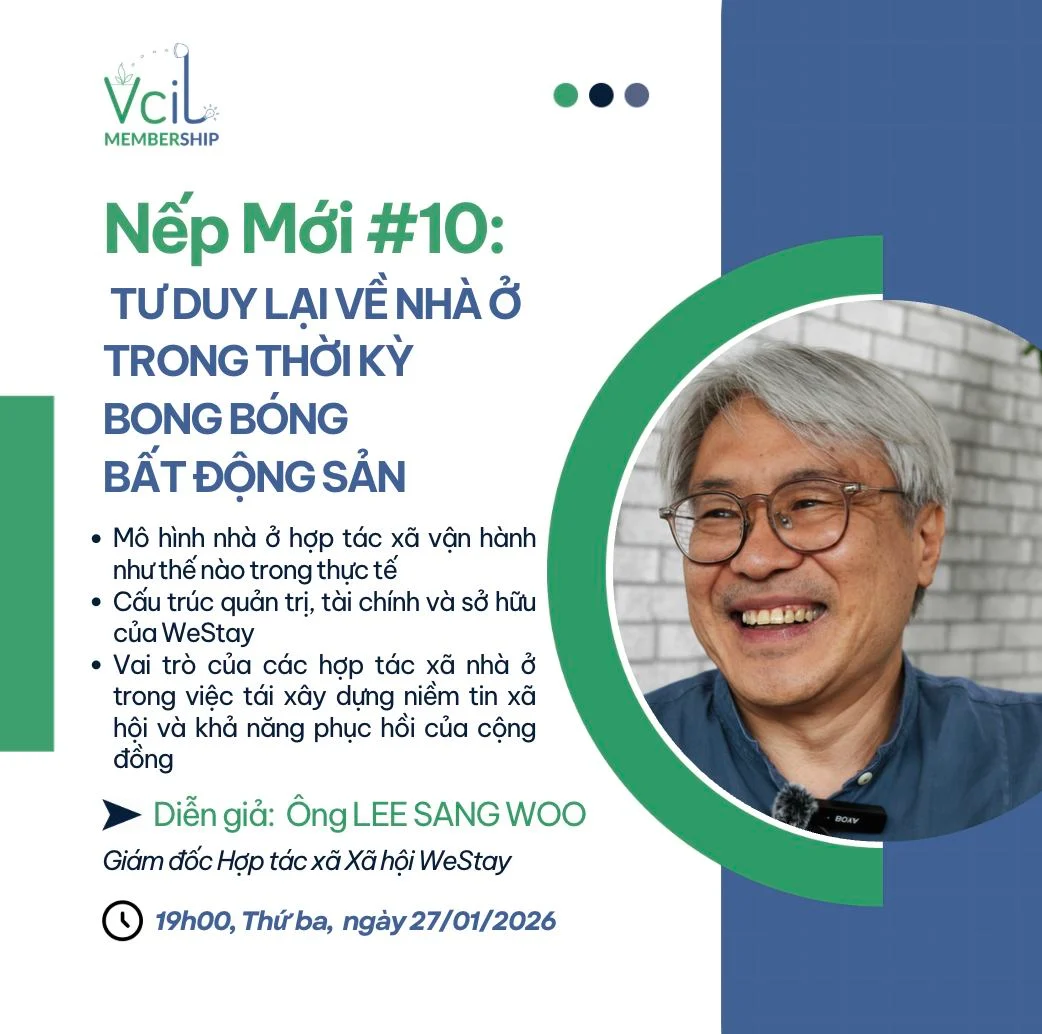
[Nep Moi #10] Rethinking Housing in the Real Estate Bubble Era with WeStay Housing Cooperative (South Korea)

Thông tin cho hội viên

Thông tin dưới đây chỉ dành riêng cho Hội viên Vcil
Để đảm bảo quyền lợi của bạn cũng như cộng đồng Hội viên Vcil, mong bạn đừng chia sẻ thông tin này nhé!


Bạn có thể chia sẻ thông tin về dự án dành cho công chúng bằng cách sao chép link này:

RECAP NẾP MỚI #10: WHEN AN APARTMENT BLOCK IS NOT JUST A PLACE TO LIVE OR A COMMODITY, BUT A NURTURING, CLOSE-KNIT URBAN COMMUNITY

The story of WeStay: an experiment in solving the housing crisis and the breakdown of community in Korea.

Introduction

On 27 January, Nếp Mới #10 took place with guest speaker Lee Sang-woo, Director of the WeStay Social Cooperative, the first private rental housing cooperative model with state support.

The session was attended by members from Vietnam and Korea. It is a topic of great interest to the community, set against a backdrop of ever-rising housing costs, urban isolation and the erosion of community life; WeStay emerges as one of the social experiments and a solution to the housing problem in general. WeStay brings residents together to co-create affordable, stable, community-centred living spaces, based on a spirit of cooperation, mutual care and democratic governance.

Below is a detailed recap of the session, in 6 parts:

1. Legal and financial structure, and the philosophy of community building

2. Spatial planning and organisation & education at WeStay
3. The activity currency system, community economy and traditional festivals
4. Summary of the model
5. Q&A with the speaker

Part 1: Legal and financial structure, and the philosophy of community building

The session began in a warm atmosphere as speaker Lee Sang-woo (known in the community as Moru) greeted the Vcil members present on the Zoom call. He introduced himself as a community activist working at WeStay Byeollae (위스테이 별내) in the city of Namyangju, Gyeonggi Province, Korea. The speaker expressed his appreciation for the chance to present this model — a complex of seven apartment buildings designed to realise the values of the collective economy.

In terms of how it was formed, the WeStay Byeollae complex, including both the built infrastructure and the land-use rights, was created from mixed funding, in which the Korean Government's budget provided 70% and the cooperative's capital contributed the remaining 30%. In terms of asset management, the project is owned by a real estate investment company operating under a trust model (REITs - Real Estate Investment Trusts). It is a government pilot programme whose official legal designation is Publicly Supported Private Rental Housing (공공지원 민간임대주택). The project has a mandatory rental period of 8 years, and residents are currently in year 6 of that timeline. A key point to stress: the project was not built solely with the resources of individual residents; the presence of 70% public capital is the foundational factor ensuring the model's feasibility.

Historically, WeStay Byeollae is the first cooperative apartment (Cooperative Apartment - 협동조합 아파트) built in Korea. The cooperative was founded in 2017, construction began in 2018, and residents finished moving in in 2020. The project brings together 491 households with a total population of about 1,400 people. The apartments come in three typical sizes to serve residents' diverse needs: 84, 74 and 60 square metres.

To understand the difference between a cooperative apartment complex and an ordinary one, we need to look at the definition of a Cooperative (협동조합): it is like an autonomously and democratically run enterprise that meets the needs and aspirations of its members. In Korea, apartments are often treated as tools for accumulating wealth through buying and reselling for capital gains rather than purely for living in. Community life then breaks down: people live in the same area but do not know who their neighbours next door, upstairs or downstairs are.

WeStay Byeollae was created to address these social fractures. Here, a home is not a commodity but a safe and happy Community. The core goal is to create an environment where good neighbours can live long-term in quality infrastructure at an affordable cost. The foundation that makes this community work is low rent. Thanks to government funding and the principle of operating for the public good instead of private profit, the initial rent was only 85% of the market rate. After 6 years, while surrounding property prices have soared, rent at WeStay has been held steady, so the current cost is equivalent to only 60% of the general market.

In terms of governance, each of the 491 households has one person who is a cooperative member. The highest decision-making body is the General Assembly (총회). In addition, the project has an Executive Committee (집행위원회) — an open structure that allows not only official members but also their families and residents in general to participate directly in WeStay's activities.

Part 2: Spatial planning and organisation & education at WeStay

Turning to concrete activities, the first distinctive feature of WeStay Byeollae is its diverse system of community spaces. The WeStay complex has a woodworking shop (Mok-gong-so - 먹공소), a library, a shared kitchen, a café, a gym and a childcare area. The total area of these shared spaces is 2.5 times larger than in ordinary Korean apartment complexes. However, the core value lies not only in the scale but in the process of creation: residents took part directly in a Community Space Design Workshop before moving in, to discuss layout and operation. Today, each space has a Management Team set up by residents themselves, run voluntarily and autonomously. It is this model of "living as a cooperative member" rather than "living as a tenant" that has created an extremely strong sense of ownership and spirit of participation.

The second important theme is building an ideal village for raising children (Child-rearing friendly village). With about 60% of residents in their 30s and 40s, this is a very young community. Childcare has therefore naturally become a central theme in community life. Here, parenting clubs organised by children's birth year (zodiac sign) have been formed so families can support one another. A recent internal survey showed a remarkable result: 70% of residents said living at WeStay directly influenced their decision to have children, and more than 75% plan to have more children, with positive feedback. Indeed, the number of children born here is rising markedly, putting WeStay Byeollae's birth rate far above the national average for Korea.

At WeStay Byeollae, the parenting culture is further bound together through shared cultural elements, notably the zodiac culture (Zodiac signs - 띠). Like Vietnam, Koreans also use the 12-animal zodiac such as Snake, Monkey or Rat to mark birth years. Drawing on this feature, parents here have formed Birth-year parenting clubs (Birth year club - 띠별 육아 동아리). Through them, residents care for, support and organise lively educational activities for their children together.

Figures from the recent internal survey report demonstrate the outstanding success of this model in encouraging the birth rate. The results show that living in the WeStay community directly affected the decision to have children for 70% of residents, and more than 75% responded positively about plans to grow their families in future. In practice, the number of families having a second and third child is rising significantly, pushing WeStay Byeollae's birth rate (출산율) far above the average for Korean society as a whole.

The Lifelong Learning Village model and the 100 Schools

The next pillar of WeStay's development is its aim to become a Lifelong Learning Village (평생 학습 마을). This is the basis for residents to support and learn from one another through the "100 Schools" programme (100개 학교). In this model, residents themselves act as both teachers and learners. On average, the community runs about 15 courses of diverse content each quarter. A special feature of WeStay's educational philosophy is the link between training and practice through Clubs (동아리). After courses end, participants are encouraged to keep connecting and developing their skills through interest groups. As of now (end of 2025), WeStay has 30 active clubs with regular participation from about 350 residents.

A sustainability commitment through the Carbon Neutral Village

The fourth theme focuses on the commitment to sustainability, with the goal of building a Carbon Neutral Village (탄소 중립 마을). WeStay Byeollae is proud to be the first apartment complex in Namyangju to install a full rooftop solar panel system on all seven buildings. The system produces about 300,000 kWh of electricity a year, saving each household about 10,000 won in electricity costs per month. In addition, resource circulation activities (자원순환) and a movement to cycle with children are carried out regularly to promote a green lifestyle.

Restorative justice and community conflict resolution

The fifth pillar concerns the concept of Restorative Justice (회복적 정의).  In an apartment environment, conflicts are hard to avoid given the closeness of living spaces. WeStay approaches this issue based on the concept of Restorative Justice (회복적 정의) and the idea of a Peace Village. Instead of avoiding conflict (갈등), the community established the principle of resolving disputes in the manner of a self-governing community. To make this real, the village implemented a Conflict mediation community activist training programme (갈등 조정 마을 활동가 양성 과정). Once trained, these activists directly intervene and help mediate disputes that arise between residents, for example inter-floor noise (층간소음).

Over time, the number of formal requests for conflict mediation has fallen significantly. This is understood not because conflicts have disappeared entirely, but because residents have become more familiar and closer to one another and found their own ways to resolve disputes without the formal mediation process. In addition, residents drafted a Respect Promise (존중 약속) together, covering noise, rubbish disposal, smoking, pets and parking. The posters promoting these promises were designed and written by residents themselves, encouraging voluntary and proactive compliance.

Governance by "elevator line"

The village's democratic governance system is made concrete through annual residents' meetings called Bansanghoe (Neighborhood Meeting - 반상회) every June. With 7 buildings and 15 elevators, meetings are organised by Elevator line (엘리베이터 라인). The village's view is that the elevator is the vertical space of interaction where people meet and greet each other every day, so each elevator line is the most natural community unit. At these meetings, residents not only discuss internal issues seriously but also share food together and hold fun bonding activities. Notably, the village has also set up Children's committees (어린이 회의체), giving even the youngest residents the chance to contribute their views to the self-governing life of the complex.

Part 3: The activity currency system, community economy and traditional festivals

To encourage residents' participation and community bonding, WeStay Byeollae set up a fascinating system called the Community Activity Currency (마을 활동화폐). The unit is called the Byeol (), which means "Star" in Korean. Residents can earn "Stars" by taking part in official cooperative activities such as Bansanghoe meetings. Each time they attend and sign the attendance list, residents receive a certain number of "Stars". This is proof of each individual's contribution, and residents can use "Stars" to buy food and drinks at events or as "tickets" to other experiential activities in the village.

The special, almost philosophical feature of this system is that the value of a "Star" decreases over time (화폐 가치 하락). Each issuance cycle of "Stars" starts on 1 January and they lose all value on 31 December each year. For example, at a May event a resident needs just 1 "Star" for a can of beer, but by December that may rise to 3 "Stars". This mechanism pushes residents to use their "Stars" quickly within the year, driving a continuous flow of community activity. According to the statistics, in 2024, 1,500 "Stars" were issued and about 700 were spent; by 2025, this rose to 1,683 "Stars" issued and 956 spent, showing residents' growing engagement.

Alongside the internal currency, WeStay also works to build a Social Economy Village (사회적 경제 마을). Statistics show the community has created a total of 88 jobs (일자리) within the complex, including apartment management, running the commercial area and staff at the association office. Although the income from these jobs is not large, they play an important role in sharing economic resources and enabling residents to support one another. Speaker Moru also currently holds one of these paid activist positions.

The village's economic vitality is also sustained through a culture of sharing and exchange. The community runs Shared Refrigerators (공유 냉장고) and a Sharing Tree (나눔 트리), where residents can leave items they no longer need for others to take if they want. In online spaces such as Naver Cafe or KakaoTalk, at least one sharing or exchange transaction takes place every day on average. In addition, the Collective Buying model (공동 구매) is very active, giving residents access to high-quality products from reputable producers at favourable prices thanks to collective purchasing power.

Finally, we cannot leave out the festive events that bind residents together. Every year on 1 January, everyone holds a sunrise event together (해도지 행사). Instead of taking the elevator, residents climb the stairs together to the top floor of the 22-storey building to greet the first sunlight and wish their neighbours a happy new year. These festive days are affectionately known collectively as Kkok-nal (꼭날), derived from the word Gong-dong-che (공동체 - Community).

During the festivals, the record-length Gimbap rolling event is the most impressive activity. Last year, residents rolled a 15 m strip of Gimbap together and set a target of 25 m for next year. What is special is that each resident brings their own family's filling ingredients, so each section of the Gimbap has a unique flavour, symbolising the blending of diverse individuals in a unified whole. In addition, water festivals in August, the Mid-Autumn Festival (Chuseok - 추석) and the Kimchi-making festival (Gimjang - 김장) in November, using ingredients from the community vegetable garden, are held regularly. At the end of December, all the arts clubs such as dance and choir perform together at a lively year-end party, closing a vibrant year of village activities.

Returning to the story of the record Gimbap roll: although the WeStay residents had intended to apply to the Guinness Book of Records, the Korean record has in fact reached more than 1 km, making that goal impossible. However, the real value lies not in the number but in how it is done: each resident brings their own filling (Resident's own ingredients), so each portion of Gimbap has a different flavour. Once complete, the giant roll is cut up and shared with everyone, testimony to the community's spirit of "integration without dissolution".

Besides the Gimbap festival, WeStay also holds water play activities in August and traditional holidays such as the Mid-Autumn Festival (Chuseok - 추석) and Dano. In November in particular, residents hold the Kimchi-making festival (Gimjang - 김장) together using napa cabbage and radish grown in the community gardens. The festival cycle closes at the end of December with a grand concert by the arts clubs, where dance groups and choirs perform the fruits of a year's activity, creating a true village party.

Part 4: Summary of the model

In summary, there are three core reasons why WeStay Byeollae has become an exemplar case (모범 사례) of community activity in Korea:

  • A low-cost foundation: 70% Government funding keeps the residential cost low. This is the most basic economic foundation that gives residents the headspace and resources to take part in social activities.
  • An autonomous cooperative mechanism: The cooperative method (협동조합 방식) creates operating "devices" that let residents participate democratically and autonomously. They are not just tenants but the agents managing their own lives.
  • Internal financial resources: To run the huge volume of community programmes, the village applies a mandatory monthly community fee (월 커뮤니티 비) of 50,000 won per household. It is this stable fund that turns residents' creative ideas into reality.

Although WeStay started as a government pilot policy project, over 6 years of effort residents have turned it into an organic community where people care for and grow together. Looking at the development diagram, from the initial goal of social housing, WeStay has now expanded into an ecosystem including education cooperatives, community care cooperatives, a food cooperative and local job creation (local economy). Every current social issue is managed and addressed directly within the village.

WeStay's vision does not stop at the complex. The new government in Korea is currently studying this model very closely in order to expand and spread it nationwide. The WeStay collective is committed to providing maximum professional support so these policies are implemented effectively. The community's dream is to see apartments like WeStay Byeollae appear all over the country, turning this model from an exception into a new standard for urban housing.

After the presentation, the session moved to the discussion (Q&A) stage.

Part 5: Q&A with the speaker

1. Question: How were the total investment, the allocation of resources and the project timeline designed in detail?

The WeStay Byeollae project was designed on a long-term timeline totalling 11 years, divided into two distinct strategic phases. The first phase was a 3-year creation period, focused entirely on acquiring the land and carrying out infrastructure construction. The second phase is the mandatory rental operating cycle of the following 8 years as required by law. The total funding needed to run the whole machine from inception to the end of the 11-year cycle is estimated at 200 billion won (2,000억 원). The key to WeStay's capital structure is the 7:3 split. The Government acts as the largest financial backer, providing 70% of total capital in the form of public support funds. The remaining 30%, roughly 60 billion won, was raised directly from the cooperative association (Cooperative Fund - 조합자금). This ratio is a matter of principle to ensure the project's stability, proving that the model cannot take shape without the synergy between public policy and residents' collective resources.

2. Question: How do the legal ownership mechanism through the REITs model and the question of rental revenue work in practice?

Legally, all assets including land and buildings are not owned directly by individual residents but managed by an intermediary legal entity, a real estate investment company under a trust model (REITs - Real Estate Investment Trusts - 부동산 투자 회사). Throughout the long operating period, the sole revenue of this REITs entity is the rent residents pay each month. However, an important fact researchers should note is that the project is always in a state of annual cash-flow deficit. This stems from its non-profit operating philosophy: WeStay does not aim to optimise annual rental revenue but focuses on the goal of welfare. Rental revenue therefore only serves to keep the operation running; it is not enough to generate a short-term economic surplus for investors or the managing organisation.

3. Question: What is the strategy for handling the deficit and repaying the principal when the mandatory rental period ends?

The essence of WeStay's economics lies not in operating profit but in the appreciation of the assets after a decade. Under the Government's original financial plan for public housing projects, at the end of the 8-year mandatory rental period the REITs entity will be dissolved and all assets (apartments and land) sold on the open market. After 11 years (including construction), property values will typically have risen well above the initial investment. The profit from selling these assets will be used for two overriding financial tasks: first, to cover all the accumulated losses from 8 years of low-cost renting, and second, to repay the 70% principal to the Government and the 30% contributed capital to members. WeStay is currently actively negotiating with the Ministry of Land, Infrastructure and Transport (국토교통부) to extend the rental period from 8 years to 20 years. If this proposal succeeds, residents will have another 14 years of stable residence, but it also means a new financial roadmap is needed to defer settlement with the government.

4. Question: How do ownership rights and the transfer mechanism at WeStay differ from ordinary commercial real estate business models?

In ordinary real estate models, an apartment is treated as a commodity to be bought and sold outright to profit from price fluctuations. At WeStay, by contrast, the home is redefined as a means of community residence. Residents do not individually own a single square metre, so they have absolutely no right to sell the apartment on the market on their own. Ownership rests entirely with the cooperative legal entity via the REITs structure. This completely prevents speculation and resident turnover for financial motives. When a household no longer wishes to live there, they do not sell the home but go through a process of transferring their share in the cooperative to a newcomer. The newcomer takes over the member position and the right to rent that apartment. This structure ensures that the complex remains the cooperative's shared asset forever, maintaining the stability of the community ecosystem.

5. Question: What strict legal conditions are applied to ensure the project's transparency and adherence to its support goals?

To maintain the integrity of a government-supported pilot programme, WeStay applies very strict resident filters. First, to live there legally, an applicant must have the status of cooperative member (조합원) or be an immediate family member of a member. Second, the project applies a "zero tolerance" rule on property ownership: 100% of residents, including the 123 households from the social activist group (25%) and the general residents selected by lottery (75%), must prove they are non-homeowners (무주택자) at the time of joining. These rules are necessary technical barriers to ensure the 70% government funding is used for its intended purpose, for people who truly need a sustainable home, rather than becoming a tool for commercial property investment.

6. Question: Who is WeStay's target group, how is the current resident composition distributed and how does the selection process work?

Building the WeStay community was strategically oriented from the very beginning by dividing residents into two distinct groups to ensure the project's sustainability and spirit of social activism. The first group, making up 25% of the whole project (equivalent to 123 households out of 491), consists of the core nucleus of social activists, people working in the collective economy (social economy), civic organisations or housing experts. Prioritising this group aims to build a leadership team with the capacity and passion to run the cooperative's complex community machinery.

The second group, the remaining 75%, is for the general public. These residents join the project by accepting the rental conditions and community standards set by the project. Selection for this 75% group is carried out through a public random lottery (lottery selection) to ensure absolute transparency and fairness among households in need. The combination of the professional activist group and ordinary residents is the key to WeStay maintaining a balance between social expertise and everyday resident life.

7. Question: What mandatory prerequisite applies uniformly to all residents who want to live at WeStay Byeollae?

Whether in the activist group or the general public, one strict legal standard applies to 100% of residents in the project: non-homeowner status (무주택자). This is a mandatory condition under Korean law for publicly supported housing. The rule ensures that support resources from the government and the cooperative are focused on the social welfare goal, prioritising those who genuinely do not own property, while preventing any speculation or profiteering from this low-cost rental model.

8. Question: What cost categories does the 70% Government support cover, and how does it differ from housing models in Vietnam or other Asian countries?

One extremely important detail needs clarifying to avoid misunderstanding: the 70% Government funding is not just for acquiring the land. In fact, this 70% covers all project cost categories, including: land cost, infrastructure construction cost, and also initial management/operational costs. This is a comprehensive support model that gives the cooperative sufficient financial capacity to control the entire housing supply chain from the site to the completed building.

In other contexts such as Vietnam or some Asian countries, land costs in big cities like Ho Chi Minh City or Hanoi are usually extremely high. Châu from the Asian Coalition for Housing Rights (ACHR) proposed a comparative option: instead of counting the land value into the total support capital, the government could apply a long-term land lease model of 30 to 50 years at low cost. Separating out land costs or subsidising land rent would reduce the financial pressure on cooperative models, allowing resources to be focused on building construction and community development. Currently in Korea, alongside the outright land-purchase model of WeStay Byeollae, the government is also piloting a land-lease model in parallel (as in the WeStay Jichuk project) to find the optimal approach for replicating the model in future.

9. Question: What different land-access models are being piloted simultaneously in Korea, and what is the core difference between them?

In the strategy for developing government-supported cooperative housing, two parallel land-access models currently exist to test their effectiveness in practice. The first model is applied at the WeStay Byeollae (위스테이 별내) project, where the cooperative purchases both the land and the buildings (Land Buying Model - 매입형 모델). The second model is implemented at the WeStay Jichuk (위스테이 지축) project, which operates by leasing the land (Land Rent Model - 토지 임대부 모델). The difference is that while Byeollae owns all the assets, the Jichuk project only leases the land-use rights and focuses its resources on constructing the buildings on that land. Running both models at once helps the government and policymakers assess the response of the market and of resident communities to each form of ownership.

10. Question: Why do experts tend to favour the Land Rent Model in the current property market?

According to experts and real-world monitoring, the land-lease model (as in the case of WeStay Jichuk) shows certain socio-economic advantages. The main reason is that land prices in urban areas keep rising to extreme levels. Leasing land instead of buying it outright reduces the cooperative's initial capital burden, thereby keeping residential costs at a lower and more sustainable level for residents. This model is considered an effective tool for coping with an escalating property market, ensuring the long-term financial feasibility of social housing models.

11. Question: How is WeStay's rent adjustment mechanism designed to protect residents' interests?

WeStay's financial structure is designed to be extremely flexible and humane to ensure stability in residents' lives. Under the original financial design (재무 설계), rent was expected to rise by 5% every 2 years. In practice, however, to give residents maximum support and maintain the low-cost housing philosophy, the cooperative proactively reduced this increase to just 1% every 2 years. Compared with inflation and the growth of the outside property market, this 1% increase is almost negligible, allowing residents to keep enjoying a high-quality living environment at a very low cost, sustainably.

12. Question: What perspective does comparison with cases in Vietnam and other Asian countries offer on the risks and opportunities of this model?

The discussion included input from an expert working in housing in Asia, who has experienced failure and even bankruptcy while trying to implement similar models. In Vietnam, the common form of support is for the government to lease land long-term for about 30 years for infrastructure construction. However, the biggest barrier remains the ability to connect support policy with the operating capacity of the cooperative. WeStay's successful launch since 2020 not only brings hope but also proves that with the right financial roadmap (with 70% support capital comprehensively covering all items), community-building efforts can avoid the pitfalls of bankruptcy and create real value.

13. Question: What is the vision for spreading and sharing the knowledge of the WeStay model with other countries in the region?

WeStay's representative affirmed a spirit of complete openness in sharing governance knowledge. All the report content and presentation materials about the project may be shared widely with social activists and partners in Vietnam and other Asian countries. WeStay's goal is not just to build one successful project, but to create a learning network where pilot models in Korea can become valuable reference material, helping international organisations understand the response of governments and markets, and thereby replicate sustainable housing ecosystems in future.

14. Question: How is the internal job structure at WeStay Byeollae organised and what is the nature of these jobs?

An important feature of the social economy (사회적 경제) model at WeStay Byeollae is the creation of a labour force within the community itself. The project has now created a total of 88 internal jobs (일자리), ranging from apartment management and running the commercial area to administrative work at the association office. In terms of the nature of the work, part-time jobs far outnumber full-time jobs. Although pay for these jobs is mostly kept at minimum wage (최저 임금) and is not large in purely economic terms, they play a key role in sharing income and providing direct economic support to the residents involved. Moru (Lee Sang-woo) also holds a paid full-time activist role in the project, drawing on his diverse professional background in community activism, alternative education (대안교육) and environmental education.

15. Question: What is the maximum residence period for residents at WeStay, and how does Government policy affect this sustainability?

Under the original rules of the pilot project (시범 사업), the mandatory rental period is 8 years. Since WeStay Byeollae has been operating for 6 years, in theory only 14 years of residence remain if the total is extended to 20 years. The cooperative is currently taking strategic negotiation steps with its supervising agency, the Korean Ministry of Land, Infrastructure and Transport (국토교통부), to extend the rental period to 20 years. Since the Government holds 70% of the ownership capital, residents' permanent continued residence depends entirely on the outcome of the upcoming policy negotiations. The community's goal is to shift from a time-limited project to a sustainable residence model where residents can stay for life instead of having to leave when the legal term ends.

16. Question: Does WeStay Byeollae have programmes for non-residents to visit, stay and learn about the model?

One member wanted to come and experience WeStay Byeollae, and asked whether they could volunteer or live with the community for a short period. Moru shared that WeStay Byeollae always strives to keep an open to all spirit for community activities. In principle, every space and every educational and cultural programme in the village is open to non-residents as well. In practice, however, because the number of residents registering is often very high, opportunities for outsiders are sometimes limited. Regrettably, although the management had planned to build a guest house from the design stage to serve experiential tourism, current social housing law only allows the space to be used for purely residential purposes, so the guest house could not be built due to legal barriers. To work around this, the community is considering flexible options such as sharing spare rooms in individual households as homestays, so researchers or visitors can experience the community atmosphere as authentically as possible without breaching the building's permitted use.

17. Question: A Vcil member was curious what background of experience and expertise you have, to be able to serve well as Director of the WeStay cooperative?

Moru explained that he has a diverse professional background to meet WeStay's different requirements. He started as a village community activist (마을공동체 활동가), and is also an activist in the field of alternative education (대안교육). In addition, he is an expert in the collective economy (social economy - 사회적 경제) and environmental education (환경 교육). It is this combination of knowledge in social governance, economics and the environment that gives him the overall perspective to coordinate the cooperative's activities.

18. Question: What is the most important recommendation for setting up the first housing cooperative model in the Vietnamese context?

Based on WeStay's experience, the speaker gave two vital prerequisites for this model in Vietnam.

First, public funding support (public subsidisation): acquiring land and building a complex of 100 to 500 households using only members' own contributions is almost impossible, so financial backing or land policy from the Government is essential.

Second, a core group of members (initiative members): at least 25% pioneering members with deep understanding of and passion for the new residential values are needed. Only with a sufficient foundation of public capital and the enthusiasm of this core group does the model have the strength to operate and maintain its autonomy in the long term.

Conclusion

Nếp Mới #10 closed in a moving and inspiring atmosphere. Members from Vietnam expressed admiration for a model that not only solves the problem of low-cost housing but also creates a dynamic local economic and cultural ecosystem, notably encouraging the birth rate through an ideal living environment for children. WeStay Byeollae has proven that when we own and govern our living space together, housing can break free from purely commercial value to become a place of care and shared growth.

⏰ Time: 19:00, Tuesday, day 27 January 2026

🎉 Format: Zoom

✨ Language: English (Vietnamese translation available)

We've all heard statements like "buying a house is the best investment" or "never rent—you're throwing money away." These ideas deeply shape our behaviors and financial decisions. But where do they come from? And is that really the only way to think about housing and real estate?

Today's housing market is plagued by speculation and disconnected from real human needs. Real estate has become a playground for financialization, where homes are treated as commodities to be flipped for profit rather than places where humans can thrive. Housing prices have skyrocketed while wages have stagnated, making homeownership increasingly impossible for ordinary people.

In the context of growing housing crises worldwide, alternative models of housing and living are emerging. Some communities are exploring cooperative housing, communal living arrangements, co-living spaces, and other creative solutions.

In Nếp Mới #10, we will have the privilege of hosting Andrea Merida, a researcher and activist working on housing justice and alternative housing models. She will share her insights on the current housing crisis, the politics of real estate speculation, and the emerging models of community-based housing that prioritize people's needs over profit.

Expected Topics:

- The political economy of housing and real estate speculation

- The global housing crisis: causes and impacts

- Alternative housing models: cooperatives, cohousing, and community-based solutions

- How we can reimagine housing to serve human flourishing rather than profit

See you at Nếp Mới #10!

You can register as a member to attend Nếp Mới #10 for free. Detailed information is in the comments section.

CONTACT INFORMATION

Fanpage: Vcil Community

Phone/Whatsapp/Zalo: 0836243541 (Huy)

Email: vcil.group@gmail.com

Các dự án liên quan bài viết

New Ways will invite scholars, experts, and people with practical experience to share about essential and familiar topics in life