Thông tin dưới đây chỉ dành riêng cho Hội viên Vcil
Để đảm bảo quyền lợi của bạn cũng như cộng đồng Hội viên Vcil, mong bạn đừng chia sẻ thông tin này nhé!
Bạn có thể chia sẻ thông tin về dự án dành cho công chúng bằng cách sao chép link này:
In the atmosphere of Nếp Mới #11, the story opened from the personal journeys of the two speakers, Atcharee Amphaikitpanich and Chanchai Chaisukkosol. Before becoming people who work in Conflict Transformation, they were very ordinary people too, carrying their own collisions, wounds and unanswered questions.
For Atcharee, that journey began very early. Her childhood was marked by witnessing conflict and violence within her own family. Those experiences planted in her a longing to seek harmony and peace between people. Later, studying psychology and researching trauma, Atcharee gradually understood more about the invisible wounds conflict leaves behind. But she also admitted honestly that even after working in this field, she still sometimes feels tense or afraid when facing a disagreement. That admission reminds us that our reactions to conflict, whether avoidance, anxiety or defensiveness, are all instinctive human responses.
For Chanchai, the story began with a paradox: as someone who teaches peace and has worked in many areas of intense ethnic, religious and political conflict in Thailand, he spent years understanding and defusing tensions at the community and social level. Yet he realised that although he could speak about peace in the classroom or in large projects, at home or in his daily work environment he could still fall into arguments with his wife and children or colleagues. The moment of recognising this became a key turning point: before speaking about resolving conflict outside, each person needs to turn back and look at the conflicts taking place within themselves.
From those very personal stories, the conversation gradually opened onto a shared realisation: conflict is not always something to be avoided; sometimes it is precisely the door through which we come to understand ourselves and one another more deeply. And the journey of transforming conflict, in the end, always begins inside each person.
In the next part of the conversation, Atcharee Amphaikitpanich and Chanchai Chaisukkosol invited participants to look at a deeper layer of conflict: the inner world of each person.
According to the two speakers, conflict does not exist on a single level. It usually operates in many interwoven layers: from inner conflict, to interpersonal conflict, spreading to organisations, communities and, further out, social structures. But at the centre of all those circles is always the human interior, where emotions, fears, memories and personal values coexist and collide.
Self-empathy:
One of the most important practices when facing conflict is self-empathy. When anger rises, our familiar reflex is to direct the attack outwards. But sometimes what needs doing first is to step back and turn inward. Why am I angry? What is really being touched? Deep beneath that anger there may be a value that my heart is trying to protect: respect, fairness, safety, or being heard.
Choosing the relationship:
The speakers also raised an important question we rarely ask ourselves when facing a disagreement: Do I really want to continue this relationship? Not every conflict needs to be resolved through dialogue or mediation. There are relationships we have the right to let go of. But for the relationships we want to keep, with colleagues, friends, family, or companions on the same journey, returning to inner work becomes the necessary first step for creating an intention to cooperate, rather than continuing the loop of defence and confrontation.
Trauma:
A deeper layer of conflict the conversation touched on was the “ghost of the past”: wounds that have not yet been named (trauma). Sometimes what makes us react strongly to a person does not come entirely from them, but from the way their action unintentionally reactivates an old memory. A domineering attitude can remind us of someone who once oppressed us; a disrespectful remark can bring back a feeling of being hurt many years ago.
So an important question each person can ask in the moment of conflict is: Am I really in conflict with the person in front of me, or with some figure from the past?
Once we begin to recognise these deeper layers of emotion and memory, conflict gradually stops being merely a confrontation between “me” and “you”. Instead it becomes an opportunity for each person to understand themselves better, which opens the possibility of entering dialogue with more awareness and compassion.
An interesting point Atcharee and Chanchai raised was how we usually misunderstand anger. Especially in many East Asian cultures, anger is often seen as an emotion that “should not exist”, something to be suppressed, hidden or quickly eliminated to keep the peace. The two speakers, however, offered another view: anger is not the enemy, but an important signal from the body and the emotions.
Anger can be understood as a gateway or a boundary. When we are angry, it is usually because some important value of ours has just been touched or violated: perhaps respect, fairness, safety, or the feeling of being heard. In this sense, anger is the natural mechanism that helps people set and protect their boundaries.
So Atcharee and Chanchai shared that, rather than trying to eliminate anger, what matters more is learning to befriend it. “Calm” does not mean we are not allowed to be angry. A person can feel their anger very clearly and, at the same time, be alert enough to recognise and observe it.
The two speakers also stressed that anger carries a great deal of physical energy. If bottled up, this energy easily explodes in ways that hurt others. So before entering dialogue, we sometimes need to release that energy in a safe space: go for a run, push hard against a wall, or simply get into the car, shut the door and shout loudly. What matters is not to unload all of that destructive energy onto the person in front of us in the heat of the moment.
And as the outer shell of anger is gradually worked through, many people discover that behind the anger there are usually softer feelings: sadness, hurt, disappointment, or deep needs that have not been met. Seen this way, anger is no longer just a negative emotion; sometimes it is the very door that leads us to understand more clearly what our heart truly needs.
Alongside returning to inner work, Atcharee and Chanchai also shared two familiar metaphors from the practice of conflict transformation, which help each person picture how conflict operates in everyday life.
In this picture, each person in a conflict is like an iceberg on the sea. The part above the water is what we can easily see: words, behaviour and outward reactions. But most of the iceberg lies beneath the surface: the needs, values, fears and important things each person is trying to protect.
So working with conflict does not stop at responding to what is happening on the surface. It begins by “diving down” beneath our own iceberg, identifying our real needs, before “surfacing” to express them as a clear request.
If the other person refuses, that does not necessarily mean the conflict cannot be resolved. It may simply mean the current solution meets the needs of only one side. The dialogue then needs to keep being adjusted, to find together a “win–win” possibility in which the needs of both sides are recognised and respected.
The second image is simpler, but very close to everyday situations. Imagine each person in a conflict as a glass full of water. The water stands for the emotions running high: anger, frustration, defensiveness.
When both glasses are already full, trying to persuade the other person with reasoning is like pouring more water into a glass that is already overflowing. The usual result is that the water splashes everywhere and the other person can barely take in anything we say.
So dialogue needs to begin in a different order:
Through these two models, the conversation suggested something simple but important: conflict lies not only in what we say to each other, but in what is happening beneath and within each person. And as we learn to look more deeply into those layers, the capacity to understand one another gradually opens up.
The Q&A opened a space in which participants brought concrete stories and situations from their own lives.
The two speakers stressed that in this case the problem does not lie with the individual employee. Care work in such an environment already carries a very high emotional load. Instead of blaming oneself, the first need is to find a safe space to release the stress and anger. At the same time, at the system level, the organisation also needs to look at how it operates: creating short breaks and spaces for staff to recover their energy, rather than placing the whole responsibility on each individual.
According to the two speakers, this is a typical example of conflict caused by system design, not by people being “hard to work with”. When each department is bound only by its own target, they are almost forced to compete or blame one another. The solution lies in the leader's role: connecting the separate targets into one shared goal for the whole organisation, for example ensuring the product is delivered in the right quantity, on time and to the right quality. Then the departments no longer stand on opposite sides of a battle line, but become links that must work together to reach the same goal.
The speakers suggested that sometimes closing a relationship is also an inner journey. The person involved can go through three steps on their own:
Going through this process helps us close a relationship without carrying bitterness or negative energy.
Here the two speakers mentioned something many children unconsciously carry: the feeling that they must “rescue” or repair their parents' relationship. In reality, that is the parents' story, and they are the ones who need to resolve it. To avoid unintentionally passing those wounds on to the next generation, each person can begin with three small practices:
Closing the conversation, Atcharee and Chanchai repeated an important point: transforming conflict and working with the inner self is not a skill that can be “mastered” after a few practices. Along the way, it is completely normal that we sometimes still get angry, react out of old habit, or need the company of friends, community or a psychologist. What matters is not avoiding every mistake, but the ability to return to empathy for ourselves. When we can look back at our reactions with honesty and gentleness, every experience, including the stumbles, becomes part of the learning. In the end, conflict transformation is not about becoming a perfect version of ourselves, but about continually learning to understand ourselves, understand others, and widen the space for dialogue between people.
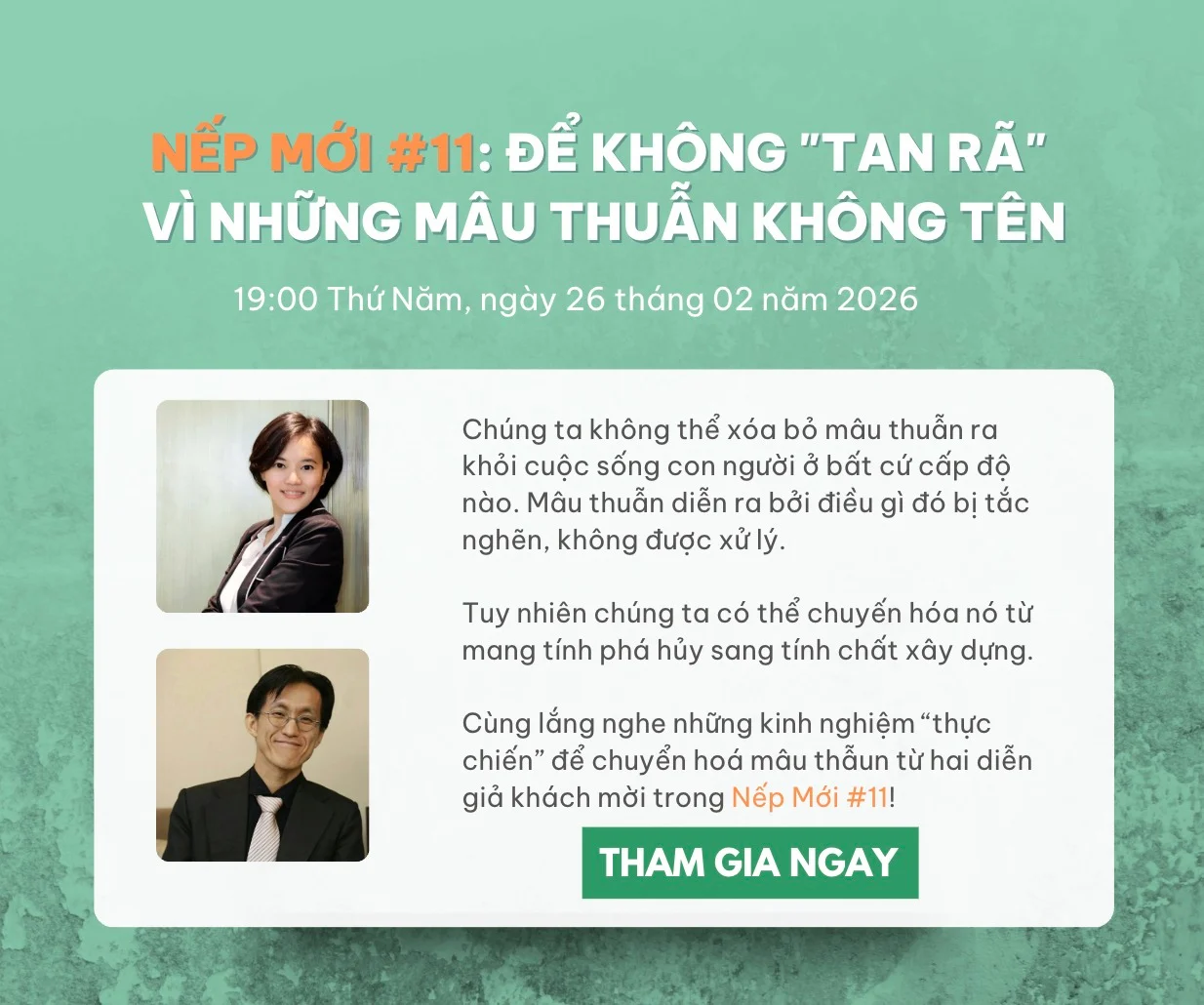
[Event for Vcil Community Membership Members]
Time: 19:00 Thursday, day 26 February 2026
Format: Online via Zoom.
Language: English (Vietnamese translation available)
Tension, disagreement, and conflict are natural occurrences when we live and work together; whether in families, organizations, or communities. During critical development phases, transition periods, or when facing external pressures, the greatest challenges facing the entire collective are not technical issues, but how we relate to each other.
In essence, community (families, classrooms, businesses, organizations,...) is a collection of different nervous systems, historical flows, inner reflections, cultures, social customs, and various journeys of self-understanding and healing. Therefore, tension or conflict simply reveals the submerged parts of the iceberg—what shapes how people listen, speak, react, and make decisions.
So when developing or building community, instead of asking "how can we avoid conflict?", we need to ask "have we prepared the foundations to receive conflict or tension when it happens?". In other words, the question is not how to eliminate or avoid tension or conflict, but how to face it in ways that promote understanding, connection, and finding common solutions.
In Nếp Mới #11, the first session of 2026, Vcil Community and our member community will have the opportunity to meet Ms. Atcharee and Mr. Chanchai—two experts and experienced practitioners in conflict facilitation, trauma healing practices, and community work. They will guide us through their practical experiences on how to face disagreements and tension in healthy, authentic, and compassionate ways. Their approach is based on Nonviolent Communication (NVC), Process-Oriented Psychology, Parts Work, along with gender-sensitive and trauma-informed approaches.
- "Working with yourself" (inner work) as a foundation to transform external challenges.
- How to communicate with others when caught in conflicts.
- Specific steps to face conflict: the process before, during, and after.
See you at Nếp Mới #11!
You can register as a member to attend Nếp Mới #11 for free. Detailed information is in the comments section.
Fanpage: Vcil Community
Phone/Whatsapp/Zalo: 0836243541 (Huy)
Email: vcil.group@gmail.com
New Ways will invite scholars, experts, and people with practical experience to share about essential and familiar topics in life