You are using the member interface.
Log out of the member interface →
← Bản tin

Nếp Mới #12: Restoring our food system - Citizens, producers and the power of consumer cooperatives

Thông tin cho hội viên

Thông tin dưới đây chỉ dành riêng cho Hội viên Vcil
Để đảm bảo quyền lợi của bạn cũng như cộng đồng Hội viên Vcil, mong bạn đừng chia sẻ thông tin này nhé!


Bạn có thể chia sẻ thông tin về dự án dành cho công chúng bằng cách sao chép link này:

Recap Nếp Mới #12: The food system: citizens, producers and the power of consumer cooperatives

In a world where food is increasingly treated as a commodity, mass-produced, globally distributed and optimised for profit, the question is: What power do we, as consumers, really have in this system? Are we merely passive shoppers, or can we become “food citizens”, people who actively shape how food is produced, distributed and consumed?

To explore that question together, within Nếp Mới #12, Vcil Community looked at the Seikatsu Club Consumers' Cooperative model, one of the most vivid examples of how consumers can together rebuild the food system and, beyond that, the way we live.

Seikatsu is not an organisation that concentrates power. It is a federation of cooperatives, a network of 33 consumer clubs spread across 21 prefectures from Hokkaido to Hyogo, with more than 419,000 members. Although that number sounds large, Seikatsu's structure is designed to be decentralised: each local club has autonomy, makes its own decisions and organises its own activities. The federation plays a connecting role, without centralised control.

This decentralisation creates something very important: power does not sit at the centre, but in each small community, where consumers actually live, interact and make everyday choices.

Watch the video recording here:

The consumer revolution of the housewives

The Seikatsu story began with a very everyday problem. In 1965, in Setagaya ward (Tokyo), a group of around 200 housewives began “buying together” milk for their children. At the time, the market was flooded with poor-quality industrial milk products, some not even made from real milk. Concern for their children's health became the catalyst for them to ask questions, connect with one another and look for a different solution.

The project succeeded, and the group extended the principle of “collective buying” to other products, leading to the formal founding of the Seikatsu Club Consumers' Cooperative (SCCC) in 1968. The reason was that they wanted to operate formally as a non-profit business entity, with democratic governance, guaranteed member autonomy and operations based on transparency.

By the definition of the International Cooperative Alliance, a cooperative is an autonomous association of people who voluntarily unite to meet their economic, social and cultural needs through a jointly owned and democratically governed enterprise. Values such as self-responsibility, equality and solidarity are not just slogans; they are the operating foundation.

The context of its birth

Seikatsu was born as Japan entered its period of breakneck economic growth, rising from a defeated nation to one of the world's economic powers, with mass production and mass consumption. Although this brought many material achievements, it came with environmental pollution, many consequences for human health and the environment, and a rupture between people and nature. Events such as river pollution, industrial chemicals and food-safety crises led many people to ask: Is this “development” really bringing a better life?

From those questions, Seikatsu sought not only clean food but a deeper philosophy:

“Citizens must be the ones who shape their own lives.”

This philosophy is clearly expressed in Seikatsu's “Declaration of Living”:

“To live is to consume.

The choices we make, what we consume and how we consume it,
are directly tied to the kind of future we want to create, and to what we want to hand on to the next generation.

We want to choose a sustainable way of life, in harmony with nature, aiming for self-reliance and circularity in food, energy and care (welfare) as much as possible.

We act with equal concern for the lives of living beings today and of future generations.”

From “goods” to “consumer materials”

In the Seikatsu system, food is not called “goods” but “consumer materials”. This change of name reflects a deep change of thinking: food does not exist to maximise profit, but to meet people's real needs.

Today, Seikatsu supplies around 800 food products a week. The distribution system is organised in a circular way: from producers to distribution centres, then to consumers, and back again, for example the reuse of plastic bottles. Most revenue (around 660 million USD in 2024) comes from home delivery, alongside some physical stores and group delivery.

What makes the difference, however, is not scale or logistics, but the relationship between consumers and producers.

In Seikatsu, prices and volumes are not decided by the market, but through dialogue and agreement between the two sides. Consumers can meet and work directly with producers to understand their processes, difficulties and the realities of production. In turn, producers understand consumers' real needs.

Food then stops being a transaction and becomes a relationship.

Over time, Seikatsu also realised that “supporting” producers through consumption was not enough. As Japan ages rapidly, especially in rural areas, many producers face labour shortages and declining local communities.

So Seikatsu widened its role: not only a food system, but a community ecosystem. In the producing regions, they build living communities together, where there is not only food production but also projects on energy, social welfare and the regeneration of local life.

Q&A: What does “collective buying” mean? What is the difference between a consumer cooperative like Seikatsu and retail companies?

First, “collective buying” cuts out the middlemen, meaning consumers can work directly with producers. Prices are no longer decided one-sidedly by the market, but formed through discussion and agreement between the two sides. This ensures the minimum cost of production is covered and producers receive a fair income, so that they can pursue sustainable production methods with peace of mind.

Second, consumers are not just buyers; they take part directly in product development. Instead of producing first and then looking for a market, as in conventional models, here consumers actively share their needs with producers, what they need and want, so that products are created that genuinely fit their lives.

Third, the relationship is reinforced through long-term commitment. At the end of each year, consumers agree with producers on the expected volume for the following year. This lets producers plan production proactively, reduce risk and secure a stable outlet.

Q&A: How are producers and consumers connected? How does Seikatsu check quality?

In the Seikatsu system, the relationship between consumers and producers does not stop at buying and selling; it is nurtured through direct, regular meetings. In the past year alone, more than 2,000 meetings between the two sides were held: spaces to talk, exchange and understand one another more deeply.

For agricultural products, the connection goes further. Many cooperative members, the consumers themselves, take part in volunteer programmes on farms. They go to live and work with farmers for a period, to experience directly and understand how food is made. “Visiting the producer” is not a rare activity but a natural part of how this system works.

Ryoko Shimizu, Seikatsu's international coordinator and researcher, shared an interesting story. Once, she took a media group to meet two farmers in the network without warning. Even unprepared, the two farmers could explain very clearly and coherently how they farm and Seikatsu's production principles. This was no accident; it comes from being used to welcoming consumers, talking and explaining their work as part of everyday life.

From there, quality control is also approached in a very different way.

Instead of relying on third-party certifiers as in conventional distribution systems, Seikatsu built an internal inspection mechanism carried out by its own members. A group of consumers prepare questions together, then visit the production site directly to observe, learn and “verify” the process.

This is not just a sightseeing trip but a genuine investigation, in which consumers actively make sure the product is made as promised. If problems arise, they discuss them directly and ask the producer to adjust, improving quality or process.

In this model, responsibility is not “delegated” to a third party. Consumers become the ones ultimately responsible for the food they use.

Q&A: What is the basis for setting a fair price between producers and consumers?

The most fundamental basis for pricing in Seikatsu is the cost of production. Consumers and producers meet regularly and discuss this cost structure directly, from inputs and production to transport. When these costs change, the final product price is adjusted accordingly.

Yet the price is not decided one-sidedly. It is the result of dialogue and agreement between the two sides.

For example, over the past year or so, the market price of rice in Japan rose sharply. The farmers in the Seikatsu network also wanted to adjust their prices to reflect real costs. But if the price rose too steeply, consumers would not be able to afford it. So the two sides sat down together: consumers accepted a price increase, but at a reasonable level; and producers adjusted to keep it workable.

In the end, the price is formed not only from cost but from a balance between two factors:

on one side, the sustainability of production,

and on the other, consumers' ability to afford it.

Q&A: Are producers subject to state supervision?

Producers must still meet the state's basic requirements and standards to bring products to market. Within the Seikatsu system, however, Seikatsu has its own set of standards, and any producer who wants to join the network must commit to them. Seikatsu's standards are usually stricter than state regulations, for example not using certain additives or ingredients that may be harmful in food.

This reflects a different approach: quality is guaranteed not only by external regulation, but shaped by values and agreement from within the community.

Q&A: If farmers are hit by natural disaster or disease, what does the cooperative do?

This is not a hypothetical; it has happened many times in practice.

When output is affected by natural disaster or disease, supply can no longer meet demand. In such cases, the cooperative calls for support from consumers themselves. Members can contribute financially to help farming households through the difficult period and maintain their capacity to produce in future.

That is no longer a buyer–seller relationship, but a form of risk-sharing.

Seikatsu also builds flexibility into the system by working with many producers in different regions.

For example, when a chicken farm in Saitama prefecture was hit by disease and could not supply enough eggs, the cooperative worked with another farm in Chiba prefecture to increase output and cover the shortfall.

The same product, supplied from several sources: this keeps the system from depending on a single point and makes it better able to adapt to shocks.

Q&A: Can you tell us more about the cooperative's care work?

Under Japanese regulations, consumer cooperatives may not directly provide healthcare-related services. Seikatsu, however, found another way to widen its role in this field.

At first they set up workers' councils, and through these developed care models such as elderly-care centres and nurseries. The cooperative provides the facilities, equipment and infrastructure needed for these services to operate and serve its own members.

Seikatsu also founded a company operating in the social-welfare field. Through this company, it runs care homes and kindergartens, with support from local government.

A notable example is the care homes run by Seikatsu. In many ordinary care facilities, spaces such as toilets and bathrooms are usually designed to be shared. Here, however, for elderly people, especially those with memory or psychological difficulties, private spaces are designed to ensure privacy and personal dignity.

Beyond that, the food in these care homes is supplied from the Seikatsu network itself, ensuring quality and wholesomeness in every meal.

Similarly, the kindergartens in this system, supported by the government and run in Seikatsu's facilities, nurture children from the very basics. The children eat lunches made from ingredients from the cooperative network, gaining access to healthy food from an early age.

Q&A: How does Seikatsu's financial model work, especially for areas such as social care and energy?

Fundamentally, Seikatsu runs on a membership model, in which each participant is not only a consumer but a member, that is, a co-owner of the cooperative.

To become a member, each person contributes initial capital by buying shares in the cooperative. This contribution is not lost; it is returned when they leave the cooperative. In addition, members pay a maintenance fee of around 1,000 yen per month (roughly 120,000 VND).

Seikatsu also builds a small margin into product prices. This margin is not aimed at maximising profit, however, but used to maintain and run the system

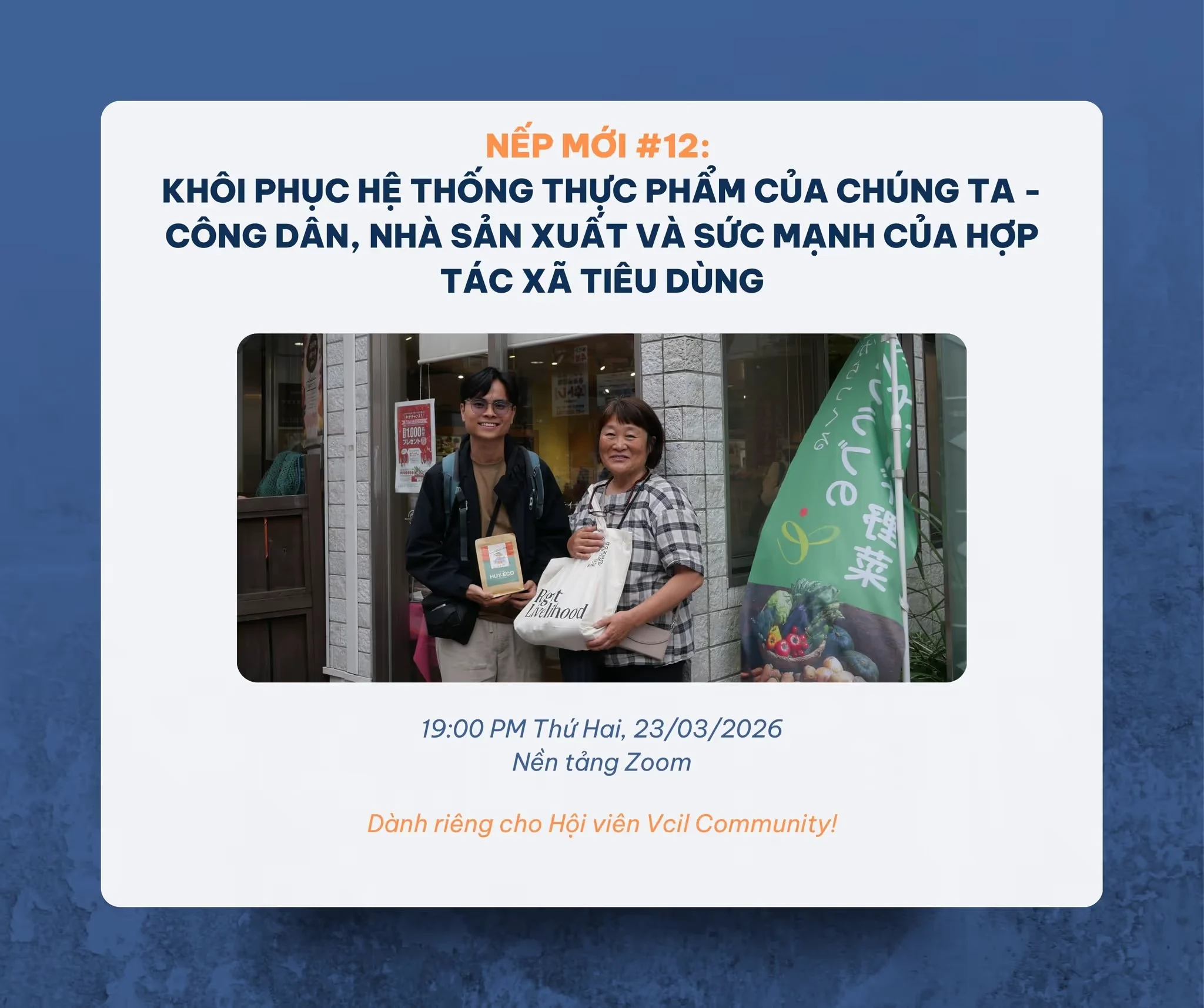
NẾP MỚI #12: RESTORING OUR FOOD SYSTEM - CITIZENS, PRODUCERS AND THE POWER OF CONSUMER COOPERATIVES

Time: 19:00, Monday 23 March 2026

Format: Zoom

Language: English (with Vietnamese interpretation)

[This event is reserved for Vcil Community Members]

ABOUT:

“Where does the food on our table really come from?”

In the late 1960s, a small group of housewives in Japan began to worry about the safety of the milk their children were drinking. Instead of waiting for companies or the government to solve the problem, they decided to act together. They contacted farmers, organised collective purchasing and created a system in which consumers and producers could build trust with each other directly.

From that small beginning, the Seikatsu Consumer Cooperative was born.

Over the decades, the initiative has grown into a nationwide network of more than 400,000 members. More importantly, it has become a living example of something powerful: ordinary people can reshape the economy when they organise together. In the Seikatsu movement, people are not merely consumers: they are co-creators of the food system, partners of farmers and active participants in shaping their community.

For many people in Vietnam today, food safety, environmental protection and the future of the food system are increasingly urgent. We worry about pesticides, about where our food comes from and about how farmers can survive in a changing economy. Yet we often feel these problems are too big for an individual to influence.

The Seikatsu story invites us to look again.

What if citizens, communities and producers could work together to build a food system that is more transparent, more accountable and better able to sustain life? What cultural values, community practices and long-term commitments could make such a model possible?

In this month's Nếp Mới, we explore the inspiring journey of the Seikatsu Consumer Cooperative and reflect on the lessons it holds for Vietnam and our community. Through storytelling, dialogue and collective reflection, we open a space to imagine how everyday actions, when connected by trust and cooperation, can gradually transform our systems of production.

ABOUT THE SPEAKER: Ryoko Shimizu - International coordinator & researcher at Seikatsu Club

ABOUT NẾP MỚI

Inspired by the Vietnamese word “Nếp”, which refers to the ingrained patterns of culture, habit and daily life, Vcil Community launched Nếp Mới to create a space that nurtures new ways of living: ways that prioritise lasting well-being and the regeneration of true wealth. It is a community space designed to help people recognise and break out of outdated patterns, learn from collective wisdom and reimagine how we live, connect and learn.

Each month, community members dive into a different theme. Nếp Mới invites scholars, experts and practitioners to share insights on essential topics that matter to our lives. Participants have the chance to join the dialogue, deepen their understanding, find solutions to personal or collective problems, or begin meaningful work.

More than a conversation, Nếp Mới is a place to foster reflection, encourage collaboration and provide practical tools for the whole community on the way to a regenerative and flourishing future.

CONTACT

- Fanpage: Vcil Community

- Phone/WhatsApp/Zalo: 0836243541 (Huy)

- Email: vcil.group@gmail.com

Bài viết cùng chủ đề

Các dự án liên quan bài viết

New Ways will invite scholars, experts, and people with practical experience to share about essential and familiar topics in life