You are using the member interface.
Log out of the member interface →
Blog

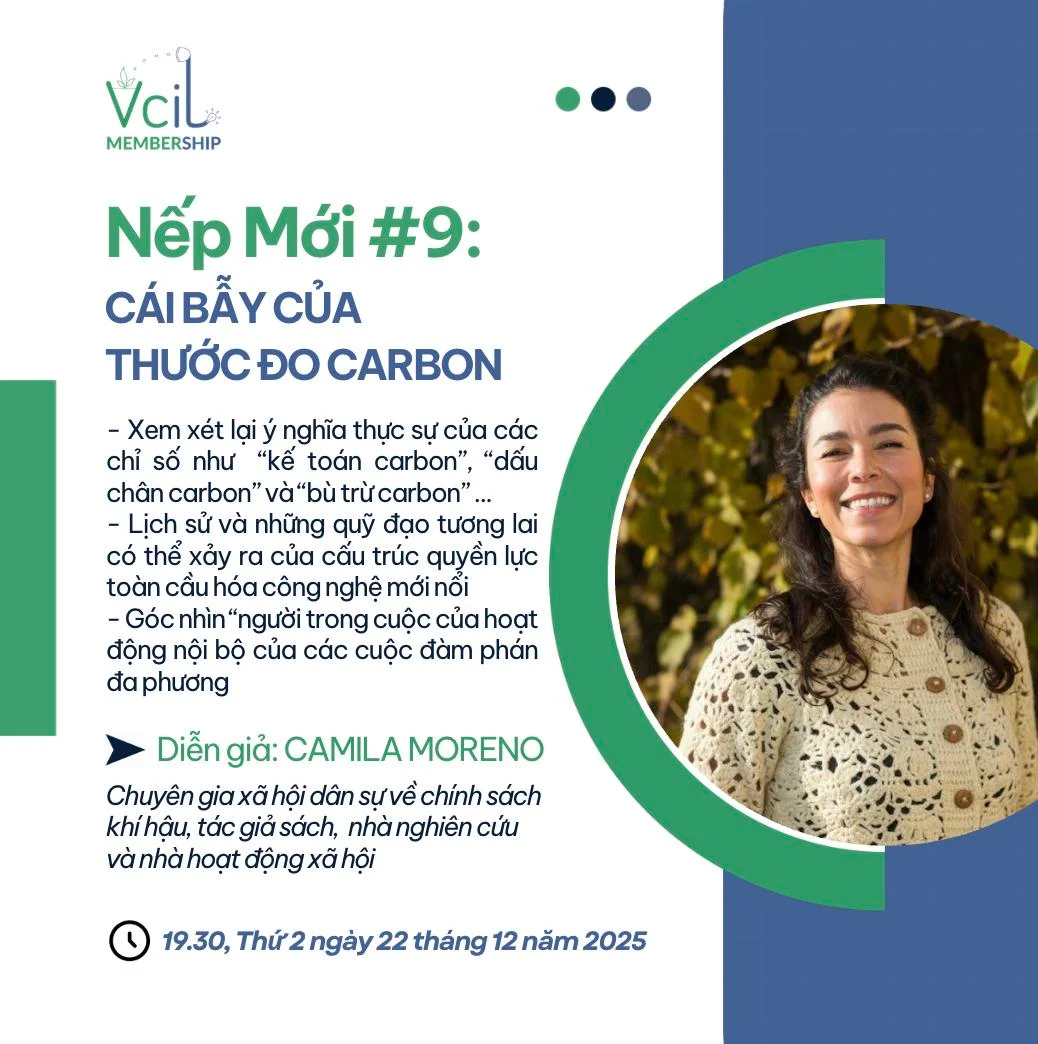
[Nep Moi #9] The Trap of the Carbon Metric with Camila Moreno

Thông tin cho hội viên

Thông tin dưới đây chỉ dành riêng cho Hội viên Vcil
Để đảm bảo quyền lợi của bạn cũng như cộng đồng Hội viên Vcil, mong bạn đừng chia sẻ thông tin này nhé!


Bạn có thể chia sẻ thông tin về dự án dành cho công chúng bằng cách sao chép link này:

THE CARBON MATRIX: WHEN CLIMATE BECOMES A TOOL FOR A NEW WORLD ORDER

At the December 2025 Nếp Mới event, Camila, one of civil society's leading experts on climate policy, took the time to share with the Vcil community about carbon metrics, digitalisation and corporate power.

Camila shed light on the history and possible future trajectories of the emerging power structure of technological globalisation, focusing in particular on how closely that agenda is tied to international climate governance, such as the COP climate negotiations.

She emphasised how the complexity of climate has been reduced to carbon dioxide, and how that has served to co-opt diverse environmental struggles into a business-friendly agenda based on plans for markets, digitalisation and the financialisation of nature. Camila gave all of us a strong warning about going any further down this technocratic path.

Below is the recap of Camila's talk.

From monoculture forests to the international negotiating table

Opening the conversation, Camilla Moreno expressed a deep sense of kinship at standing before friends in Vietnam. She shared that, as a daughter of Brazil and of the countries of the Global South, she has always felt an invisible thread connecting the lands that are jointly affected by global policies. Camilla's journey did not begin in the luxurious meeting rooms of the United Nations, but in the field, in the struggles back home in Brazil more than 15 years ago. In the 2000s, when she began following the climate summits from COP14 in Poland, she realised there was a vast gap between the flowery rhetoric about saving the planet and the harsh reality people were facing.

At that time, Camilla was involved in campaigns against eucalyptus monoculture plantations for pulp and the encroachment of genetically modified food, especially GMO soy. Through those experiences, she began to notice a strange pattern: environmental policies were gradually becoming a new kind of tool for restructuring law and the economy. She stressed that we should not see the COP conferences merely as meetings about the environment. In reality, they are where public policy templates for the whole world are designed. When a country signs and ratifies these agreements, it is bringing home a "blueprint" that will then be turned into national law, directly affecting the life of every citizen at the local level.

"Blueprints" and the erosion of sovereignty

For almost two decades, from 2008 to today, in many different roles — from activist to university researcher — Camilla has been present at almost every COP. She treats it as a primary research site to witness first-hand how global public policy is built in an extremely strange way.

Usually, when we talk about law, we think of city councils, provincial councils or national parliaments — where elected representatives debate and set the rules for their own locality. But Camilla points to the opposite reality: what we are facing is in fact a pre-fabricated global legal system. She calls these policy "blueprints" or "templates".

These policies are designed and agreed at the COP conferences, and then "reproduced" in each country. That is why we sometimes see new laws appearing strangely without understanding where they came from: from Net Zero commitments and "smart" mandates to low-carbon certification processes and the way carbon markets are created.

All of them originate from a higher level of governance that she calls Global Climate Governance. This is a fairly young governance regime, only formed since the late 1990s, but it has now become extremely concrete and present. It holds absolute power in reshaping how we live, produce and see the world, turning complex ecological problems into technical blueprints imposed uniformly from the top down.

Russian Matryoshka dolls: decoding the COP "operating system"

To help us picture the nature of today's climate policies, Camilla offered a fascinating metaphor: the Russian Matryoshka doll. She explained that when the doll is closed, we only see a single outer shell. But once you start opening it, you find countless other dolls nested deep inside.

Climate policy is much the same. The outermost shell we always see is the shining messages such as "Let's fight climate change together", "Decarbonisation policy" or "Carbon markets". Yet hidden deep within those slogans are layers far more complex than what the naked eye can see. Camilla, who had just returned from the 30th COP, stressed that we cannot understand this "doll" without looking at its origins and how it has operated over more than three decades.

She posed a fundamental question: "COP" means Conference of the Parties, so who are the Parties and what are they party to? "The Parties" are the Nation States that have signed the international conventions. However, she highlighted an important detail about sovereignty: a government cannot simply go to the United Nations, sign a document and be done. That document must be brought home and ratified by the National Assembly or Senate before it becomes law that the country must comply with. This is how international agreements penetrate and change the laws of each country.

That is why the COP conferences are in reality global public policy "design workshops". There, governments and experts create the blueprints. This means that if you see a new environmental policy in Vietnam or Brazil, it usually does not stem from that locality's own needs, but is the result of "domesticating" standards that were fixed in advance at international conferences. She calls this a governance system that is young (it only began in 1992) but that holds absolute power in reshaping how we live and produce.

The legacy of Rio 1992 and the New World Order

The system of multilateral environmental agreements that the COPs discuss today actually originates from the "Earth Summit" in Rio de Janeiro, Brazil in 1992. That is where the three major conventions on Climate, Biodiversity and Desertification were signed at the same time. Camilla invited us to look deeper at the machine behind these conventions: the United Nations (UN) system, an 80-year-old entity born in 1945 after World War II.

She described the United Nations as a giant system with specialised branches: FAO for agriculture, UNDP for development, UNEP for the environment, and not forgetting the financial institutions of the Bretton Woods agreement such as the World Bank and the International Monetary Fund (IMF). Together they form a post-war world order, in which common rules are established to govern the globe.

The 1992 milestone in Rio was not just an environmental event, but a profound geopolitical turning point. Camilla pointed out that this was the moment that clearly divided the world of the Cold War from the world after the fall of the Berlin Wall. When the confrontation between the two poles of capitalism and communism ended, the world needed a new "shared story" to bind nations together. And the "Climate Story" appeared as the perfect tool. It created a sense of a "shared planet", a shared threat, thereby establishing a new governance framework in which environmental issues became the main language for running global politics and economics.

From the United Nations to the "United Corporations" and the 2050 Matrix

Camilla took us back to the familiar images of the United Nations with its brilliant flags and luxurious plenary halls. Yet she warned of a shift: we are gradually moving from the United Nations model to an entity she calls the "United Corporations and Nations". At the COPs, the space for civil society is really just a shell, while the country pavilions are now flooded with the presence of corporate sponsors.

Once again, Camilla stressed the "Carbon Matrix". She explained that for many years, every effort has focused on forcing the ecological crises into a template that can be measured and weighed. This is a purely quantitative worldview, in which the complexity of life is reduced to equivalent numbers of tonnes of CO2. Under this climate regime, all countries are being pulled into a process of "aligning" their policy frameworks towards the 2050 milestone.

So-called "nature protection" has been stripped of all qualitative value to become dry numbers. Camilla calls this the thorough "carbonisation" of thinking. A sacred old-growth forest, home to ancestors and to thousands of years of ecological diversity, is now forced into a single measure: carbon stock. Mother Earth is no longer seen as the source of life, but becomes a CO2 "storage facility". Reducing every complex ecological crisis to a single unit of calculation, the tonne of carbon, has stripped nature of its soul, turning life into a data sheet that can be managed remotely by technocrats.

She analysed how 2050 is painted as a "historical horizon", where in 25 years the global economy will reach Net Zero, climate problems will be solved and the energy transition will be complete. To reach that milestone, we are living in what is called "The Critical Decade". Since the COVID-19 pandemic in 2020, the message at the COPs has always been "leave no one behind" over the next 10 years. But Camilla exposed a truth buried deep in the national contribution plans: you cannot achieve a Net Zero future without fully digitalising society within this decade. This is the trap – where protecting the environment becomes an obligation to accept digital control.

The Paris Agreement and the rise of an unelected world government

Camilla recalled the history from the Kyoto Protocol (1997) – where only developed countries had emission-reduction obligations – to the turning point of the Paris Agreement (2015). After the 2008 financial crisis, developed countries changed the game, turning the climate regime into a "universal" system. Now, whether you are a developed or developing country, everyone must decarbonise.

At today's COPs, the boundary between governments (the Blue Zone) and the private sector (the Green Zone) has been completely blurred. Camilla pointed out that it is very hard to tell who is acting in the national interest and who represents corporations. In reality, corporations are the entities running this climate regime, because the system has become so dependent on high technology, AI and digitalisation. We are witnessing the birth of a kind of "unelected world government", where life-and-death decisions about our lives are made by people we never voted for.

The clearest evidence of this is the Singapore pavilion – a country that is now becoming a giant "hub" for structuring carbon markets, especially in Southeast Asia. Here, people not only trade carbon but also trade "adaptation". Even adapting to disasters is opened up as an investment opportunity for the private sector under pretty names like "Resilient Finance" or "Climate Intelligence".

Camilla concluded this section with the image of the role of Artificial Intelligence (AI). In every session, AI is hailed as the only technology capable of seeing through and calculating every unit of carbon in the world. This is the reality she wants to warn about: a world where power flows to those who own the algorithms, the fund managers and the financial empires, while nature and people are just invisible numbers in a matrix that cannot be touched, smelled or sensed with ordinary senses.

When AI becomes the supreme "referee" and the thirst for nuclear energy

In the final stretch of the talk, Camilla Moreno issued a stark warning: under the banner of "decarbonisation", we are gradually accepting a giant technological infrastructure that covers all of life, and ironically, we ourselves (through our governments) are borrowing money to pay for the installation of this surveillance system.

She cited COP26 in Glasgow, where methane (CH4) began to receive its "death sentence" and became a target of even stricter monitoring than CO2. Immediately, US satellites were launched to track methane from landfills and livestock facilities. Camilla pointed out that this is not just an environmental matter, but part of the space and AI infrastructure race between superpowers like the US and China. In this race, Google appears as a "green hero", providing tools like the Environmental Insights Explorer to help cities measure and track climate action. But in reality, this is Google using proprietary data to monitor us, turning governments into entities dependent on their algorithms.

In the negotiating rooms, Camilla described a deeply ironic image: the walls where governments are negotiating are covered in advertisements for "AI for sustainability". AI is now portrayed as the supreme "referee", the only force on Earth capable of calculating and verifying invisible units of carbon. It is praised as the "game changer", the "great accelerator" for every solution: from smart grid management and forecasting flows of climate migrants to setting insurance payouts for victims of natural disasters. AI even plays the role of a "dating app" between governments and private investors to optimise costs and profits.

However, running such a giant AI empire requires an enormous amount of energy. That is why, at the most recent COP, a new message exploded: "Net Zero needs nuclear". Camilla pointed to the strong rise of the international nuclear alliance with the goal of tripling capacity by 2050. Major organisations like the Rockefeller Foundation have also begun publishing reports backing nuclear as a saviour solution. The carbon matrix is now not just data, but is reinforced with new-generation nuclear reactors.

Closing: escaping the matrix to return to Mother Earth

Camilla ended her talk with a haunting conclusion: the current climate regime is in fact a "hostage" of AI. Without AI, this entire global carbon governance plan would collapse because it is too complex and invisible for humans to run themselves. We are being forced to accept AI for everything, from precision irrigation in Africa to managing mining waste in South America.

But she also opened up a way out, a truth we all feel deeply: the real solutions to climate change are not found in algorithms or satellites. They lie locally, bound to the ground, to native seeds and to communities' autonomy over their land.

She called the technological vision being sold at the COPs a "dystopian" world. The real solution lies in us taking back power from the machines, escaping the spell of quantitative numbers to return to protecting the qualitative values of life. It is a fight not only to save the planet, but to save our humanity and the sacred connection between people and nature, without going through any digital "referee".

Q&A

Question 1: Should farmers invest in order to sell carbon credits?

Camilla gave a warning: when you join any carbon credit programme, you are not simply selling a product. You are agreeing to have your entire productive life "integrated" into a giant technological infrastructure. Because for carbon to be calculated, traced and verifiable on the international market, it needs continuous monitoring by satellites, sensors and algorithms. Once the contract is signed, the farmer unwittingly becomes a link in the "tech stack" she analysed earlier.

Why are these programmes exploding so strongly? Camilla took the example of Brazil and suggested this scenario is playing out in many other places. Governments often declare that they are in a state of "austerity", with no more public budget or fiscal space to support farmers directly. Instead of subsidising agriculture with taxpayers' money, they choose the path of "public-private partnership" (PPP).

In this model, the government plays the role of holder of the data lists on farmers, while corporations provide the monitoring technology. Carbon credits are then introduced to smallholder farmers as a "new source of income" to replace the state support that has been cut. This is the reality behind the name "United Corporations" – where livelihood solutions no longer come from welfare policy but from cooperation between the state and financial empires.

Camilla expressed deep empathy for farmers' difficult reality. She understands that for a farmer who needs capital to grow rice or vegetables, turning down a source of income is extremely hard. When hunger and debt close in, selling carbon credits looks like a viable way out.

However, she noted that farmers need to be very clear-eyed about what they are really signing. You are not just selling carbon; you are signing a licence that allows this system to monitor you 24/7. They will not say they are monitoring you; they will say they are "monitoring carbon". But because carbon is tied to the breath of your livestock, to how you till the soil and how you use water, in reality it is your life and your freedom to farm that is placed under the remote-sensing lens and the algorithm.

Camilla concluded that this is not an easy choice. On one side is the urgent financial need to keep producing; on the other is the risk of being locked into a mega governance system – where decision-making power over your own land is gradually handed over to unfeeling algorithms far away. For her, selling carbon credits is not a sustainable development solution, but a surrender of farmers' sovereignty to a new digital feudal order.

Question 2: Are those in power deliberately "chopping up" the complexity of nature and society to make it easier to control? And is any government truly willing to let go of power and hand it back to local communities?

Camilla was very taken with the way the question framed control. She fully agreed with the questioner's view that those in power are deliberately "chopping up" the complexity of nature to control it more easily. She explained that the way they understand climate today is not as local microclimates tied to geography, but as a "global atmospheric climate" consisting only of dry CO2 molecules. In the eyes of the administrators, climate is just countable carbon molecules: one, two, three, four...

This thinking actually stems from the Cybernetics theory of the 1950s – a view that treats all biological and human systems as giant programmable machines. According to Camilla, what the Intergovernmental Panel on Climate Change (IPCC) is now promoting, from sustainable diets to fake proteins, is in reality a large-scale Social Engineering programme, not pure empirical science. In the name of science, people are trying to "mould" humans into certain templates. Camilla likened these efforts to change the narrative and "hack" culture to the psychological operations (special operations) of hybrid warfare – where the goal is not to seize land but to seize our minds and behaviour. China is pushing a "new cybernetics" for the 21st century, but its roots still lie in American governance doctrines from the last century.

Another issue Camilla raised is that the concept of the Nation State is actually a fairly recent "experiment", only appearing in the 17th century in Europe, and in her region (Latin America) only about 200 years old. However, to run today's surveillance capitalism, the technology and financial corporations no longer really need nation states.

In Camilla's personal view after many years of research, states are being eroded from within. Apart from a few controlling powers such as the US, Russia, China or India, the rest of the world is gradually being turned into "vassal states". We are shifting strongly towards the Platform State model.

Why are organisations like the Clinton Foundation or Tony Blair so enthusiastic about promoting the concept of "Open Government"? Camilla exposed that, behind that transparent-sounding name, is an effort to dismantle large national structures in order to "localise" everything. However, this is a "distorted localisation".

The system wants to separate us from the protection of the state (even if that state can sometimes be authoritarian or corrupt) to push us into a direct connection with Google, Uber or Nvidia. We get to live "locally", but surrounded by giant data centres and even small modular nuclear reactors (SMRs) – things labelled as "energy autonomy" but in fact tools for corporations to control every last corner.

What saddens Camilla most is the way corporations and technocrats have "stolen" the very words of social movements. Words like "local", "decentralised", "autonomous" and "transparent" were once the weapons of those fighting for community, and are now used by the powerful to promote a comprehensive system of digital surveillance and control.

She concluded that our greatest challenge today is how to reclaim our own stories and language. We want localisation in the true sense – based on seeds, on community self-governance and a deep understanding of the land – not a "localisation" in which every behaviour is measured by AI and every resource is controlled by Silicon Valley algorithms or the technocracy of the superpowers.

Question 3: Do any "real solutions" exist amid the maze of false solutions at COP?

Camilla shared that, alongside the glitz of the technology pavilions, there is always a "People's Summit" self-organised by different branches of civil society. There are no grand halls or polished speeches there, but hundreds of vibrant parallel discussions.

In their final declaration, they loudly denounced the "false solutions" and pointed to a key factor that the COPs usually ignore: Peace and demilitarisation. Camilla stressed that we cannot talk about saving the planet when a huge share of national budgets is being poured into wars and the military apparatus. There can be no money for climate change if money is still being used to destroy life. Peace, therefore, is a core part of the environmental solution.

She acknowledged that the world has no shortage of wonderful people doing regenerative agriculture, reforestation, recycling or building a circular economy. We know how to save seeds; we know how to do agroecology.

But the problem is this: how do we stop those good solutions from being "swallowed" by this insane financial and technological machine?

Camilla likened the Big Tech system to a giant "dome" trying to cover everyone. They are peddling a coercive argument: that without high technology you cannot "see" carbon; and if you cannot see carbon (because it is invisible), you will never receive finance. The entire architecture of world finance today has been "hijacked" and privatised, forcing every ecological solution to depend on digital data.

A painful reality is that the younger generation is gradually leaving the countryside for the "Smart Cities". Camilla pointed out that the system is sowing fear, making people feel too weak in rural areas and needing to run to the big cities to be "protected" by digital infrastructure.

She affirmed: the real and most important solution to climate change is to stay on your land and fight there. Instead of herding people into urban "digital prisons", we need a wave in the opposite direction: people leaving the big cities to return to the countryside.

Staying with the land is not just an act of farming, but the most powerful political act of resistance against the carbon matrix. It is how we keep indigenous knowledge from being erased, keep seeds from being monopolised and keep life from being turned into unfeeling tokens on a Blockchain. The solution lies not in staring at an iPad screen to track carbon, but in touching the soil and building autonomy right in our own communities.

⏰ Time: 19:30, Monday, day 22 December 2025

🎉 Format: Zoom

✨ Language: English (Vietnamese translation available)

We often hear about "carbon footprints," "carbon neutrality," and "net zero emissions." These metrics have become dominant ways we measure environmental impact. But here's the problem: when we reduce the environment to a single metric, we lose sight of the bigger picture.

Focusing solely on carbon metrics creates a dangerous illusion. It suggests that if we just lower our carbon numbers, everything will be fine. Meanwhile, entire ecosystems are being destroyed, indigenous lands are being seized, and exploitation of both nature and people continues unchecked—all while appearing "carbon neutral" on paper.

The carbon metric trap is a symptom of a deeper problem: our tendency to quantify and commodify nature. Instead of asking "How do we live in balance with nature?", we ask "How do we measure and manage carbon?" This reductionist approach can lead to perverse outcomes where supposed "solutions" cause more harm.

In Nếp Mới #9, we have the honor of welcoming Camila Moreno, an ecosocialist activist and author who has been at the forefront of critiquing the carbon metric trap. She will help us understand why carbon metrics are insufficient, what they mask, and what alternative frameworks we need to build truly regenerative and just futures.

Expected Topics:

- The limitations and dangers of the carbon metric

- How "green" solutions can perpetuate exploitation

- Ecosocialist perspectives on environmental justice

- Moving beyond carbon: towards holistic environmental regeneration

See you at Nếp Mới #9!

You can register as a member to attend Nếp Mới #9 for free. Detailed information is in the comments section.

CONTACT INFORMATION

Fanpage: Vcil Community

Phone/Whatsapp/Zalo: 0836243541 (Huy)

Email: vcil.group@gmail.com

Các dự án liên quan bài viết

New Ways will invite scholars, experts, and people with practical experience to share about essential and familiar topics in life