VCIL MEMBERS’ TALKS #10: IN SEARCH OF AN AUTHENTIC LIFE - ‘EXISTENTIALISM’ LIES IN THE PRACTICE OF DAILY LIVING
Topics Recap & Sự kiện, Câu chuyện thành viên
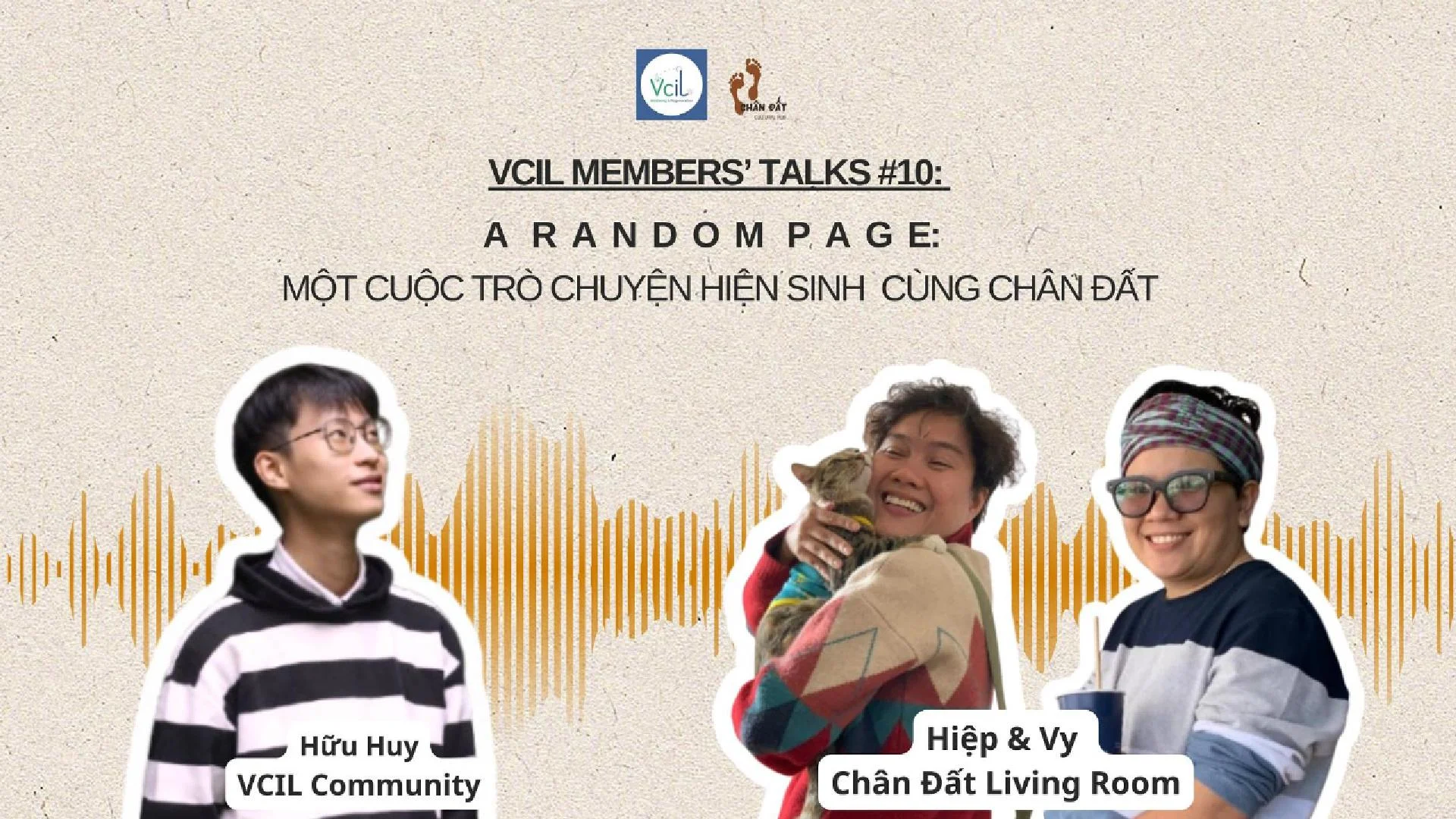
On the evening of May 26, Vcil Members’ Talks #10: A Random Page - An Existential Conversation with Chan Dat took place, featuring guests Vy and Hiep (Chan Dat Living Room), members of the Vcil Community. They shared their journey through personal setbacks and shifts in both geography and worldview, and how these experiences gradually led them to existential philosophy, Eastern thought, and the creation of the Chan Dat Living Room space in Hoi An.
On this pageOn this page (5 sections)
VCIL MEMBERS’ TALKS #10: SEEKING AN AUTHENTIC WAY OF LIFE – ‘EXISTENTIALISM’ IN DAILY PRACTICE
On the evening of May 26, the talk Vcil Members’ Talks #10: A Random Page - An Existential Conversation with Chan Dat took place, featuring guests Vy and Hiep (Chan Dat Living Room), members of the Vcil Community. They shared their journey through personal setbacks and shifts in both geography and worldview, and how these experiences gradually led them to existential philosophy, Eastern thought, and the creation of the Chan Dat Living Room space in Hoi An.
THE ‘CHAN DAT’ SPIRIT & THEIR PERSPECTIVE ON EXISTENTIALISM
The ‘existential’ conversation that Chan Dat aimed to bring to the session was a story of lived experience rather than a complex, abstract academic concept. It manifests in the choices people make every day, in times of crisis, in our collisions with reality, and in the journey of learning to understand oneself, living authentically, and taking responsibility for one's own life.
From Chan Dat’s perspective, an existential person is someone who harbors a desire to seek the values of Truth, Goodness, and Beauty, and who constantly questions how they are living. On this journey, it is hard to avoid periods of confusion, conflicts with social expectations, or the loneliness that comes with choosing a path different from the crowd. However, it is precisely in those moments that each person has the opportunity to return to what they truly believe in and choose to continue walking with their own authenticity.
This authenticity is not just about "being yourself"; it also requires a deep awareness of oneself and an understanding of the world around us. Only when we clearly understand ourselves and others can we truly stand firm on the path we have chosen.
Hiep added that this approach by Chan Dat shares many similarities with Buddhist philosophy. If Buddhism has the Buddha, the Dharma, and the Sangha, then for Chan Dat, every person carries within them a "Buddha-nature"—the capacity to move toward purity, kindness, and the good values that are already present within. The "Dharma" can be understood as the unique path each person chooses to walk through life, sometimes intersecting with others for a stretch before diverging as the journey changes. And the "Sangha" represents the communities and companions who share the same values, supporting one another along the way.
FROM A FORCED ‘MIGRATION’ TO THE BIRTH OF CHAN DAT LIVING ROOM
Before settling in Hoi An, both Vy and Hiep lived and worked in Saigon. For nearly eight years, they ran a business in retail, distribution, and the organization of traditional cultural, artistic, and culinary events. It was a time of many experiments and years spent burning with passion for their work.
Yet, like many journeys in life, things did not unfold as they had imagined. Resource constraints and shifting circumstances eventually brought the business to an end. This collapse was not just the end of a job or a project; it triggered fundamental questions about themselves, the meaning of what they were pursuing, and how they wanted to live in the years to come.
In those circumstances, Hoi An appeared almost like a place of "refuge." But sometimes, certain lands come to people exactly when they need them most.
Upon arriving in the land that once belonged to the ancient Champa kingdom, Vy and Hiep felt a unique empathy with its history. A civilization that was once brilliant and glorious, yet passed through loss and change to leave only silent traces amidst the passage of time. There was something in that story that allowed them to see themselves.
Hiep was the first to arrive in Hoi An. She recounts that it was the fresh water of the Thu Bon River and the Cua Dai sea that nurtured them during that time. From there, Chan Dat Living Room became a way for Vy and Hiep to acknowledge and express gratitude to the land that opened its arms to welcome a "group of survivors" after their own failures and setbacks.
FROM FAMILIAR FRAMEWORKS TO THE JOURNEY OF SEEKING A DIFFERENT UNDERSTANDING OF THE WORLD
Although they traveled very different paths, Vy and Hiep met at a common point: both had spent a long time placing their faith in linear, Western-based systems of explaining the world.
For Vy, the trauma and sense of displacement from her youth led her early on to Western literature, music, and existential questions as a way to interpret her own experiences. Later, working in an international environment further reinforced her belief in knowledge systems built on logic, analysis, and verifiability. That was until her entrepreneurial journey failed, and she could no longer explain the reality unfolding before her. She turned to Eastern systems of thought—initially Zi Wei Dou Shu—not to seek predictions about the future, but to find a different way of understanding people and life.
For Hiep, her journey into Eastern philosophy began with questioning her own faith in data and the objectivity of numbers. With a love for mathematics, statistics, and systems thinking, Hiep once believed that with enough data and analytical capability, humans could understand and predict most of what happens in society. However, as she engaged directly with life, she gradually realized the vast gap between data and reality.
From their two distinct journeys, Vy and Hiep gradually found common ground in Eastern philosophies regarding humanity, transformation, and the relationship between the individual and the world around them.
MANDALA & THE HARMONY OF THREE TEACHINGS
Throughout the journey of building Chan Dat, Vy and Hiep have often referred to Mandala as a way to visualize the workings of the universe.
In the Tibetan Buddhist tradition, a Mandala is often viewed as a symbol of the universe and the mind. If "Manda" means essence, then "La" is the space that contains that essence. At the center of every Mandala, there is always an immovable point—the heart or core value—from which everything else is formed, moves, and changes.
For Chan Dat, this image serves as a metaphor for their own journey. Over time, the space, activities, or forms of expression of Chan Dat may change, expand, or contract according to different stages of life. But at the center of all that movement remains something almost constant: the desire to create spaces where people can experience, engage in dialogue, and understand themselves and the world around them more deeply through authenticity and insight.
Furthermore, Vy and Hiep share that Chan Dat’s perspective on the world is deeply influenced by the spirit of the harmony of three teachings which has long been present in Vietnamese cultural life, especially in the Central and Southern regions.
According to them, in real life, people rarely live entirely within a single ideology. There are times when we need the spirit of social engagement and community responsibility found in Confucianism; there are periods when we find support in the compassion and introspective observation of Buddhism; and there are moments when we need to learn to go with the flow, let go of control, and trust in the natural course of life, as taught by Taoism.
Perhaps it is this flexibility that has created the vitality of Vietnamese culture throughout various historical periods. According to Hiep, the most prosperous eras in the nation's history, such as the Ly or Tran dynasties, all bore the mark of the ability to harmonize and flexibly apply these seemingly different schools of thought.
Chan Dat is also experimenting with creating a space where different perspectives can coexist, engage in dialogue, and complement each other on the human journey of finding meaning in life.
____
Closing the conversation, the spirit that Chan Dat strives to nurture and spread is being true to oneself in order to keep moving forward, keep learning, and keep an open heart to the lessons life has to offer.
We invite you to listen to some of the highlights and insights from Chan Dat in the photos below!
_____
Q&A: Questions and Answers with Chan Dat
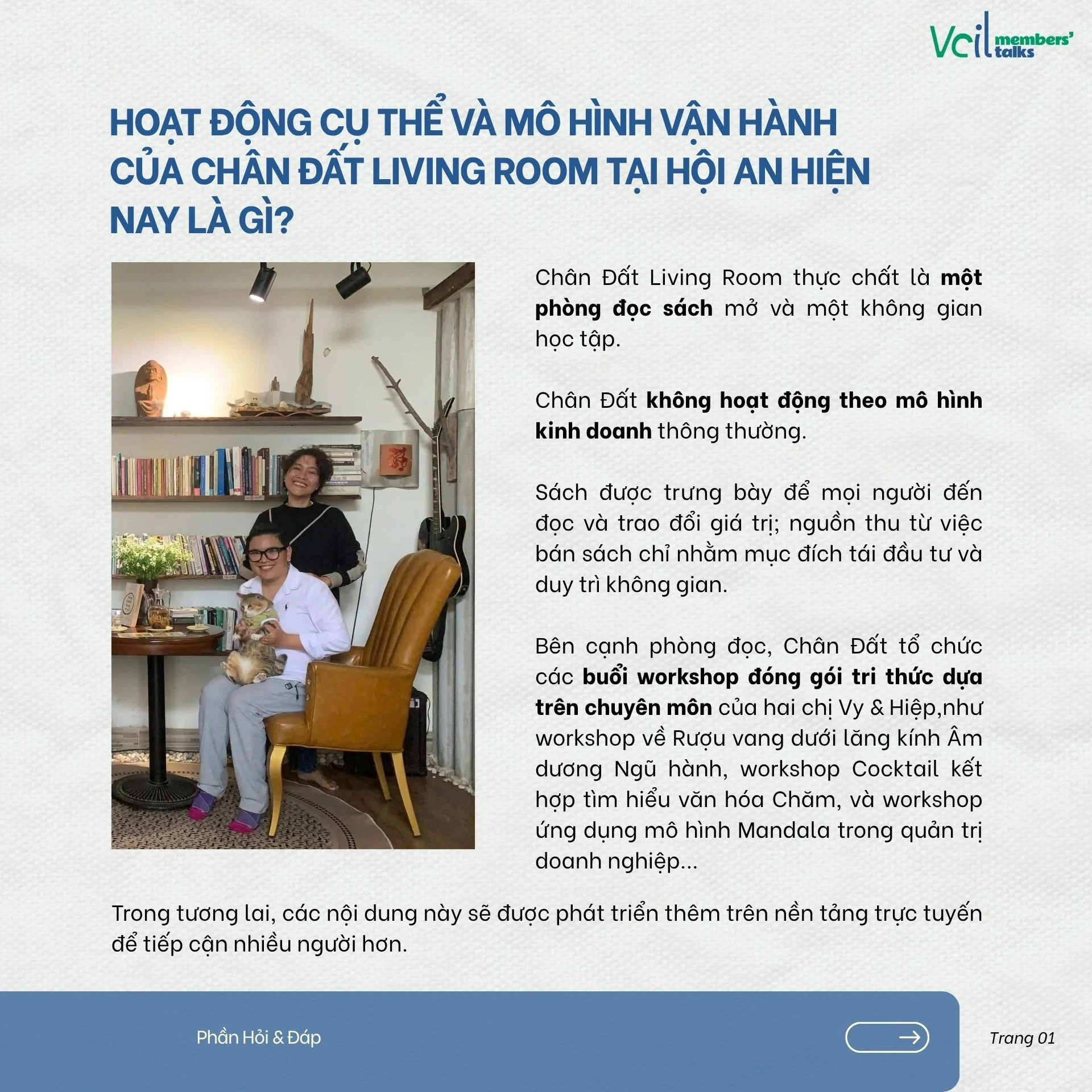
What are the specific activities and the current operating model of Chan Dat Living Room in Hoi An?
Chân Đất Living Room is essentially an open reading room and a learning space. Chân Đất does not operate as a conventional business model. Books are displayed for people to read and exchange value; revenue from book sales is used solely for reinvestment and maintaining the space. Beyond the reading room, Chân Đất hosts knowledge-sharing workshops based on the expertise of Vy and Hiệp, such as workshops on Wine through the lens of Yin-Yang and the Five Elements, Cocktail workshops combined with exploring Cham culture, and workshops on applying the Mandala model in business management. In the future, this content will be further developed on online platforms to reach a wider audience.
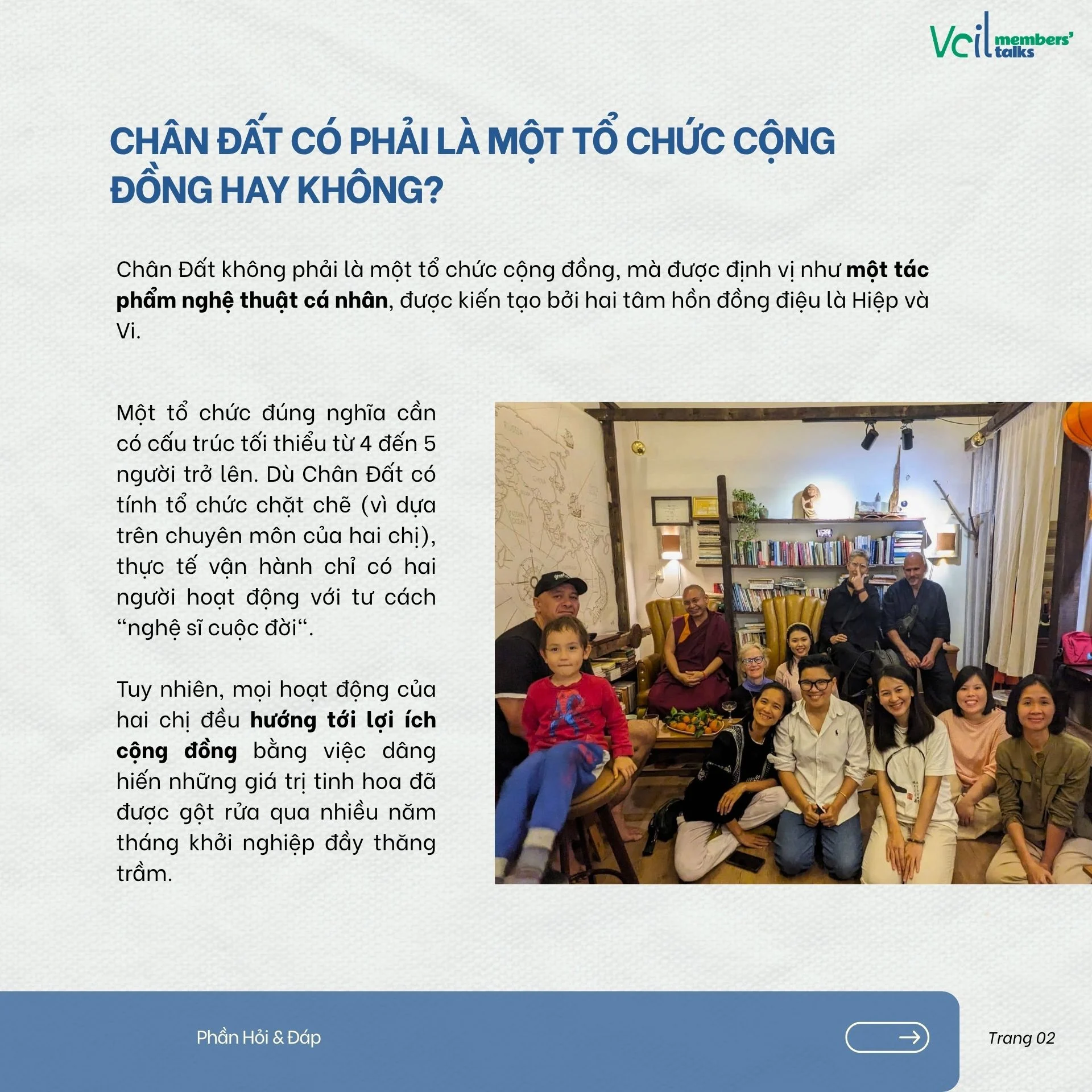
Is Chân Đất a community organization?
Chân Đất is not a community organization, but is positioned as a personal work of art, created by two kindred spirits, Hiệp and Vi. A true organization requires a minimum structure of four to five people or more. Although Chân Đất has a tight organizational structure (based on the two founders' expertise), it is actually operated by only two people acting as "life artists." Nevertheless, all their activities are directed toward the community's benefit by offering refined values distilled through years of ups and downs in entrepreneurship.
How has your life philosophy been tested by family conflicts?
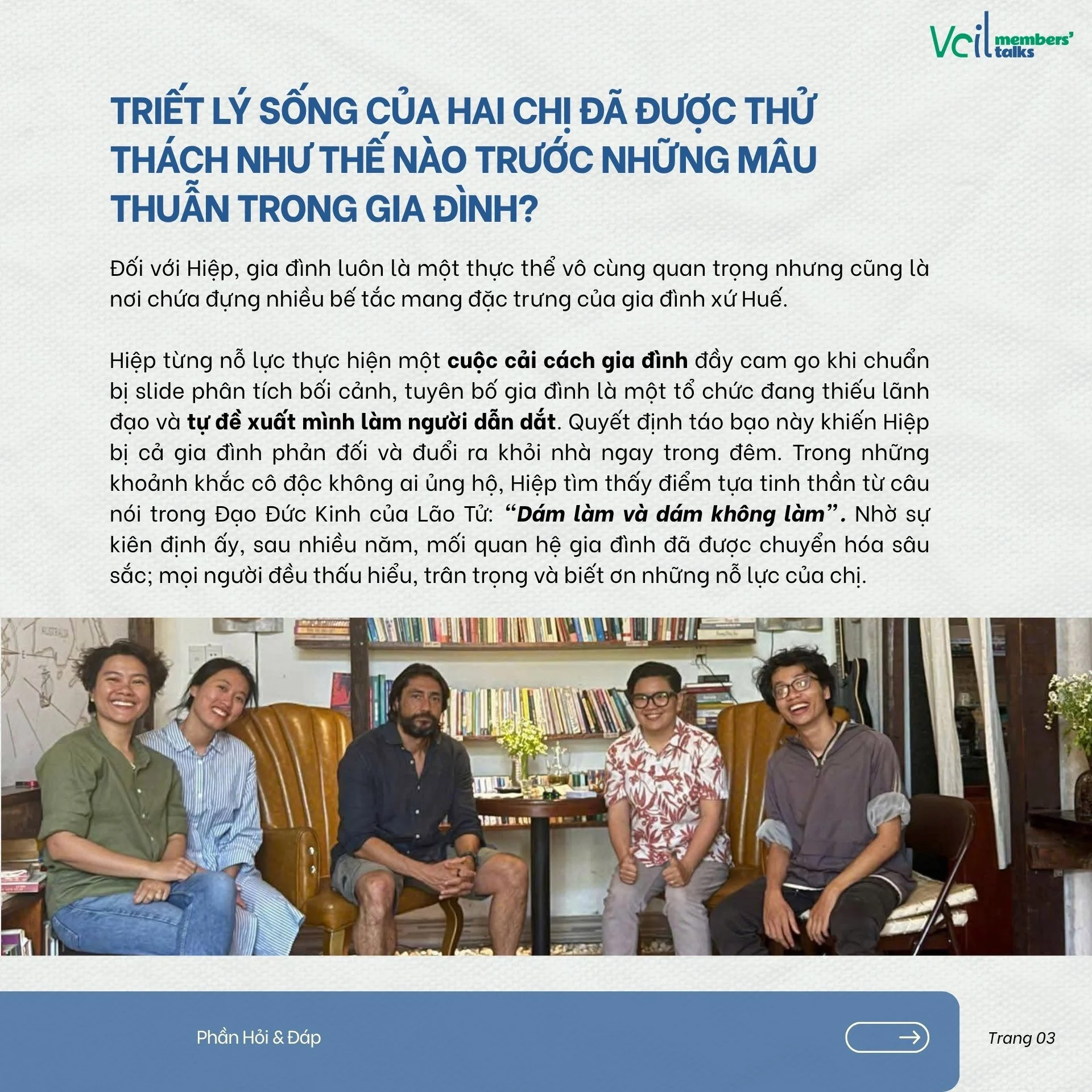
For Hiệp, family is an incredibly important entity, yet it is also a place filled with the specific impasses characteristic of a Hue family. Hiệp once attempted a grueling family reform, preparing a slide deck to analyze the situation, declaring the family an organization lacking leadership, and proposing herself as the leader. This bold decision led to her family opposing her and kicking her out of the house in the middle of the night. In those lonely moments without support, Hiệp found spiritual solace in a quote from Lao Tzu’s Tao Te Ching: "Dare to act and dare not to act". Thanks to that steadfastness, after many years, the family relationship has been profoundly transformed; everyone now understands, appreciates, and is grateful for her efforts.
How is the freedom of choice defined in your worldview?
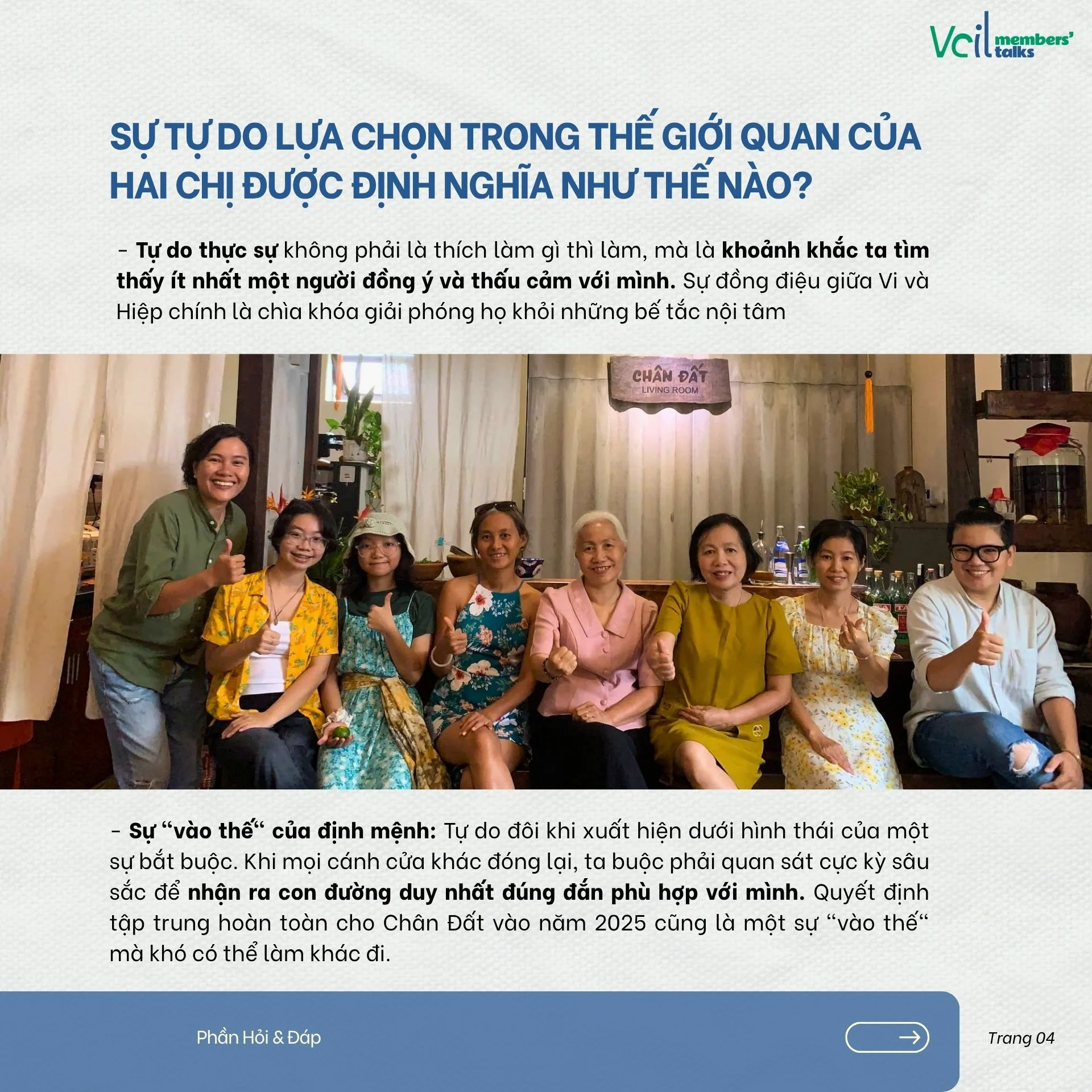
- True freedom is not about doing whatever you want, but the moment you find at least one person who agrees and empathizes with you. The synergy between Vi and Hiệp is the key that liberated them from their internal impasses
- The "forced hand" of destiny: Freedom sometimes appears in the form of an obligation. When all other doors close, we are forced to observe with extreme depth to realize the only path that is truly right for us. The decision to focus entirely on Chân Đất in 2025 is also a "forced hand" that could hardly have been otherwise.
What are the upcoming projects and plans for Chân Đất Living Room?
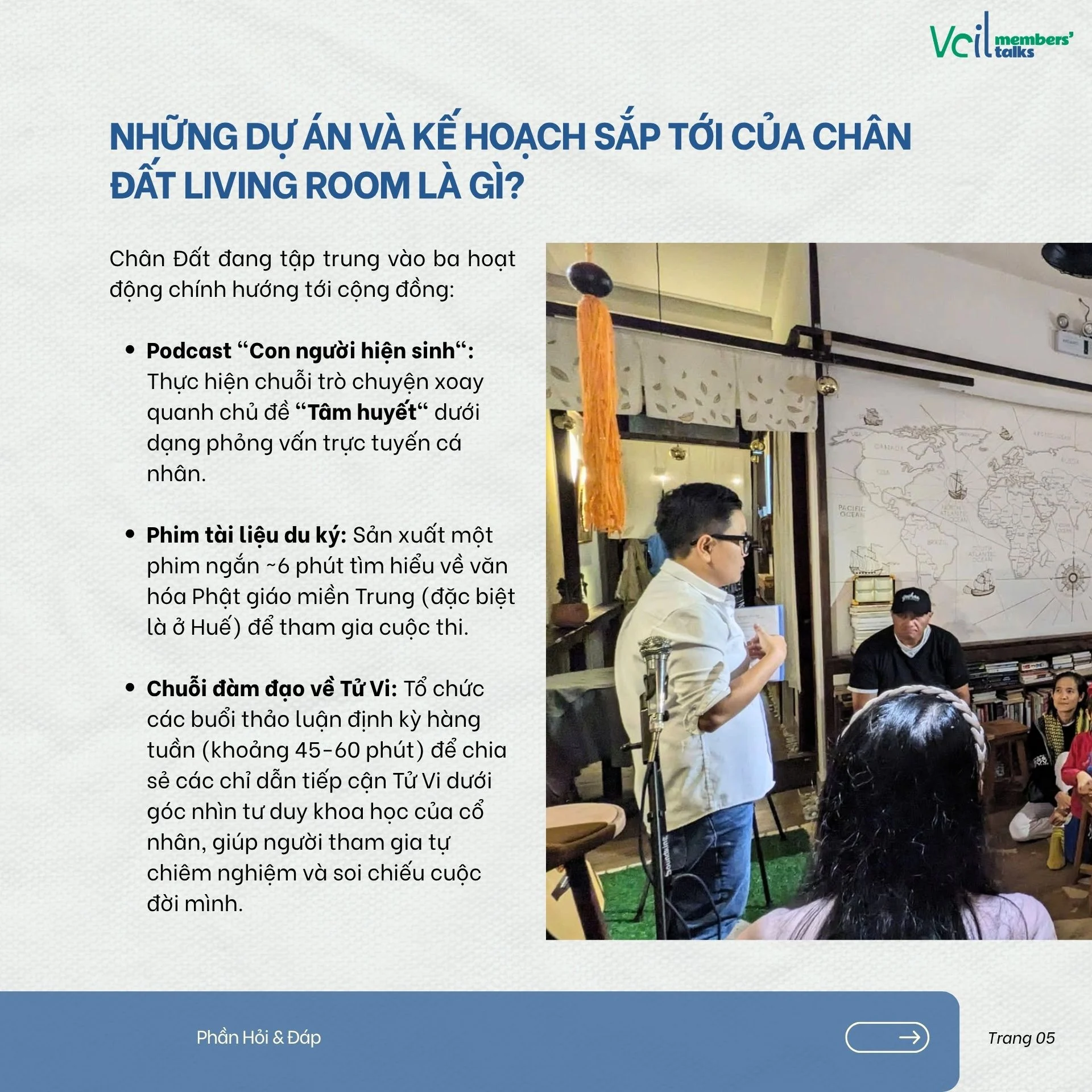
Chân Đất is currently focusing on three main community-oriented activities:
- "Existential Human" Podcast: Producing a series of conversations centered on the theme of "Dedication" in the form of one-on-one online interviews.
- Travel Documentary: Producing a short film (~6 minutes) exploring Buddhist culture in Central Vietnam (specifically in Hue) for a competition.
- Zi Wei Dou Shu Discussion Series: Hosting weekly discussion sessions (approximately 45-60 minutes) to share approaches to Zi Wei Dou Shu through the lens of ancient scientific thinking, helping participants reflect on and gain insight into their own lives.
_______
☎️CONNECT WITH US
Vcil Members' Talks is a monthly public event series where stories, initiatives, and regenerative models from the Vcil community ecosystem are shared. Vcil Members' Talks is not just a place to listen, but a space to learn together, expand your network, and foster a spirit of collaboration for a regenerative future.
Information about Vcil Members' Talks #11 will be announced soon on our Fanpage. You can follow our Zalo group, Substack, or Facebook to stay updated with the latest information.
If you are interested in sustainable/regenerative production models, or in connecting with individuals, organizations, and communities that are creating a flourishing and regenerative society, Vcil Community invites you to learn more and join Vcil Community Membership for the opportunity to live, learn, work, and collaborate with members who share the same values.
#VcilMemberTalks #VcilCommunity