BlogThông tin dưới đây chỉ dành riêng cho Hội viên Vcil
Để đảm bảo quyền lợi của bạn cũng như cộng đồng Hội viên Vcil, mong bạn đừng chia sẻ thông tin này nhé!
Bạn có thể chia sẻ thông tin về dự án dành cho công chúng bằng cách sao chép link này:
Nếp Mới #13: Building Communities Is Joyful – Stories from a Community Facilitator Who Has Traveled Through More Than 140 Countries
Last April, the New Habits #13 event took place with the participation of community members as well as guests from outside the community who came to listen and join the conversation. Pratul Jain was the guest speaker for this session. The discussion centered around philosophies of community building, as well as Pratul’s principles and experiences in developing communities. Beyond that, he also shared stories from his life journey, and his process of understanding himself and the world through more than 16 years of traveling across the globe.
Below is a detailed recap of New Habits #13 and its main contents:
2.1 The Alivelihood List
2.2 The Core Team’s Working Philosophy
2.3 What Can We Do to Bring Communities Together?
2.4 How Do We Create Spaces Where Good Work Can Be Nourished and Take Shape?
Question 1: What helps alternative communities remain sustainable over time?
Question 2: When building a community, what mindsets should a community builder have?
—
“I was someone who asked a lot of questions — a curious child. I was never the kind of person who easily believed everything I was told.” Because of this, Pratul constantly questioned many aspects of the education system and the ways society programs us.
Throughout his teenage years, Pratul failed school nine times. He even sued the Indian education system in the Supreme Court. He could not understand why studying five or seven unrelated subjects would help someone become a good citizen for society and community.
Eventually, he received a scholarship to study fashion design in New York at the Fashion Institute of Technology.
Even so, unresolved questions about education and its irrationality continued to linger within him — especially questions surrounding the definitions of success, progress, happiness, and development. More importantly, he wondered: how do we know what “enough” truly is, when the world constantly feeds us the idea that accumulating more is always better? Another question that stayed with him was: how do people from different cultures perceive life differently?
Therefore, in 2011, Pratul decided to sell all of his possessions and donate everything he owned. He kept only a few necessities and set off to travel around the world without money and without a phone. At that time, his business was thriving and held enormous potential. But what mattered more to him was experiencing and understanding the world. Most importantly, he did not want to live according to someone else’s definition of success — especially when being trapped inside labels such as “successful” or “stable.”
His journey began with no possessions and no phone (he would not use a phone again for the next six years). He started by literally “knocking on strangers’ doors” asking for a place to stay. In exchange, he offered whatever skills he had: English, cooking, cleaning, farming — anything he could contribute.
However, in the beginning, no one agreed to let him stay in their homes — a strange man with messy hair and a nose ring, an appearance that made people reject him immediately. From the United States, he returned to Asia and chose India as the place where he would dive deeper into his exploration of the world.
He slept wherever he could: on streets, train stations, and bus terminals. This gave him opportunities to spend time with homeless people. These experiences and acts of immersion led to profound encounters, especially helping Pratul better understand the perspectives of different people across society. Depending on their living conditions, each person carries a completely different way of seeing life. From this, he realized something important: there is no single definition for anything.
These differences create diversity in how people perceive love, community, career, success, and belonging. Our perspectives are shaped by the conditions we grow up in, the people around us, the countries we live in, and the cultures that nurture us. Since life perspectives emerge from all these different factors, there can never be one absolute answer for everything. This realization deeply astonished Pratul, especially when individuals are constantly pressured by societal ideas and viewpoints that claim to be the “best,” “correct,” or “most suitable.”
This understanding helped Pratul realize that nothing is completely right or absolute. Even moral values cannot always be understood through rigid standards of “this is what a moral person should be.”
Over the next 14 years after selling all his belongings, Pratul traveled across seven continents by hitchhiking, working, and exchanging value. During that time, he did all kinds of work: building snow shelters in Norway, walking the Camino pilgrimage route in Spain, working with tribes in the Amazon, participating in conservation projects in Madagascar and Papua New Guinea, living with communities throughout Europe, Africa, and Southeast Asia, becoming a skydiving instructor, diving instructor, learning natural building with earth and stone, and more.
This journey also led him to remarkable alternative communities around the world: such as Auroville in India — a community operating without money, religion, or government; Tamera in Portugal — a pioneering model community experimenting with self-governance and harmonious coexistence between humans and non-human beings; Findhorn in Scotland — an ecovillage applying progressive knowledge and thinking to create sustainable ways of living; and Damanhur in Italy — a self-sufficient spiritual community and living laboratory for the future. Direct exposure to these alternative communities broadened his worldview and gave him tremendous inspiration, especially regarding how such communities operate and embody their ideals.
He also worked with the United Nations as a program designer during his travels. Through this, he had opportunities to visit Syria, Afghanistan, Iraq, and other regions in Central and West Asia — places often misunderstood or little known to the broader public.
For Pratul, 14 years of living on the road, moving through diverse cultures, and understanding different people and communities led him to one realization: no matter who we are, where we live, or what background we come from, everyone longs for a sense of belonging. Therefore, people search for communities where they feel they belong.
Ironically, while we search for community, we are simultaneously sinking deeper into individualism within a capitalist system — with mindsets like “this is my house” and “this is my property.” In the past, people shared and connected deeply with one another. Today, we share less, engage in fewer heartfelt conversations, judge one another harshly, and impose stereotypes upon each other.
For Pratul, this is a kind of illness — and not a healthy sign for humanity. And it is a global illness.
——
During his 14 years of traveling, Pratul documented a list of individuals contributing to the creation of a new world in their own ways. For example, he recorded people living in alternative communities and practicing different forms of “Alivelihood” across many fields: natural building, permaculture, community building, alternative education, and more. These were people whom he believed genuinely wanted to serve the world, without being driven by money or fame, but by a desire to help create a better future.
When COVID happened, the world became more fragile than ever, while nature continued to be destroyed. Pratul also felt it was time to give back to the communities that had supported him throughout his years of traveling.
He began reconnecting with friends from his “world-serving list.” Together, they created Place of Possibilities — POP. The idea behind this initiative was to strengthen and deepen organizations already doing meaningful work in the world. POP believes there are countless individuals, organizations, and communities contributing to a better world, but many gaps still exist. Many people have beautiful intentions and inspiring ideas but do not know how to implement them or transform them into practical action.
There are many questions needing answers: What truly creates value? Which activities generate meaningful results? How do we reach the people we want to reach? How do we communicate our ideas and perspectives? How do we create genuine communities and live together meaningfully?
Within the alternative world we are trying to create, these tasks become even more difficult.
POP itself does not create a physical space. Instead, it supports individuals, organizations, and communities in addressing the challenges, struggles, and gaps they face.
Each year, the Alivelihood list continues to expand. Every suitable individual, practical idea, meaningful practice, and progressive initiative that POP encounters around the world is added to this growing network.
POP’s core team consists of 18 people — individuals Pratul met throughout his travels. This list became an essential tool in POP’s work. Whenever someone or an organization needs support, POP searches within the network for suitable resources to provide assistance. This could mean helping with ideas, tools, or resources for community building, implementing projects, or improving ongoing work.
From local residents to organizations, governments, and government officials — if support is needed, POP is willing to contribute. Pratul shared that many government officials, despite holding power and resources, genuinely wish to create meaningful change within communities. POP also operates in Portugal, Poland, India, Zimbabwe, Haiti, Kenya, and many other places.
POP’s philosophy is that they do not need their brand name attached to good work. Anyone is free to use POP’s knowledge, tools, ideas, and resources. This is something the entire POP team clearly agreed upon together. Interestingly, everyone in POP believes their role is simply to share and spread goodness into the world. Therefore, what matters most is that meaningful work gets done and expands further. The more people use valuable ideas and engage in positive action, the happier POP becomes — regardless of whether anyone gives them credit. In fact, others are even welcome to use POP’s reputation if it helps them do meaningful work.
Because of this attitude, many organizations, communities, and government bodies are eager to collaborate with POP. This also makes cooperation with governments much smoother. POP genuinely cares only about ensuring meaningful work happens and is willing to engage in practical action, while government agencies can publicly take credit if needed — POP does not require recognition.
POP also focuses on initiatives for young people. One project Pratul shared was the Bastar Project. This project is a collaboration between POP and local governments in Central India, where many Indigenous communities live, including groups residing deep within forests across Bihar, Chhattisgarh, Jharkhand, and Odisha.
A serious issue in these areas is that many corporations have lobbied to displace Indigenous communities from their ancestral lands. Governments have also wanted to relocate these communities in order to exploit natural resources found on those lands. This creates severe consequences for communities whose lives have been deeply connected to forests and largely separated from modern society for centuries.
However, there were also government officials who did not want this displacement to happen, so they collaborated with POP to resist it. POP, together with a few “kind officials,” worked with local youth by training and empowering them to develop agriculture, tourism, art, and traditional crafts as sustainable livelihoods — helping communities remain rooted and resilient against external pressures.
Pratul described this as an incredibly meaningful but politically sensitive project. These initiatives helped bridge gaps between different communities and foster deeper relationships among Indigenous groups. The process helped communities feel proud of their culture rather than inferior to others, enabling them to actively participate in protecting themselves and their land.
Gradually, positive changes began emerging: governments started building schools, developing industries, creating livelihoods, and understanding that development must go hand in hand with preserving culture.
One thing POP realized is that many communities live as though inside isolated bubbles, disconnected from one another. Therefore, POP seeks to encourage connection and spread ideas and practices from alternative communities such as Auroville and Plum Village to wider audiences — using language ordinary people can understand. Most importantly, these ideas should feel approachable, joyful, and accessible rather than complicated.
The goal is to break free from rigid structures, making them flexible and adaptable so communities can modify practices according to their own needs. As facilitators, the worst thing one can do is impose or control too closely.
When working with communities, avoid doing everything for them. Instead, bring a playful and relaxed spirit into projects — this creates conditions for communities to embrace them more naturally.
After some time, projects are handed back to communities themselves, who continue operating them in their own ways — sometimes in forms very different from the original idea. But according to Pratul, this is precisely what makes community work effective: communities must be fully free to adapt and reshape initiatives according to their own realities.
For example, POP once operated a free store in Dhaban, a village in Rajasthan, India. The idea was simple: anything you no longer needed but still usable could be left at the store, and anyone could freely take whatever they needed. The spirit was not charity or aid for poor people specifically. The store belonged to everyone. Community members could exchange clothes, shoes, and other items there.
Pratul himself shared that he has not bought clothes or shoes in the past 16 years thanks to simple initiatives like this. “There is so much abundance in this world once we begin sharing with one another,” he concluded.
—
POP also works with artisans and craftspeople, especially those practicing traditional crafts at risk of disappearing.
One project, hosted in Auroville — a 64-year-old community with residents from more than 80 countries — has been organized by POP members for over seven years. Its goal is to help people recognize and appreciate traditional crafts that may disappear because fewer people continue practicing them.
The initiative invites artisans to share their knowledge with young people, and these craftspeople are often deeply loved by the youth who learn directly from them. Each year, depending on budget and resources, children aged 8–14 are brought to Auroville to learn, connect, and practice these crafts. In 2025 alone, around 250–300 young participants joined the event.
The gathering also brings together children from many countries, regions, and cultural backgrounds to learn together. The spirit of the event is one without hierarchy, labels, or divisions of ethnicity. Young people come to connect, learn, and become friends.
——
Pratul also observed that many people want to do meaningful work but lack the space, environment, frequency, or “vibe” that allows them to use their skills, contribute, and share something valuable. Therefore, if we can create healthy spaces like these, people will naturally come, enjoy, contribute, and offer what they have.
At POP, whenever there is a project or idea needing implementation, they do not hire employees. Instead, they rely on the Alivelihood network — a database containing around 870 individuals, organizations, and alternative communities from 18 different fields such as law, accounting, agriculture, youth work, and government collaboration.
Whenever resources are needed, POP reviews the project’s needs, then identifies people within the network who possess suitable skills, time, and interest. Everyone involved joins as volunteers, motivated by service and intrinsic motivation rather than external pressure. As a result, people contribute wholeheartedly whenever they feel aligned with a project and genuinely wish to participate.
POP also operates through peer-based structures without hierarchy, encouraging people to work with focus and passion.
In summary, POP seeks to create environments where initiatives can be carried out joyfully, inclusively, and in ways that ensure no one feels left behind. According to Pratul, the most important thing in any project is the original spirit and intention behind it — more important than structure or organization itself. Only then can work flow smoothly, with everyone aligned around a shared vision and direction. Everything else can then naturally organize itself around that common intention.
Another important point Pratul emphasized is that whenever a new project begins, proposals should always remain proposals. If members resonate with them, they may accept; if not, they are completely free to refuse. Team members work autonomously, which reduces unnecessary pressure within groups. Projects are also carefully planned with multiple backup systems for risk management, allowing them to operate smoothly.
Pratul shared the story of Johnny, an 86-year-old friend and devoted POP volunteer who is always among the first to participate in most POP initiatives. For POP members, working together feels like a celebration. POP has cultivated a culture rooted in intrinsic motivation, passion, contribution, and an environment free from guilt and competition.
Pratul observed that many organizations fall into patterns of comparison such as “I work harder than this person” or “that person doesn’t contribute enough,” which easily creates guilt and competition within teams.
Therefore, POP prioritizes intrinsic motivation, passion, and willingness to contribute. They deeply value each person’s efforts and avoid creating environments where members feel “not good enough.” Instead, POP brings playfulness into work. This creates the foundation for a happy team and a “nice zone” where people accept differences, enjoy one another, and celebrate together while working.
According to Pratul, there are two types of communities: newly formed communities and Indigenous communities that have lived together for generations.
He referenced a study showing that approximately 80–84% of communities collapse within their first two years. Therefore, it is not easy for alternative or ecovillage-style communities to survive long term.
Indigenous communities and tribal groups, however, have lived deeply connected to the lands they depend on. They live together collectively. Pratul encouraged people to learn from the organizational methods, spirit, and ideas of Indigenous communities and adapt them to their own communities.
POP has also learned important lessons from observing communities such as Auroville and other alternative communities. Whenever hierarchy exists or internal divisions emerge — for example, in Auroville, some groups wish to follow the teachings of The Mother, while others desire innovation — communities become much more vulnerable to collapse.
According to Pratul, creating rigid systems and forcing conformity can easily lead to cult-like dynamics. Likewise, too much structure, responsibility, and attachment to roles can accelerate community breakdown.
On the other hand, when individuals maintain autonomy and continue pursuing their own lives while still coming together for shared work and joyful collaboration when needed, communities become more sustainable. The collective and the individual must coexist.
Auroville, for example, has existed for 64 years. The community grew through shared labor and collective projects: restoring degraded land, regenerating forests, and creating a unique lifestyle together. This built a strong foundation.
However, Auroville currently struggles financially and lacks younger generations. They do not have sufficient financial resources to support volunteers and youth participation, which has led to an average resident age of 54.
Traditional communities such as Indigenous tribes remain more deeply connected to the land and less dependent on money. They rely on many different forms of resources and gifts from nature. Because of this, they often endure longer and more sustainably than newly formed intentional communities.
A leader or initiator must understand the needs of the community they wish to build, rather than focusing solely on what they personally want to offer.
At POP, they repeatedly encountered situations where they became trapped inside their own ideas while trying to create communities. This happened because they did not truly understand what local people actually needed.
To build community, the first thing they do is spend time with the community itself — without immediately launching projects during the initial phase. Before anything else, they seek to understand local customs, existing knowledge systems, geography, ecology, personalities, and social dynamics. Once these foundations are understood, working with communities becomes much easier.
Pratul emphasized one core principle: do not rush into action. Spend time with people. Connect and understand each other. Learn the community’s strengths, weaknesses, and areas where support is genuinely needed.
During POP’s first year in Bir, Himachal Pradesh, India, they focused entirely on relationship-building. For over a year and a half, they intentionally avoided launching projects and instead concentrated on understanding local realities — from farmers to youth, observing genuine needs and ongoing issues within the community.
For example, they tried to understand why farmers used chemicals instead of natural farming methods. Why did young people leave villages for cities? What were they truly feeling and needing? What roles did women play within the community? How did they feel? They also researched local organizations already doing valuable work, which eventually led them to discover Deer Park Institute.
They also had to understand the local temperament, traditions, livelihoods, and social dynamics.
Only after gaining these insights did they initiate projects grounded in real conditions and “hot data” gathered from lived experience — ensuring their work genuinely supported local needs rather than imposing outside assumptions.
Whenever you build community, Pratul said, make sure the community itself is included in everything you do. Spend time understanding what people truly need and developing relationships together.
POP also strongly believes in social capital. One thing Pratul struggles to understand about modern society is why people place excessive importance on financial capital while overlooking other forms of wealth within communities: skills, wisdom, knowledge, experience, relationships, and moments of standing beside communities during times of grief or celebration.
What matters most is how you show up with people, walk alongside them, and remain present for them. If you truly care about these things, Pratul believes everything else unfolds naturally.
Many people want to build something that is “mine alone.” For Pratul, this mindset itself is problematic: “my yoga studio,” “my project,” “my work.” He believes life becomes much easier and richer when resources are shared. When they arrived in Bir and saw Deer Park Institute already doing meaningful work, POP simply collaborated and supported them when needed instead of creating something entirely separate from scratch.
In summary, to build community, Pratul believes we need inclusivity, deep understanding, and spaces where people can connect meaningfully with one another. Once those conditions exist, everything else will naturally fall into place.
Pratul also shared that in May, POP would organize a large youth festival in Bir, bringing together 300 young people from around the world. The entire village was preparing to welcome them. Everyone wanted to contribute in some way.
It became clear that not only the POP core team was organizing the festival — the entire village was participating. Farmers and local youth were working alongside them. For Pratul, this itself was deeply meaningful: a community coming together because genuine mutual understanding and connection had been cultivated.
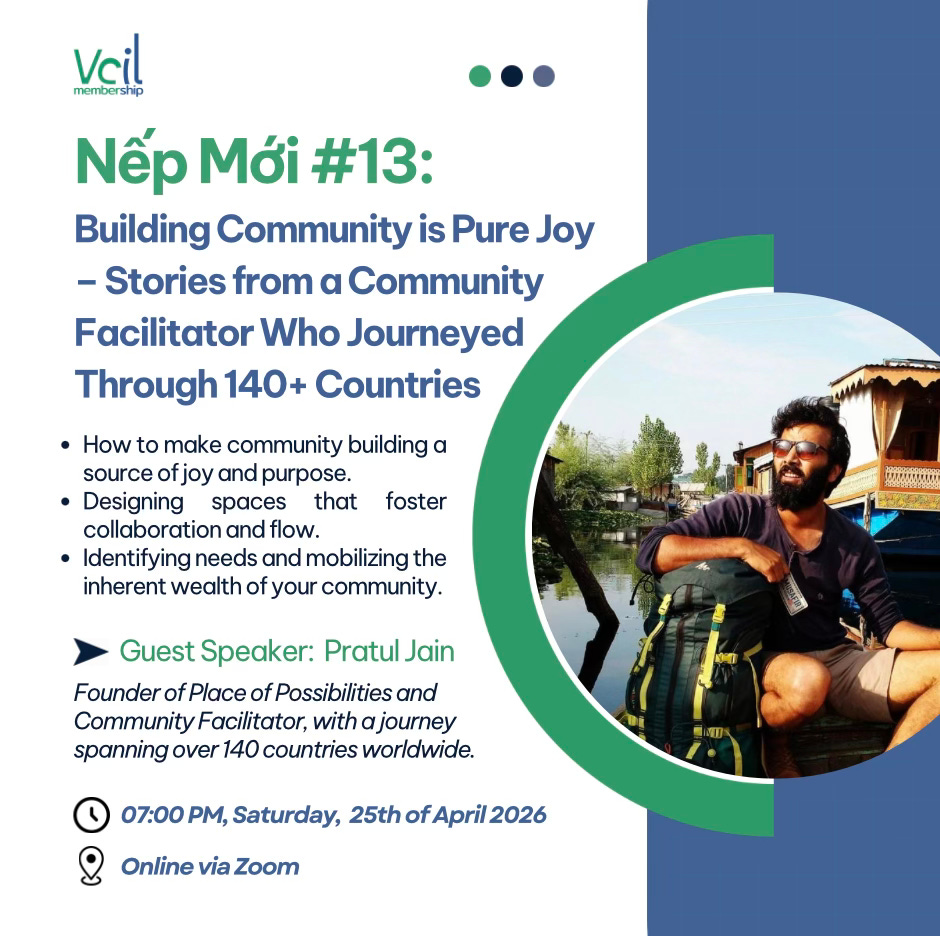
- Time: 19:00 Saturday, April 25, 2026
- Platform: Zoom
- Language: English (with Vietnamese interpretation)
- [Exclusive event for Vcil Community Members]
Across the globe, countless individuals and organizations are joining hands to cultivate an equitable, inclusive, compassionate and diverse society. However, good intentions alone aren’t enough. Many meaningful social initiatives struggle to sustain and create their impact.
Recognizing these gaps, Place of Possibilities (POP) was born with the mission: “Empowering change-makers to make their journey more effective and joyful.”
POP is built on values of gifting, connection, and community—a space where communities are co-created to grow holistically and harmoniously. It focuses on re-establishing diverse connections: between the individual and the self, the community, and nature. Ultimately, POP works with local communities to create alternative lifestyles where connection and belonging are the foundation, and spiritual, ecological, and communal practices are the core values.
POP drives social movements through both short-term and long-term approaches:
Learn more at: https://placeofpossibilities.in
This session focuses on the heart of community development. Pratul will engage with members on:
Pratul Jain - Founder of Place of Possibilities and Community Facilitator.
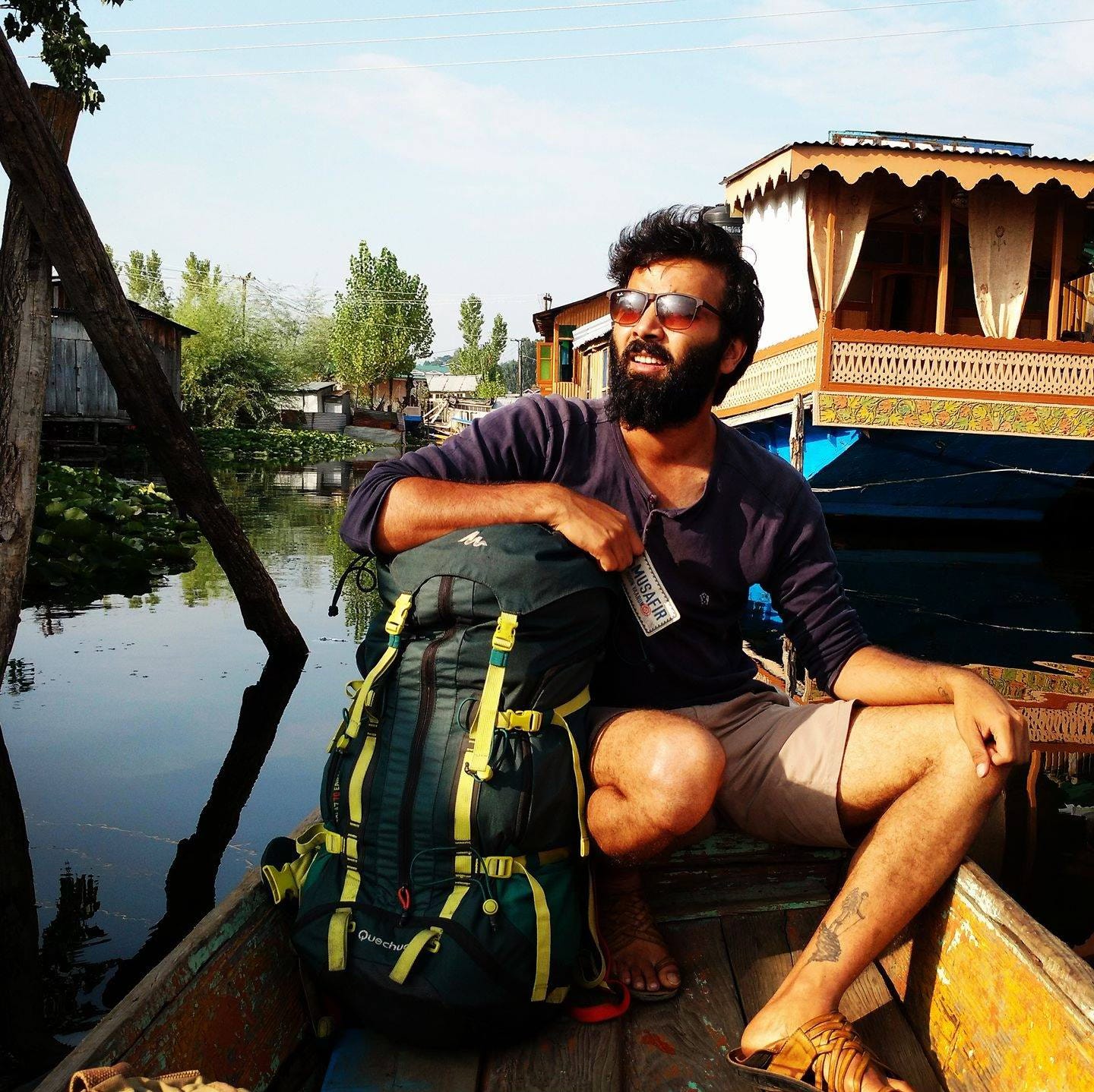
Pratul is an explorer and experimenter at heart. Once a successful fashion entrepreneur with significant material success, he grew curious about how people define happiness, wealth, and development.
In 2011, Pratul decided to sell and donate all his possessions, carrying only the essentials to travel the world without money or a phone. His journey has been as diverse as it is grounded: from driving rickshaws and working in local eateries in India, building igloos in Norway, and walking the Camino de Santiago in Spain, to living with Amazonian tribes and joining conservation projects in Madagascar. After 14 years and 140+ countries, POP is the crystallization of his life’s journey—a platform to connect what he gathered from the road back to the world.
Inspired by the Vietnamese word “Nếp”—referring to the inherent patterns of culture, habits, and daily life—Vcil Community initiated Nếp Mới (New Patterns) to nurture new ways of living that prioritize sustainable happiness and authentic wealth. This space helps us unlearn outdated patterns, learn from collective wisdom, and reimagine how we live and connect.
New Ways will invite scholars, experts, and people with practical experience to share about essential and familiar topics in life