Thông tin dưới đây chỉ dành riêng cho Hội viên Vcil
Để đảm bảo quyền lợi của bạn cũng như cộng đồng Hội viên Vcil, mong bạn đừng chia sẻ thông tin này nhé!
Bạn có thể chia sẻ thông tin về dự án dành cho công chúng bằng cách sao chép link này:
We were delighted to have Helena's presence at this Nếp Mới session. What made it even more special is that this was the first event Vcil Community opened to the public. We were quite surprised that the topic drew so much interest from a very wide range of people. Those who registered came from very different backgrounds and areas of expertise, but most shared an interest in the same questions: whether alternative economic models and ways of organizing the economy—alternatives to the capitalist system—are feasible; and whether localization might be one of the possible solutions.
Nếp Mới was the opening activity for the Localization Week "The Treasure of Our Own Locality." This is how Vcil Community and communities across Vietnam respond to World Localization Day. It is an annual event in which tens of thousands of people from more than 50 different countries take part each year—an occasion for individuals, teams, and communities to act together toward the local in many different ways: watching films, holding discussions, organizing community meals, planting forests, gardening, and more. These may be small actions, but they create moments of action that help build strong local economies.
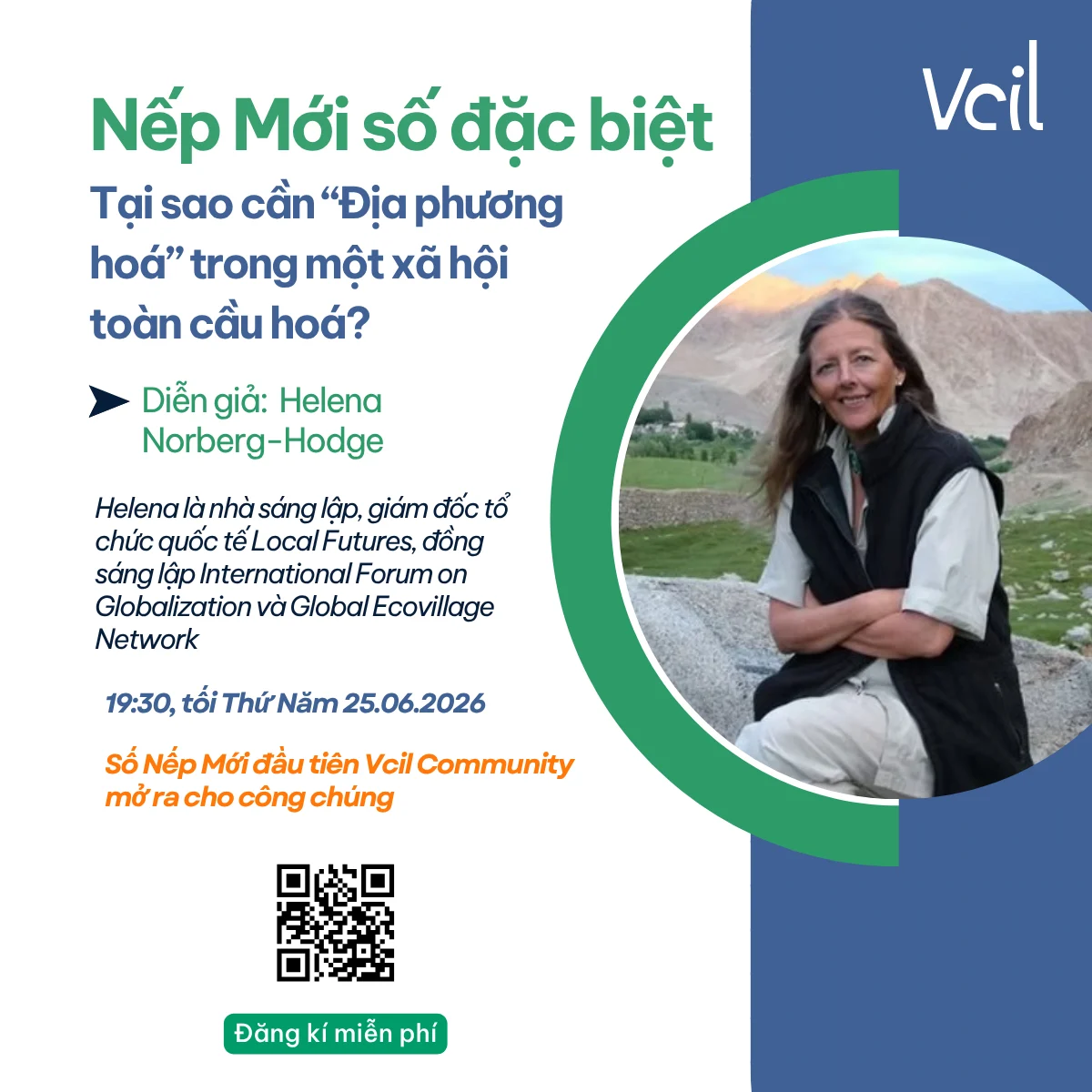
Sharing in that vibrant atmosphere spreading around the world, when asked about her feelings on localization month, Helena couldn't help but share with enthusiasm: "I'm very happy to witness that all over the world, people are recognizing a real need to connect with others, with plants, animals, nature, and the living world that is present all around us. These are the very things that make us who we are, and thanks to which we keep evolving. So when we separate ourselves entirely from nature, from community, to go and live in cities full of competition and hurry, we suffer.
This is a common trend everywhere. People are gradually coming to realize that we need to return to things that are more human: human pace—slow—and human scale. They all want to belong to some group or community. And that is exactly the core idea of the localization movement: helping people understand the ways and reasons that relationships and connections have been severed; and therefore why people need to cooperate with one another to re-establish what makes us human, and how to live happily and healthily."
Another question was posed: "In a globalized society where technology is present everywhere, what does it mean to be human?"
To answer this, Helena shared about culture and the relationship between people and nature. She pointed out that even in Vietnam, every land and every region has very clear cultural differences. And this is quite obvious around the world. These differences exist because people live and adapt according to the land they inhabit—a place where people have an intimate connection with the river, the trees, the food, and the climate there. That is a very human trait, and wherever they are, people will adapt to where they live, adapt to nature. From this, local culture is formed. That is why there is a culture of the coast, a culture of the mountains, and so on.
In the West, people are now calling the common culture that the vast majority practices "consumer culture." Helena believes we should not call this a culture, because it did not arise from some group of people living in close bond with a specific place and then developing different practices or ways of life. Consumption arose because global traders and large corporations began to manipulate politics, economics, and local culture everywhere in the world; and ultimately, to impose this monocultural consumer culture upon everywhere that globalization reaches. Therefore, consumption does not help us become more human. In fact, it goes against an important thing we must acknowledge: every child born desires the feeling of belonging. They also need to be loved, held, and comforted. They also need to feel that they themselves are growing, and therefore that they deserve respect and to be loved by others.
What is catastrophic here is that "consumer culture" has led many people to understand—in a "distorted" way—that the need for love and belonging means one must consume. From the lifestyles, the way of speaking, and the behavior of adults, children everywhere in the world come to understand that: if they want to have friends, and to have their friends admire them, they need to have an iPad, must dress a certain way, their appearance must follow a certain style, their footwear must follow the trends, and they must drink the bottled beverages being advertised. This message is so pervasive that the basic universal need of human beings has come to be understood as a universal need to consume! Helena offers a wake-up call, that we need to wake up from the consumerist dream that has been overwritten onto the human mind. Everyone needs to cooperate with one another to pull each other out of that meaningless consumption. This is not only for the sake of individual happiness, but also to avoid the global crises now unfolding: depression, addiction, and even the current reality of suicide among young people—clearly reflected in real-world data around the world. We are truly in a state of emergency.
To better understand the context and the necessity of [addressing] globalization, Vcil Community asked Helena: "What moment in your life made you feel that you needed to focus on localization? What has been the driving force that motivates you even now?"
What Helena says and writes does not come from herself, but from experiences of living within a culture that, up until the 1970s, had still not been disturbed and influenced by the West—neither by missionaries nor by conquest by empires. They still preserved their own distinct culture, values, and way of life.
She believes there are two reasons for this. First, they lived at an altitude of over 3,500 meters, surrounded by the majestic Himalayan range, covered in white snow for around 8 months of the year—these isolating geographical barriers helped them minimize the impact of outside forces. Second, Tibetan Buddhism played an important role in protecting the indigenous worldview and self-respect—a worldview that reminds everyone that we are part of a vast web of relationships; and that human beings are a part of this world. Helena shared that these are fundamental things that our grandparents and ancestors all knew. This is very easy to understand: when we live depending on the place where we live, that means the things we need—from food, clothing, shelter, to drinking water or animals—are all available around us. Therefore, everyone understands that we must live in dependence on nature. Only when we are pushed into the city, and we become dependent on the "economy"—something we never see, nor know the people living within it—do we begin to lose our (mental) dependence on nature. Living in the city, people become more competitive.
While in Ladakh, Helena was fortunate to experience a culture untouched by the Western system. Everyone lived depending on the land, living interdependently with one another.
"The stroke of fortune that led me here came through joining a film crew. Before that, I grew up in Sweden, then I went to university in Germany, and had lived in the US and in Paris. I spoke 6 languages, and I also traveled a great deal. Thanks to this, I had observed different traditional cultures. So you could say I had seen many different corners of this world. I thought that when I came to Ladakh, I was only there to support the film crew. But when I arrived, I fell in love with the people there—it was 'love at first sight.' After the film crew left, I decided to stay, continuing my studies toward a doctorate in linguistics. Ultimately, I worked with Professor Noam Chomsky at MIT, a very famous linguist.
From the very first days, I realized that the Western system about to arrive would destroy the Ladakhi way of life, as well as their self-esteem. This system would make them feel stupid and inferior, not as 'advanced' as Westerners. But in essence, they simply had mistaken impressions about people from Europe. They didn't know that in the West people work far harder than the Ladakhis, many hours a day, and even more over a year. They had no idea of that. When they met travelers, it seemed as though those people didn't need to work. Because people like us had money, traveled, and enjoyed life, as though every day were a holiday and there were no need to go to work. So I began to share with the Ladakhis a more realistic picture of the West, and I also realized that this was truly important to them. In the end, for all of us, protecting the local economy is absolutely necessary.
We need to know about what is happening in other places, because the media in general keeps us gripped within the narrow viewpoint of a single country, lacking a realistic view of what is happening in other countries. So, from the very first days, I invested in promoting the decentralization of the global economy, and began to speak more about Ladakh and many other places in the world."
From those experiences, Helena has never stopped calling for international cooperation, acting together to realize and spread localization. And this is exactly what she and Local Futures are doing.
From the registration forms, many people showed great interest in localization, so Vcil Community asked about the definition and the essence of what localization is. And this was her answer.
According to her, at its core, localization is the promotion of a process of social change, aimed at rebuilding and re-establishing connections between people, especially intergenerational connections (this is another aspect that consumer culture is destroying) between the young and older generations. This connection is not only about feeling, but is also expressed through interdependence. People need to support one another, in a practical way in daily life. For example, generations raising children together, instead of young people having to raise children on their own within a nuclear family, which she considers very unhealthy. She argues that this has never occurred in the evolutionary history of humankind. In traditional societies, every mother had many others to help in caring for and raising children. In today's nuclear family (only parents and children), women easily feel guilty, because they often feel that they themselves are not good enough (because there is too much to worry about, from raising children, taking care of housework, taking care of themselves…). Not to mention, the entire process of mothering is not respected in a consumption-oriented culture.
When interdependence is re-established, the components of happiness are accordingly developed along with it, from health to the economy.
In addition, shortening distances is another important aspect. Currently, we are having to rely on products made thousands of kilometers away from us. When we depend on systems and people we don't know at all, we come to feel that there is no need to be kind, empathetic, or careful at all. Helena believes that if we want to practice any spiritual values, then acting according to localization is one way, because we see everything, are aware of everything, and we can be empathetic, kind, and generous. In an economy small enough like that, if someone behaves badly, has bad intentions, everyone will discover it; because it is very easy to know if someone around you is only after money, or only cares about themselves rather than the whole community.
In contrast, globalization is a process in which all of us become dependent on an economic structure far from where we live. The supermarket is one such structure, and they conceal a great deal. When we buy food at the supermarket, we have no idea that the farmers are treated like slaves. We don't know that the food contains many toxic chemicals, and because of this many people are facing illnesses like dementia, cancer, or Alzheimer's. No one knows about these things, because we are living in a system in which we cannot begin to behave kindly, consciously, or with care. How can one care or be kind when the things we use every day are exchanged for oppression, exploitation, and unsustainability somewhere?
Today's global system began from oppression and violence. Specifically, it originated from the system of slavery, beginning with pushing communities off the land they lived on in Europe. That movement was called the enclosure movement. This happened when the wealthy class pushed for new laws that allowed them to take land and drive local communities off the places where they lived. And those who lost their land were pushed into the big cities. In these cities, they had to depend on the elite, those engaged in global trade—the very ones who had established the conditions to enslave people in countries on the other side of the hemisphere. These people were forced to do heavy labor, in terrible conditions, to grow crops such as cotton, tea, bananas, or whatever this class needed to trade in Europe. Therefore, this system originated in Europe, created by white men, and the core of it was to separate people from one another, and to separate them from where they live.
When we understand the broad picture, and the historical process, we will understand why, all over the world, people would gain enormous benefits by doing the opposite of globalization. Instead of depending on global banks or corporations, people begin to support or start supporting national banks or businesses within the country or region. Nor should we mistakenly think that we must immediately do everything within the boundaries of the village. Rather, it means that for food production and childcare, we want to operate within the space of the local. Because when food is produced locally or in a nearby area, close to or right next to where we live, the food can be fresher and more wholesome, suited to the local biodiversity, environment, and climate; compared with products transported around the world, preserved with chemicals, or genetically modified to look more appealing.
From this, Helena concludes: the process of globalization is fundamentally a process of separation, pulling people away from the land they live on, then pushing them into urban areas, where they can no longer depend on and support one another. Currently, the majority depend on jobs, money, and power from someone else. And everyone is forced to compete with one another to grab and contend, everyone becoming a rival. And clearly, as she analyzes, [it] severs the connection between the young and the elderly because the young now have to migrate to crowded and cramped cities. Meanwhile, if we live in the countryside, we will have more time and space for the generations to connect with one another.
From the analyses above, localization can be understood as doing the opposite of globalization. We will find ways to support the establishment of connections between relationships, between people and the land. If we live in the city, we can help farmers in the region by creating local markets, forming cooperatives, and even shops that sell only local products. It doesn't stop at changing shopping habits—we can support in many different ways, from money, effort, and time to connections with initiatives that are striving to create local markets or work with farmers. Or we can also support ideas that are trying to connect the young with the elderly.
In Europe, in the cities, co-housing initiatives are one initiative to create a living space where people can support one another and understand one another. There, people raise children together, and the elderly are welcomed and respected. As we can see, many such initiatives are being tested and operated, and even in the city, you too can find ways to connect with people and with nature.
So in her view, how can we convey to people that localization truly matters? What is Local Futures' experience in spreading this movement?
According to Helena, the most important thing we can do is education. She particularly believes that we need to educate adults more—that is, people from about 18 years old to 100 years old. We need to help people see the overall picture, to understand why today's world has so many problems. Why is pollution so severe? Why is depression becoming more and more common? Why are there so many people who are unhappy? And why are both mental and physical illnesses increasing?
When we understand that, we will understand the essence of the system we are living in. It is a techno-economic system. As she mentioned earlier, this system began in the era when the European powers promoted global trade, in which the global traders relied on slavery.
Even in Europe, when cotton was brought back from India (the cotton production process had already enslaved the people of India), a great many people in Europe were driven off their land to go and work in ever-larger textile factories, producing cloth on an industrial model. And the factory owners treated their workers no differently from slaves. They were exploited and treated extremely badly. This is a long chapter of history that deserves to be discussed more deeply.
She believes this is very important, because today that system has become truly global. The elites in every country have contributed to maintaining it, and regrettably, most governments have too. Even in her homeland of Sweden, whether the government leans left or right, both continue to hand over more and more power and resources to global banks and corporations.
The tragedy is that everywhere, as much as 99% of people are bearing the consequences of this system. But government leaders are not compelled to step back and recognize why specific policies—such as promoting ever more trade or the ceaseless increase in energy consumption—are leading to rising poverty within their own countries. They do not realize that what is called economic growth is in fact making a small number of billionaires ever richer, while the majority of people grow ever poorer.
Therefore, most people—including the middle class in Western countries—have to work more, harder, just to be able to buy a house, have enough food on the table, or pay for education and healthcare. These basic needs are becoming more and more expensive.
Yet the statistics we usually hear do not reflect the truth. What matters is not how much money we earn, but how many hours we must work each day, how many hours each week, to be able to meet basic needs like housing, food, and essential services. The reality is that with each passing year, we all have to work longer and harder.
She also emphasized that the responsibility belongs to ourselves—the people, especially those who are more privileged and better-off—to act together in the face of the crisis we are confronting. We need to state very clearly what is happening, while strongly supporting a completely opposite direction: the path of reconnection. That is the reconnection between person and person, and between people and nature. It is precisely that reconnection that is a better and more meaningful form of international communication.
In fact, what we need is a peace movement of communities on a global scale. Because government leaders today are locked into a competitive worldview that is overly dependent on technology. They are investing more and more into AI as a war machine, while at the same time using AI as a tool to manipulate us on social media, similar to how algorithms are operating.
Today's algorithms know very well that if we come to hate one another more, become more divided and more extreme, then more money flows to the top. The more clicks, the more profit for those at the top of the system. So they are encouraging conflict and violence.
To better understand these designs and algorithms, Helena suggests we watch the film The Social Dilemma. The film shows that the algorithms are like money-making machines, created to suck wealth toward the tech billionaires.
AI is a technology built upon the foundation of those algorithms. Therefore, it is important that we refuse to let AI remain in the hands of the current system. AI may bring benefits in some fields, but that will not be possible unless we have democratic participation in deciding how AI is to be used, and who will have the power to control it.
It is an extraordinarily powerful tool, and it absolutely should not be in the hands of a small group of tech billionaires.
What Helena emphasizes is that the practical action of education—helping people see the overall picture—is the most important action of all.
That is also why Local Futures has tried to do every possible form: from writing books, making documentaries, publishing articles, to organizing workshops, conferences, international speaking tours, as well as field exchange trips, to help people learn directly from reality and understand what is truly happening in the world.
What Helena had just shared spoke quite a lot about the downsides of the current growth model. So Vcil Community posed the question: How does the Economics of Happiness differ from the way we currently measure economic growth?
First, to understand this, we need to recognize that most governments in the world today measure development based on GDP or sometimes GNP—that is, Gross Domestic Product or Gross National Product.
If we look at it honestly, we will see that this index rises every time a monetary transaction takes place. In essence, it is almost merely a measure of the degree of commercialization in society.
This means that when a friendship falls apart, when the bonds between generations in a community are broken, or when the things that family, friends, or neighbors used to do to help one another gradually disappear, that is… not at all disadvantageous to GDP. In fact, to some extent, those relationships even run counter to the logic of the modern economy and the way national governments measure growth.
For example, if you decide to grow a garden yourself, live healthily, and produce organic food for your own family, then GDP will… "suffer." Meanwhile, if a person contracts cancer and has to undergo chemotherapy for a long time, GDP rises. If there are more burglaries, forcing people to buy new cars or new televisions to replace their lost property, GDP also rises. Even more absurd: if a city is bombed and completely flattened, then the process of rebuilding that city is regarded as very beneficial to GDP. It's hard to believe that even now we continue to use such an index to assess development.
Environmental activists have pointed this out for a very long time. But at present, the pressure toward commercialization and the way of viewing the world through the logic of business corporations is still enormously strong.
In this context, Helena shared that she personally feels very fortunate to have the opportunity to connect with so many people all over the world who are questioning this system. Especially when she has the opportunity to work with many grassroots community groups—small groups, very close to local life, and largely led by women. There, people are going in a completely opposite direction. They build community spirit, support one another, and by shortening distances—especially distances in the food system—they have created many wonderful success stories.
She recounted many examples she has worked with or knows of. There are projects that help heal people who come from the city—people struggling with addiction or depression. When these people join a small local farm and learn to labor and produce in a meaningful way, their recovery process happens very quickly. These projects also show that they can restore lands once devastated by modern chemical-based industrial agriculture. The chemicals have destroyed the soil, making the land lose its life. But when people come together to build a local project, they care for the soil, restore the soil, make compost, and begin to cultivate again. In particular, when they develop biodiverse agricultural models, combining many types of crops and livestock as well, the effectiveness is even higher. Manure from livestock is one of the best sources of nutrients for the soil. That is why the model of multi-canopy, multi-crop agriculture (mixed farming) is the ideal direction.
Ultimately, the most important thing is the health and happiness—or more broadly the well-being—of all of life. We all know that everything is interconnected. We all know that and often talk about it.
Yet regrettably, although governments and even the United Nations also talk about that interconnectedness, their economic policies are leading us in a completely opposite direction. That is precisely why the movements of people all over the world and the initiatives from local communities are the greatest source of inspiration. They are proving in reality the benefits of a different path, and even having a positive impact on policies. To give an example, Helena shared that in the US, in some states, community initiatives have even managed to influence public policy. For instance, low-income people are supported by the government through the food stamps program, meaning they receive an allowance to buy food. And in some states, if they use that support to buy food at a local farmers' market, the value of the support is doubled. In other words, they can buy twice the amount of food compared with using that money at a supermarket. This is a wonderful way to simultaneously support farmers, restore the land, and help people in difficult circumstances.
That is one example showing that policies can also change, even if only at the local scale.
At the national level, at present Helena has not found a truly positive example of policy change. But at the local level, the power of the people—people power—has truly created influence and contributed to changing some policies in a positive direction.
There is still a viewpoint—or you could say a misconception—that localization is synonymous with turning back to the past or advocating for closedness and isolation. In her view, is this correct?
That is a very common argument, and in reality, it is precisely the large corporations that are continually pushing this view. Within global businesses there are strategic research groups (think tanks) that genuinely see localization as a very great threat. Because, if everyone ate food produced right locally, then the global corporations would no longer make profits from their supply chains.
If food is bought from local farmers and local shops, then global businesses will lose their source of revenue.
That means there are people who are weakening the local economy. We might think they are bad people, but that's not quite so.
Helena shared a further and very interesting perspective: Such people, in reality, have been trained to think: "I work for this company. The company must increase revenue. And those small businesses are the competition."
That is a way of thinking so detached from real life that people can regard eliminating small businesses as something entirely normal, simply because it is what they must do so that the company continues to grow and stay in operation. She wants everyone to understand that this is not a story about good people and bad people. This is the problem of a bad system. A system that is disadvantageous to the vast majority, that is, most of society. Even the well-off middle class, or even the wealthy class in many countries today, are also struggling to hold onto their lives: to keep their house, their own job. The common thread is that almost everywhere, they too have to run faster each day just to stay in place.
Let us focus on the fact that this system is making almost everyone poorer—except for a very small group of billionaires. Perhaps only a few thousand people are the true winners in this insane system. Therefore, let us regard this as an insane system, rather than a system created by evil people.
However, part of the strategy of this system is to continually broadcast the message that localization is right-wing, selfish, or closed thinking, especially in the context of Western countries. They use the word "protectionism" as a concept carrying negative meaning, making the protection of local businesses seen as a selfish or extreme act.
The paradox is that the very people who always say that supporting the local economy is selfish or isolationist have no idea what is happening to workers on the other side of the world, whether they are struggling to keep their small businesses or shops afloat. Most of the destructive acts have the involvement of large corporations.
They do not see the forests being cut down to grow oil palm. They do not see the terrible impacts on the environment or on people. If they own a large garment corporation, and send someone to Vietnam or to villages in China to inspect working conditions, then many factory managers will warn the workers: "Someone is coming to inspect soon. If any of you dare to say anything, you will lose your job." So information about the actual conditions is very poor and incomplete. And it is precisely that lack of transparency that allows those at the highest levels of the corporations to continue making extremely destructive decisions, continuing to maintain inhuman labor conditions, almost like slavery.
Meanwhile, they say that a small shop serving the local community is a bad thing.
Therefore, Helena thinks that upon hearing this far, most people will agree that closer relationships bring a very great advantage. When people can directly see what is happening on the land where the food is grown, they will know whether the farmer is using too many chemicals, whether they are exploiting migrant labor or forced labor. It is precisely that ability to see and to be accountable to one another that makes localization the path closest to the values that spiritual traditions all over the world all aim toward: That is, treating others the way we ourselves wish to be treated. It is living with compassion and care.
In local communities, we all know that when we help others, someone will also help us in return. That is a system in which all benefit together.
Helena said that when she was in Ladakh, she had the opportunity to live within a culture and an economy in which that truly existed. She wonders how many people in Vietnam have already experienced this. And she also witnessed with her own eyes what happens when the global economic system floods in. Therefore, what she shares with all of us is not just an idea or a mere belief, but something she has directly observed and experienced.
The above experience also leads to an observation that in many places in the world, smaller-scale societies often create conditions for people to be more connected. For example, in Sweden, only about 10 million people together elect one government. Meanwhile, in the United States, with hundreds of millions of people, the distance between the people and the government is far greater. And that is certainly not a positive thing. Of course, small scale does not mean everything will be perfect.
But what is very hard for people to understand is: if today you go to a small village in Vietnam, or to a small village in Sweden or the United States, then what we see is not a local economy in the true sense. That is not the model of localization we are talking about. What we are seeing are communities that have been left behind.
Power has been concentrated in the big cities—and not only in the cities, but even at the global level. Therefore, people in remote areas become marginalized and gradually lose the power to decide their own lives. That is why many remote villages today can give a feeling of sadness or lifelessness, because they no longer live within a local economy.
That is precisely why it is enormously important that we clearly distinguish between villages left behind by the global economy and the new localization movement.
Some people often make the mistake of imagining that "local" is a concept with absolute and fixed boundaries. First, she also wants to reiterate that, in the way she and Local Futures use it, "local" is a relative concept. It is understood in relation to dependence on global power structures. In other words, localization is the process of shifting toward economic structures that are closer to people, more visible, and more transparent. Local Futures therefore wishes to promote a political and social program in which people truly have a voice; while also caring about the health of the environment and the health of people, with a clear awareness that nature always has limits in its ability to provide resources.
But she also emphasizes something very important: "Localization does not mean scarcity or having to accept less." The remarkable thing is that when the units of production are smaller in scale, and there are more people directly working on the land, on the sea, in the forest—broadly speaking, caring together for natural ecosystems—then we are entirely able to create higher productivity.
Take fishing as an example. Small-scale fishing communities were gradually replaced by industrial fishing vessels using enormous trawl nets. These nets sweep the entire seafloor clean, and each net is so large that it could hold up to seven large ships. Meanwhile, when fishers fish with small boats, they release the small fish back into the sea.
That is a completely different relationship with nature.
The same is true of forests, as well as the way we exploit other natural resources. Imagine there are two plots of land of equal area, say each about 5 hectares. If on one plot you grow only a monoculture—for example only oil palm or only potatoes—while on the other plot you apply crop diversification, then in almost every case, the diverse model will produce higher productivity. Therefore, on an increasingly populous planet, we have all the more reason to head toward a local economy, with biodiverse farms combining both crops and livestock.
Yet that is not how the large corporations operate. Corporations produce food mainly to generate profit, not to feed people or to improve the health of the economy. And if we continue to let this global economic system serve only the interests of a very few billionaires, then the majority of people on the planet will continue to bear the consequences.
That is precisely why we need to raise society's awareness, first so that the economy returns to being within the scope that democratic nations can govern and be accountable for. And she hopes there will be enough people awakened to be able to bring the economy back under the oversight and decisions of decision-making processes that involve the participation of stakeholders.
At present, what is happening is that governments around the world are allowing transnational corporations to operate with almost no commensurate constraints, while at the same time many corporations even seek to avoid or reduce their tax obligations.
Meanwhile, the people, local businesses, and economic activities taking place within the national scope have to bear ever-higher taxes and more and more regulations and administrative procedures. What is notable is that many of those regulations are counterproductive. Quite a few regulations are issued to remedy the consequences caused by the very global corporations themselves.
Yet these corporations are almost entirely exempt from following similar rules. In fact, when a government tries to enact policies to protect the environment, it can even be sued back by the corporations through legal mechanisms in international investment or trade agreements.
Therefore, what we really need to consider is the difference between two ways public policy operates. On one side are taxes, subsidies, and regulations designed to nurture a healthy economy that serves the community and the environment. On the other side are the mechanisms that are favoring and creating conditions for the corporate-dominated globalized economy. That is the core point we need to recognize and discuss.
Over many years of pursuing campaigns and pouring so much dedication into this movement, what have been the greatest difficulties she has faced? And has she ever had many conflicts with the government? If we want to promote the localization movement, then how can we build relationships and cooperate with state agencies?
"I think it is very important to remember that the current system has developed to this point because we have not yet truly understood it. We have not had a sufficiently clear way of seeing, have not connected the pieces of the overall picture.
That is precisely why I believe we should always begin with compassion. However, we must distinguish very clearly between living with compassion and accepting or tolerating destructive ideas or policies. We must be very clear and steadfast in our position, but we should not turn others into 'the bad guys.'
From my perspective, I always act with peaceful methods of struggle. That is true both in the way we debate with reasoning, and in social activities or protests. If there are protests, they must always be peaceful. If there is dialogue, it must always stem from kindness. Personally, I have never had a conflict with the government. I have also taken part in protests, but they were all nonviolent protests.
In my view, the form of social action that is most undervalued today is precisely raising awareness. And that is also where we should begin and focus more. The first thing is to help more and more people understand the big picture. I think we should connect with all those who belong to spiritual communities, peace movements, organizations working on sustainable development, climate change, or poverty reduction. All of those issues are in fact related to the economy. But most of the people working in those fields still do not see that connection in the overall picture. Once we see the big picture, each person can still continue to pursue the field they care about most. But at the same time, all of us can connect those issues with the need to change the economic system. When we do that, our voice will be far stronger, and enough governments will take notice and have to change."
In today's conversation, she has suggested some ways to realize localization, such as connecting with more people, building community markets, or supporting farmers. So at the individual, family, and community level, once we have understood all of this, what concrete actions can we begin with right now?
The first thing, whoever is reading this article, the first thing I hope you will do is find one or two more friends, or a colleague who shares the same concern; that way, you can change how you refer to things from "I" to "we." Once you have a small group, ask yourselves together: "In the current circumstances—when making a living in the countryside is increasingly difficult, when we feel that we don't have much decision-making power over our own lives—what can we do together?"
At Local Futures, we have a great deal of materials, films, as well as supporting methods to help people move from awareness to action. But the first step is always to think together as a group. After that, support one another emotionally and spiritually through deep conversations. This is enormously important. Because it is precisely within a small community that we can heal together, at least in part, the pressures, stresses, and feelings of depression that modern life is creating.
Next, everyone, reconnect with nature together. You can organize a trip together in the spirit of a vision quest—a journey seeking inner illumination or direction, which is a practice originating from many indigenous communities. Even without a guide, you can still organize a simple version of this journey yourselves. Go to a place that retains as much natural character as possible. Bring the children along too and let them have the chance to be present in nature peacefully, instead of only taking part in competitive activities. You can also combine the trip with light fasting (if suitable), meditation, sitting together around a fire in the evening, telling each other stories and singing together.
Singing together is a practice that has existed in almost all traditional cultures in the world. But the modern economy has gradually eroded that. It has made people begin to think: "I can't sing." Even Helena herself once felt that way. Looking back, she thinks it is truly hard to believe that this has happened! And this is one of the consequences the modern economy has created: it makes most of us believe that we cannot raise our voice in song. Instead, we build a culture that has only star performers and audiences standing to watch. That is not a culture that brings happiness. On the contrary, when people raise their voices in song together, it is an experience of very great spiritual depth. Humans have done that together for thousands of years. In addition, there are many other ways for us to uplift and care for one another.
But at the same time, she also invites everyone to enter a process of rethinking. We want everyone to realize that many of the things we were once taught in school—from assumptions about progress, about human nature, to how we understand the economy and development—in fact need to be reconsidered. We need to be brave enough to question and reflect again on many beliefs that seem self-evident.
That process of rethinking will help us be ready to resist the ceaseless pressures from an artificial consumer culture. At the same time, it also opens the way for the rebirth of authentic cultural values.
That is:
And Helena wants to make clear that this is not the sloganeering language of "cooperation" that corporations often use, but genuine cooperation between people. Similarly, we need to head toward true sustainable development, not stopping merely at words. And we also need authentic regeneration, not models labeled as "regenerative agriculture" but which in essence are still enormous monoculture fields aimed only at serving exports. Therefore, rethinking will lead us to two things: Resistance to systems that no longer serve people, and the regeneration of healthier cultural, community, and economic foundations.
And finally, there is one thing she always wants everyone to practice, and that is the joy of gratitude (rejoicing). Practice that every day. Because when we look at the news or observe what is happening in the world, it is very easy to feel overwhelmed, powerless, and discouraged. Yet when we open our hearts to truly look at life, when we open our eyes to feel the wonder of life, we will realize that the miracle is present everywhere.
Just by observing how our body works, we already see so many wondrous things within it. Every muscle of the body is performing a miracle each day, every cell is different and continuously changing in each moment. Just by looking at that, we can see that life is a miracle. And when we truly connect with life, that will awaken in us a deep sense of gratitude and a very natural joy. And we will attune ourselves to this life.
But I also want to emphasize that this is not simply about connecting with life. Because we also need to be aware that the artificial system working against that life continues to operate. Therefore, we need to devote a portion of our time to resisting that system—both in thought and through concrete actions, within each person's capacity.
Those are the core things Helena wanted to convey.
[Moderator – Vcil]: There's a question in the chat, let me read it out: "How should a local economy be structured to combine both strengths — the affordability of cheap goods from outside, and local resilience?"
[Helena]: Well, this again depends so much on what you're talking about. And I want to remind people that food is the only thing we produce that everybody needs every day, and that's why focusing on food is so important when we talk about producing goods. The other side — caring for children, for the elderly, for the sick, and so on — is equally important. But when it comes to producing goods, food is central. So when you ask how it should be structured: there are very many different ways of going about this.
If you're living in a city: first of all, as part of a group, try to find where there are farmers in the region who could still be producing on a relatively small scale, and as organically as possible — and see if you can help set up a market for them. It could be a farmers' market, a shop, a co-op, or something called community supported agriculture. Do look at our Localization Action Guide, which has different examples of various ways of doing it.
Then, when you're looking at cheap goods and local resilience — we have to remember that the goods coming in from outside, which now seem cheap, are not actually cheap. We have an economic system that lies to us, because our governments are favoring global corporations over local ones. But they don't even know they're doing it, because they're just following a formula for economic growth. This means that those who use more energy, more resources, transport further, and use more plastic, more chemicals, and slave labor are allowed to deliver goods into local economies around the world at an artificially low price. It's absolutely criminal, what's happening, if people understood what's going on.
So the balancing of cheap goods with local goods is something that, once people understand what's happening, they will want to change. But if they feel they can't afford to buy from the local farmers' market and are buying at the supermarket instead — it's not a question of demonizing people, or pushing them as consumers to always do the right thing. We often can't even do the right thing, because the right thing isn't available in many places. So it's a question of being compassionate and working together to bring about as much change as we can.
And of course, when it comes to electronic gadgets that are artificially cheap, and the electronic waste that's killing people because it's so toxic — we want to reduce our dependence on these. We want to be doing what are called repair cafés, or swapping, learning how to repair, while also raising awareness about government policy being criminally unfair. Our grandmothers had refrigerators, and there were cars — there were lots of industrial products that had a lifetime of a hundred years or more. Now things are being produced to break down faster and faster. It's called built-in obsolescence. And I think almost any voting public would want their government to prevent that from happening. So once you look at this bigger picture, there's every reason to believe that the majority of people would want to move away from this system.
[Moderator – Vcil]: Are there conflicts or disagreements among the followers of the localization movement?
[Helena]: Well, there are people who don't want to use the language of localization, even though what they promote is, in effect, localization. Some now prefer to use the language of bioregionalism — and we feel that this, too, is being encouraged by big business, because it sounds very intellectual and very green. And there are more and more people now who are very worried about their jobs, and are becoming anti-green. They would also be happy to have their government support their local farmers and local businesses — and I think that's true everywhere in the world. But unfortunately, the corporate think tanks put out the word that localization is right-wing, or isolationist and selfish, and a lot of activists believe that too.
So I don't think — when you say followers of the localization movement, no, not within that group. But there are a lot of people who are doing things that are actually localization, yet they call it regenerative agriculture, for instance, instead of being part of a local food economy — or permaculture, or diversified farming. There are people who use the term bioregional; others use the language of transition, or degrowth, or the doughnut economy. And when you actually look at what they're doing, a lot of it ends up being localization. But my understanding is that they haven't studied the global system, and that's why they're not so clear about the need to move in the opposite direction. They haven't studied the global system from global experience. It's when you see everywhere — from Vietnam to Brazil to Sweden to America — that the global is destroying local economies, that it becomes very clear.
[Participant]: Hi, and thank you for your amazing sharing about localization. I have a question: I'm also aware that being able to be localized is also a privilege, because there are some regions that cannot grow all year round because of the weather or other factors. For example, in northern Europe they have a long, long winter — for example in Sweden. So how could it work in the winter there? Because probably many products there come from Spain, or from southern European countries.
[Helena]: Yeah, very good question. In these colder climates, you'd actually be amazed how much people used to be able to save through the whole winter by having proper storage. Many things like potatoes, beetroot, and carrots could be kept, sometimes through the whole year — also in Ladakh. They can be kept quite easily, but again, you need the localized system and the shorter transport.
There have also been, in Minnesota in America, local food restaurants where in the winter you'd have root vegetables and meat, or eggs and animal products, and also make use of a few greenhouses — not greenhouses like the ones you have for the global economy now. In southern Spain, for example, greenhouses plaster the whole region, exporting things all over the world. But when you have greenhouses providing for the local market, they are very ecological. They can also have glass windows. And you'd be amazed at how much you can produce, and store, locally — much, much more than you would imagine.
And then, to the extent that there would be import and export — there's no reason why localization means there would be no trade. Trade has been part of economies going back many thousands of years. But generally, wisely, people didn't depend for their survival on something from thousands and thousands of miles away. So trade tended to include things that were more of a luxury, or things like coffee, teas, spices, and herbal medicines, that can easily be transported more slowly, by ship for instance. And if in the future — who knows how quickly we're going to move toward localization — there would be things transported more rapidly by air, whatever. In any sane economy, where people care about the health of people and planet, an item that's been flown from across the world is going to cost more than something transported from 10 or 50 miles away. So in a fair economy — one that's fair to the people of the world and concerned about sustainability — having strawberries in the winter in northern Europe could be a luxury that people might want to enjoy now and then, but it would be considerably more expensive than a local product.
[Participant – Wing]: Hi, I'm Wing. So nice to meet you. I have a question around habit change for education. During your years of education work, what rituals or activities did you use to start changing people's habits?
[Helena]: Well, a lot of people are now saying that people don't learn from information. I don't agree with that. What I'm seeing is that people are getting information that's very narrow, very technical, and is again being managed by corporate interests. The information we're sharing — about how governments are subsidizing corporations and punishing local businesses, and so on — that's information people would like to have, and it would lead them to want change.
So education doesn't have to be just experiential or through storytelling. It's very hard for us to experience what this global system is doing globally, and it's very hard to communicate it in any other way except through words — and yes, some images. But beware of the propaganda that says people don't learn from information. Let's think about what kind of information. And let's also remember that a lot of the information that gets shared is, as I said, far too narrow, far too technical, and it doesn't show the links between our choices and what they mean for our personal health and wellbeing — mental health and physical wellbeing. So once we start presenting the bigger picture of the connections, and how it affects all of us, I think people are interested in learning about it.
[Participant]: Hi. Thanks for your knowledge and sharing. My question is: in the localization you mentioned, do phones, laptops, internet, and such still exist, and can we still use them? That's the first question.
[Helena]: Yeah, that's a very good question, thank you. Yes. First of all, where we are today, we obviously need to use the internet, and even the mobile phone, to share this information. So we have to distinguish between using these technologies, and saying that they are essential as part of a good life in the future.
I find now that in almost every culture where people have become very dependent on the screen, they are wanting to spend less time on the screen. They actually want to have more time in nature. So I think that in the future, once we start looking at the bigger picture, we're going to want to be less dependent on these technologies. We're going to want to be able to work and be out in nature more, more connected face to face with other people. The evidence is really in now: the harm from not having direct face-to-face connection with people is causing huge problems with addiction, depression, and even suicide among young people. So we're going to want to move away from that dependence. And that's why we also don't want AI to be able to become a fundamental part of this process of separation.
I don't know if you're seeing this in Vietnam, but here in Europe it's so frustrating: if you try to talk to a big business or a government agency on the phone, you sit for hours talking to robots. You're not actually getting a human person. You have music playing, or you have to wait and wait and wait, and if you ever get a human being, they're now so locked into a standardized system that they can't even relate to your particular situation. So the more we become dependent on these techno-systems — which is what the internet is, too — the more we become dehumanized, and the more difficult it becomes for unique circumstances to have a voice.
So I think, for our everyday economic needs and our everyday needs, we're going to want to use it less. But in terms of climate emergency, or helping people during a catastrophe, we also need speedy communication. So I'm sure some of that infrastructure will be there. But I think we will more and more want to be less dependent on it, and want more human scale, more direct interaction for most of our needs.
[Participant]: But is it going to be just a transition toward a future of not using all of them anymore? Or — because I'm not sure, I'm not good at this thing — can localization still produce tech devices like this?
[Helena]: Yeah. You see, it's not globalization that's producing tech devices. So we have to understand — people often think that if we didn't have global mobile corporations, we wouldn't have the mobile phone, or almost any industrial product. It's not true. We're talking here about big business having rules set by society — rules that limit their profit-making and their power over government. You see, now they're suing governments — taking governments to court if the government does anything that threatens their profit. So we have rule by a blind casino economy. It's so dangerous. This is why every day there's more war, more friction, more madness.
Because of that — the answer is having businesses belong to a country. That's the fundamental part of "local" as well: every business should belong to a place, and adhere to the democratic rules for business. Then they might be engaged in technology, and they might collaborate with other businesses on the other side of the world — but again, under the umbrella of democratic oversight, to prioritize human and ecological wellbeing over profit. So it's not necessary to allow a business to just move around, never pay tax, and sue governments, in order to have technology.
But probably the technologies we have — like the internet, the mobile phone, and AI — would not have been developed if businesses had been democratically accountable. It's also tragic, but it's linked to military intelligence and fear. This escalation is about governments wanting to be on top, in what they perceive as a life-or-death threat with China and Russia. So America, China, and Russia are racing, and that's pushing this high-tech development. This is something else we need to be talking about. And particularly, there needs to be a loud voice for America to hear that if they wanted to reach out for détente, almost certainly those countries would agree to a moratorium, to not continue this escalation.
[Participant]: Yes, thank you so much for your answer. Can I have one more question?
[Helena]: Sure.
[Participant]: I want to ask this because I've read some books that somewhat support the idea of a violent approach — because a lot of big changes happen not only through peaceful means, but through violent ones. The elites control the government, and all their material interests are in their hands. And we are just small individuals trying to make some kind of difference. But if they're still in control, is the peaceful way going to make any real change? Or does it just make the unbearable a bit more bearable, so they can stay in the elite and keep control of everything?
[Helena]: Yeah. I think the key is to realize, first of all, that people's movements have come together to make very big change — even smaller numbers of people, starting in situations that seemed impossible. With slavery in America, for example, or various other cases. But it's also true today that we have a system that is marginalizing and harming literally 99%. You know, 1% of the global population would be 80 million people. This is not a system that's benefiting 80 million. This system is being pushed and continued because of perhaps a few million — but nothing like 80 million. So it's crazy.
You see, if we think we aren't powerful — the system could never operate without our ignorance, and even, I would say, without the ignorance of our political leaders and the majority within the corporations. The majority are ignorant of how these connections fit together. They really believe that overpopulation is leading to this problem, that they have to have bigger farms, that they have to have more technology. People believe this. I personally know scientists who are working really hard to develop more genetic engineering to feed the world, and they have not been exposed to the truth about that. So the problem is that the truth has been buried over many generations.
And so, to uncover it — this is also why a country like Vietnam is very important. Because you still have more tradition. You still have more knowledge of something more land-based and interconnected than we do in Europe or North America. And this is why your waking up and participating is so, so important.
So partly we have to think about how to win over more people. Even here, with Extinction Rebellion — that didn't become exactly violent, but I don't know if you heard, they would lie in the road and block cars, to really get in the news. They were blocking people trying to get to their jobs, to pay for their house, to pay for their child's education. And it just led to more people turning away from the movement. So we have to invite people to join. We have to invite — also with song and music, and the positive that we can gain.
And anger toward a particular elite — the elite you see, the elite in your own country, is not the problem. It's the elite you don't see that's the bigger problem. And that's why, even working with the elites in our own country, we can motivate people to say: "Wait a minute. This has got to stop. It's escalating rapidly because of technology. The escalation is very rapid, in the wrong direction." I hope that makes sense.
[Moderator – Vcil]: We have one more question — would you answer it briefly? "Between human connection and food connection, which one is more important to start with?"
[Helena]: When you ask which is more important — I would say that, fundamentally, for humanity, the most important is human connection. Every child that's born needs the care and love that we had throughout our history. We would never have evolved without it. So that is more fundamental.
But right now, where we are, it may be easier to start with the food connection. That, I would say, is the movement gaining momentum, and it's also the most central, economically speaking. Remember: if there is a crisis, the roads may be blocked, and the supermarkets are empty in three days — and this is true all around the world. So restoring food where people live is, for survival, so important. And it's also such a joyful movement. It brings so many benefits instantaneously. It's a win-win-win strategy. So I would urge you to focus on that.
Never before have humans produced so much wealth, connected with one another so quickly—and felt so exhausted. The global economy promises abundance for all, but delivers one crisis after another in return: climate change, environmental depletion, a widening gap between rich and poor, and a food system in which most profits flow to a handful of giant corporations rather than to farmers. As everything is scaled up ever larger, the power to decide about our own lives slips further from the hands of ordinary communities.
That grand paradox isn't somewhere far away—it's present in everyday life. It's the feeling of having to run faster each year just to stay in place. It's a meal made of food that has traveled thousands of kilometers, grown by someone we'll never know. It's loneliness in the middle of a crowded city, as face-to-face connections are gradually replaced by screens, and self-worth is measured by consumption. The more we "develop," the more many of us feel disconnected, and struggle to name what truly makes for a full life.
What if the way forward lies not in "getting even bigger," but in bringing the economy back to a human scale? This is the spirit of localization. It's not about turning our backs on the world, opposing technology, or returning to the past—it's about prioritizing the production of what a community needs right where it is, so that the money we spend circulates within the local area rather than flowing far away. When this happens, the farmer nearby is fairly paid, work becomes meaningful, the environment carries a lighter burden, and people rediscover a sense of belonging. In other words—recognizing that the most precious "treasure" is often already right where we live.

In 1975, a Swedish linguist—who had studied alongside Noam Chomsky at MIT—went to live among the people of Ladakh, the "Little Tibet" region of the Himalayas. She became the first foreigner in modern times to speak the local language fluently, and witnessed a community that used almost no money yet was full of joy, connection, and dignity—until the global economy rushed in, bringing with it both loneliness and competition.
That woman is Helena Norberg-Hodge. Her Ladakh experience was captured in Ancient Futures—translated into more than 40 languages and sold half a million copies.
Helena is the founder and director of the international organization Local Futures, the convenor of World Localization Day, and one of the pioneers of the "new economy" movement. She produced the award-winning documentary The Economics of Happiness, wrote Local is Our Future: Steps to an Economics of Happiness, and co-founded the International Forum on Globalization and the Global Ecovillage Network.
She is also a recipient of the Right Livelihood Award (often called the "Alternative Nobel") and the Goi Peace Prize, for her lifelong contributions to preserving cultural and ecological diversity and strengthening local communities around the world.
Time: 19:30, Thursday evening, 25.06.2026
Format: Online via Zoom
Speaker: Helena Norberg-Hodge — Founder of Local Futures
See you at Nếp Mới #15!
To view the detailed recap, please log in as a Member.
New Ways will invite scholars, experts, and people with practical experience to share about essential and familiar topics in life