NẾP MỚI #16: WHEN A CITY BECOMES A PLACE OF BELONGING
Topics Nếp Mới, Cộng đồng & Địa phương hoá
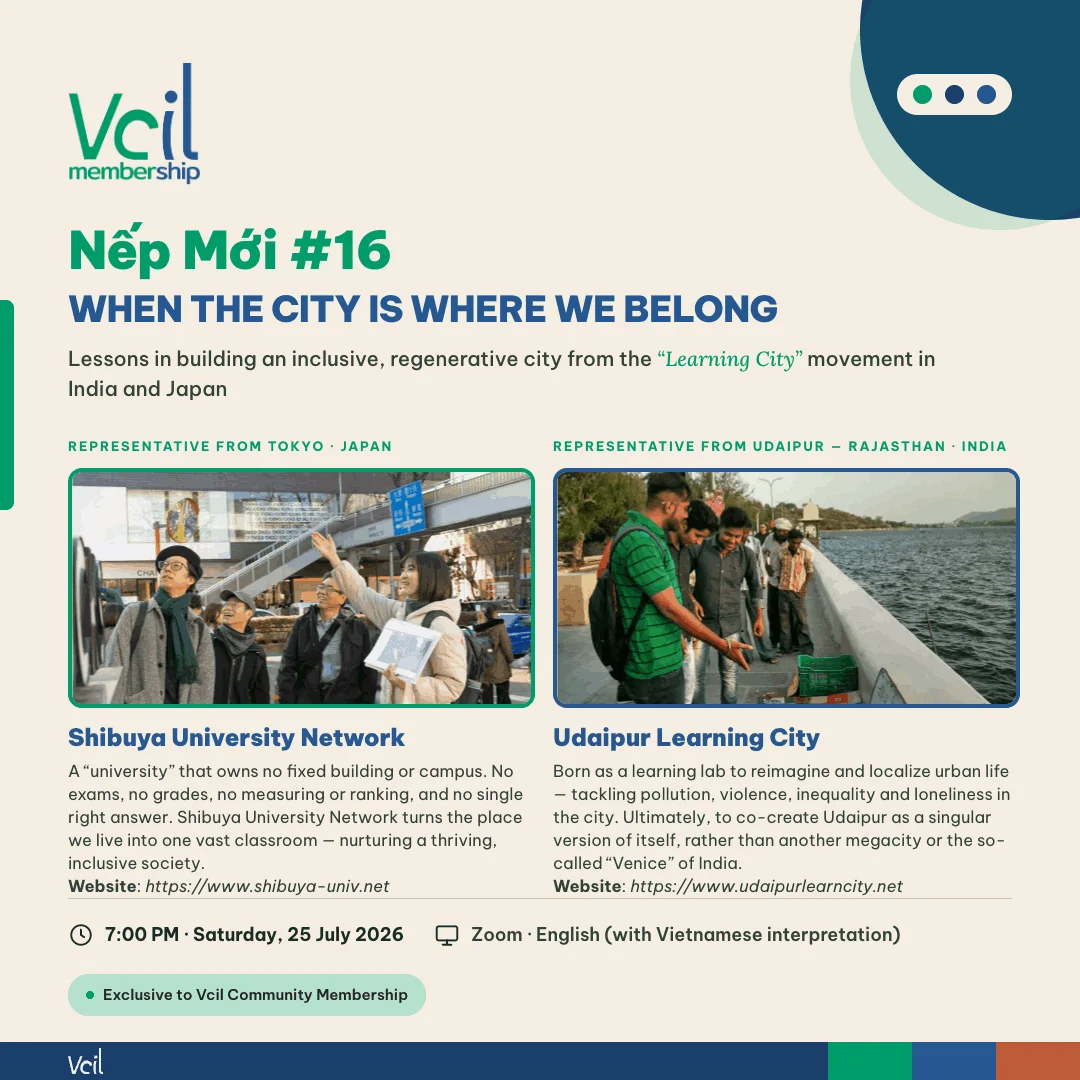
In this month’s Nếp Mới, we journey across cultures to explore two of the world’s most inspiring and pioneering models of alternative urban education: the Shibuya University Network in Japan and the Udaipur Learning City initiative in India. Through the experiences of the Learning City movements in Japan and India, we will discover how cities can become spaces of inclusion, lifelong learning, and regeneration—places where education is woven into everyday life and where people cultivate a genuine sense of belonging to the communities they inhabit.
On this pageOn this page (4 sections)
Time: 19:00, Saturday, July 25, 2026
Format: Zoom
Language: English (with Vietnamese interpretation)
Registration link: https://luma.com/1jkp0uuz
[Event exclusively for Vcil Community Members]
DESCRIPTION:
What makes a city livable, a place where we feel we belong? From an agricultural foundation, Vietnam has surged forward to form dynamic economic corridors and urban supply chains, bringing the urbanization rate to 44.3%. This trend is becoming increasingly pronounced in the country's major cities.
Yet modern cities seem to be missing the essential ingredients for people to live happy, sustainable lives. Cities appear to be replicating the same development model, all revolving around the same relentless churn: bustling shopping centers, sleek skyscrapers, fiercely competitive job markets, and a school system detached from local culture and ecology. But what if a city itself could become one vast learning campus? What if every street corner, every home, every neighborhood turned into a lecture hall, and every resident became a teacher? What would a city look like if it still held onto its cultural and ecological character — a place where every resident feels affection and a sense of belonging?
These "what if" questions are precisely the shared vision that the global "Learning City" movement seeks to answer — a powerful shift away from consumerist, centralized, competitive, resource-depleting cities toward cities of collective intelligence, of a passion for learning and lifelong learning, of an indigenous gift culture, of a life lived happily and in harmony with the place we inhabit.
"Learning City" is a name close to Vcil Community's heart, as the community and its members have organized the monthly "Learning City" festival in Đà Nẵng, Vũng Tàu, Hồ Chí Minh City, and most recently Hà Nội — where we step outside traditional classrooms and turn every space, every corner of the city into a place of learning and equal exchange among citizens. Above all, the festival is an opportunity to build community, to weave networks of information-sharing, collaboration, and mutual support across localities.
This July, "Learning City" in Vietnam enters its eighth month since it first began. Ahead lie countless possibilities for the movement to imagine, contribute to, and co-create. So what futures might unfold in the "Learning City" — in each city, and in Vietnam as a whole?
To explore this question, in July's edition of Nếp Mới we will travel through a global lens and lived experience to learn about two of the world's Learning City models: Shibuya University Network (Japan) and Udaipur as a Learning City (India). Together we will discover how communities in entirely different cultural contexts are breaking through inherited limits, and in doing so creating community spaces rooted in human development, ecological awareness, and genuine happiness.
MEET THE GUESTS:
Representative from Shibuya University Network (Tokyo, Japan):
A "university" that owns no buildings and has no fixed campus. No exams, no grades, no metrics, no assessments, and no single right answer. Shibuya University Network aims to turn the places we live into an enormous classroom, and through it, to create an abundant, inclusive society—one where learning makes us more human, more purposeful, and more joyful. It is also a place where residents can make friends, exchange ideas, learn freely, and renew themselves each day.
Founded in 2006, Shibuya University has completely redefined learning in the city by turning the megacity of Tokyo into a free, open lecture hall. Operating on a "zero-campus" model, it utilizes and widens access to underutilized public spaces, transforming them into community learning hubs. Its members have held classes in cafés, izakaya pubs, bookstores, hair salons, and parks. The sessions are never one-directional—those who share and those who attend co-create together.
To date, this entirely free learning model has drawn more than 45,000 participants, hosted over 1,600 unique courses, and sparked the "Sister University" movement spreading across Japan (from Kyoto to Fukuoka) to heal the loneliness of urban life.
Representative from Udaipur as a Learning City (Rajasthan, India):
Launched in 1999 by residents of Udaipur, the initiative was born as a learning laboratory for reimagining and localizing urban ways of living, addressing the city's problems of pollution, violence, inequality, and loneliness. Ultimately, it seeks to co-create Udaipur as a singular version of itself, carrying its own identity—rather than turning it into a megacity or letting it wear a label like "the Venice of India."
The initiative runs on the core ideas of reimagining education, reimagining development, regenerating indigenous knowledge, and building community and ecosystems. Learning City is therefore a space that opens a network of learning opportunities to everyone, focusing on ideas that nurture intergenerational learning, ecological regeneration, spiritual growth, and the resilience and sustainability of the local economy. To realize that vision, the initiative mobilizes different resources within the community, invites the participation and co-creation of diverse stakeholders, and acts from a place of sacred service— seva (a core philosophy across many religions and spiritual practices in India). These are the resources it draws on to meet Udaipur's complex local challenges.
The initiative rests on four main pillars:
- Nurturing right livelihood: training and cultivating ethical, impact-driven vocations, and regenerative enterprises and startups. The aim is to regenerate the city's and neighboring villages' true forms of capital: natural capital, social capital, health capital, and knowledge capital.
- Community-building events: festivals, unConferences, community cafés, workshops, and more.
- Unlearning programs: helping participants deepen their understanding of indigenous knowledge, gift culture, livelihoods, and reimagined education.
- Community media: telling the stories of regeneration, nurturing, and meaningful community-building unfolding locally.
The above is only a broad introduction to these two Learning City initiatives. To learn more, you can visit each initiative's own website—and above all, join Nếp Mới to hear directly from their founders and stewards, and to ask them your questions!
See you at Nếp Mới #16 later this month!
ABOUT NẾP MỚI
Inspired by the Vietnamese word "Nếp"—signifying the inherited patterns of culture, habit, and everyday life—Vcil Community created Nếp Mới to open a space that nurtures new ways of living: ones that prioritize sustainable well-being and the regeneration of true wealth. It is a community space designed to help people recognize and break outdated patterns, learn from collective intelligence, and reimagine how we live, connect, and learn.
Each month, community members dive deep into a different theme. Nếp Mới invites scholars, experts, and practitioners to share insights on essential topics that touch our lives. Participants have the chance to join in dialogue, deepen their understanding, find solutions to personal and collective problems, or begin work that matters.
CONTACT
- Fanpage: Vcil Community
- Phone/WhatsApp/Zalo: 0836243541 (Huy)
- Email: vcil.group@gmail.com