You are using the member interface.
Log out of the member interface →
Blog

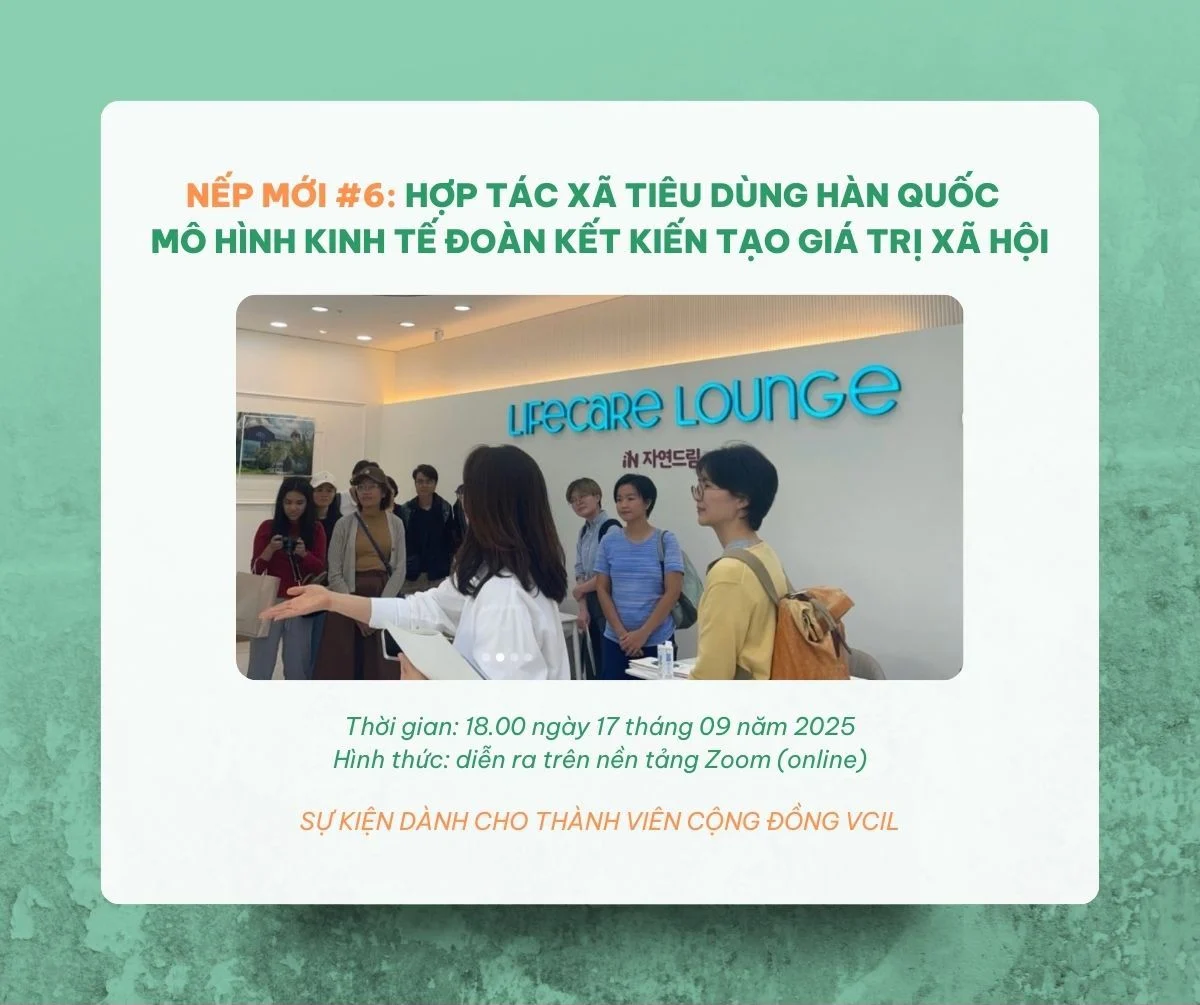
[Nep Moi #6] South Korean Consumer Cooperatives - A Solidarity Economy Model Creating Social Value

Thông tin cho hội viên

Thông tin dưới đây chỉ dành riêng cho Hội viên Vcil
Để đảm bảo quyền lợi của bạn cũng như cộng đồng Hội viên Vcil, mong bạn đừng chia sẻ thông tin này nhé!


Bạn có thể chia sẻ thông tin về dự án dành cho công chúng bằng cách sao chép link này:

NẾP MỚI #6: KOREAN CONSUMER COOPERATIVES – A SOLIDARITY ECONOMY MODEL THAT CREATES SOCIAL VALUE

At Nếp Mới #6 in September, Vcil Community invited Yena Lee to share on the topic of consumer cooperatives. Wanting to find alternative paths and contribute to positive change in society, she decided to pursue a master's and a PhD in Business Management of Cooperatives at Sungkonghoe University. There, Yena researched Korean cooperative models and gained in-depth knowledge of the consumer cooperative model. She is currently also a member of the Hansalim and iCOOP cooperatives.

In this event, we went through the following discussions about this model together:

- The historical context that led to the birth of consumer cooperatives in Korea

- The legal framework that drove the development of consumer cooperatives

- The differences between the leading consumer cooperatives: Hansalim and iCOOP

- The difficulties cooperatives face

- Q&A about consumer cooperatives

Below is a write-up summarising the main content shared in this session.

1. OVERVIEW OF THE HISTORICAL CONTEXT AND FORMATION OF KOREAN CONSUMER COOPERATIVES

The origins of consumer cooperatives in Korea are closely tied to the country's historical and political upheavals. In the 1950s the Korean War broke out, leaving devastating consequences and resulting in the formation of two countries: North Korea and South Korea. South Korea then went through rapid, breakneck economic development, pushing industrialisation under a dictatorship throughout the 1960s. This dictatorship spurred the growth of civic movements, which ultimately led to the birth and maturing of the democracy movement in the late 1980s.

It was during this period of a flourishing democracy movement that the cooperative movement in Korea was driven forward and became closely tied to civil society initiatives. In the late 1980s, consumer cooperatives, typified by pioneers such as Hansalim and Happycoop, were born to address social problems related to domestic agriculture and workers' rights; in particular, consumer cooperatives were closely linked to the movement to reconsider and reshape the role of women in post-dictatorship Korean society.

The period from 1986 to 1997 was clearly a crucial one for the later development of consumer cooperatives, laying foundations through the strong growth of the middle class, the rise of civil society and democracy movements, and pressure to open up the economy from globalisation. It was in this period that the two pioneering cooperatives, Hansalim (founded in 1986) and Happycoop (founded in 1989), were established.

One of the major barriers to the sustainable development of cooperatives in the early period was the lack of an appropriate legal framework. Before 1999, consumer cooperatives operated with great difficulty, lacking a credible legal entity. This left customers with little trust in a market economy. From 1999, after a long period of tireless effort to push for a change in the legal framework, the Cooperative Act was passed. This change legitimised the legal existence of cooperatives, helping them communicate their purpose and become more trustworthy to customers.

This legal foundation created the stability needed for cooperatives to emerge and grow.

In the early period, cooperatives were operated under the dictatorship with the aim of post-war economic recovery and development. The dictatorial government of the time forced the development of key industries such as land planning for industry, agriculture and fisheries. In other words, the early cooperative movement was run top-down. By contrast, today's consumer cooperatives are run autonomously, bottom-up, democratically and from the grassroots. They are initiated and run by the people themselves, showing a clear difference from their earlier predecessors.

Today, consumer cooperatives operate under two basic cooperative laws: the general cooperative law and the Consumer Cooperative Act. This Act provides a trusted foundation for the stable development of the roughly 400 cooperatives currently in Korea.

Since the 1990s, the consumer cooperative movement in Korea has grown strongly, led by four consumer cooperatives: Hansalim, Happycoop, Dure and iCOOP. Today, Happycoop and Dure are no longer growing strongly; only Hansalim and iCOOP are still developing well. This session therefore focused on Hansalim and iCOOP, to understand the conditions that have kept these two cooperatives stable to this day.

2. THE CHALLENGES AND DIFFICULTIES COOPERATIVES FACE, AND THE SOLUTIONS

As shared above, the development of cooperatives was constrained by two main challenges: the market economy and legal restrictions from the government.

THE PRESSURE OF GLOBALISATION AND THE MARKET ECONOMY THREATENS ORGANIC FARMERS' LIVELIHOODS

Amid rapid industrialisation, agriculture could not escape the trend either. This also marked a structural shift: from an agriculture-based society, Korea moved towards a service-based industrial society, directly driving rapid urbanisation and dismantling the inherent structure of an agrarian society. Agriculture, pushed and controlled by the government, prioritised mass farming and increased yields.

This approach relied heavily on chemical fertilisers and pesticides, which were considered essential for boosting crop yields. This way of farming directly created food safety problems and environmental degradation, leading to consequences such as depleted soil, water pollution and loss of biodiversity, destroying the essential biological foundation for the long-term, sustainable development of agriculture.

In addition, the industrialisation of agriculture also had a direct negative impact on farmers, who are passive and vulnerable in a market economy. Typically, traders and intermediaries control the distribution channels. This means the price consumers pay is usually higher than the actual price paid to farmers, resulting in an unfair distribution of profits. Moreover, farmers cannot control the market, so when prices fall they are the most vulnerable, making farming a precarious occupation.

On the positive side, this process gave consumers an abundant supply at affordable prices; low prices also came from the government's market deregulation. However, the consequences of this approach wiped out the short-term benefits of industrialised agriculture. The direct result was that smallholder farmers could not compete with industrially produced goods and cheap imports, leading directly to the destruction of the basic foundations of local communities.

Against that backdrop, Hansalim, founded in 1986, was the pioneering cooperative that responded to the pressure of globalisation in order to protect organic agriculture. Hansalim promoted the “Save Farming, Save Life” movement as a root solution to the existing problems. Hansalim's concrete action was to establish a model of direct trade between farmers and urban consumers, cutting out intermediaries to protect organic products and farmers' livelihoods. They advocated removing intermediaries because they are the reason agricultural consumer products cost more, and to avoid dependence on the market and on intermediaries. This helped build a close relationship, understanding and connection between consumers and producers (farmers).

This small change immediately solved the existing problems caused by the market: stable prices, farmers with secure livelihoods, consumers with organic products at affordable prices, regenerated ecology and environment, and communities resilient to market fluctuations.

The first rice shop in Seoul in 1987 was the starting point for Hansalim's growth into a nationwide network of more than 200 shops. Gradually the products became more diverse, expanding into environmentally friendly products, organic products and products made with ecological and social economy considerations.

The impact of the Hansalim cooperative is far from small. Yena Lee shared that this movement has truly driven the organic agriculture movement, spread the wellbeing lifestyle widely, and shifted the food system in Korea in a healthier direction.

STATE LEGAL BARRIERS LIMIT THE SUSTAINABLE DEVELOPMENT OF COOPERATIVES

The constraints that the Korean consumer cooperative movement faced from the state show up in three main aspects: top-down governance, the absence and limits of a legal framework, and a lack of trust in product quality.

Initially, cooperatives were run top-down, meaning they were operated and managed by the government. Under the dictatorship, cooperatives became a tool for economic and industrial development to rebuild the country after the war; therefore, the cooperatives' decisions and direction all had to serve that reconstruction purpose.

After the dictatorship, Korea democratised, and bottom-up civic organisations tied to the farmers' and labour movements grew strongly. These were the cradles from which progressive cooperatives were born. Today's consumer cooperatives are created and run by the community, of the community and for the community; therefore, the new cooperatives are highly democratic and autonomous.

The second challenge came from the legal side. This was arguably the biggest barrier in the early period of cooperative operation, when the absence of an appropriate legal system left cooperatives without a suitable legal status or credibility in the market.

To solve this, the cooperatives pushed for legal reform, leading to the Consumer Co-operative Act being enacted in 1999, which officially granted consumer cooperatives legal status as non-profit organisations. However, this law still had a legal limitation: it only allowed cooperatives to sell organic agricultural products, hindering business diversification. The cooperatives therefore continued to call for amendments to the law, and succeeded. In 2010, the Consumer Co-operative Act was amended, removing this restriction and allowing them to diversify into daily necessities.

On the question of quality, to guarantee and proactively control their products, the cooperatives built their own certification systems and set up their own production systems and facilities (such as iCOOP), creating trust among members. Finally, the Framework Act on Co-operatives of 2012 expanded the available business models to include legal status as for-profit companies; this gave cooperatives more business models and greater flexibility.

3. SIMILARITIES AND DIFFERENCES BETWEEN HANSALIM & ICOOP

The two representative names, Hansalim and iCOOP, represent not only two different generations of cooperatives, but also two distinct approaches on the journey of building an ethical, community-oriented solidarity economy.

HANSALIM – FOCUSED ON FARMERS & ECOLOGICAL CONSERVATION

When talking about consumer cooperatives, Hansalim has to be the first name mentioned, as the pioneering cooperative founded in 1986. Hansalim was born at a time when Korea's rapid industrialisation was shrinking traditional agriculture, and land and food sources were heavily polluted. Farmers, intellectuals and social activists began looking for an alternative model to protect life – not only human life, but that of soil, water and ecosystems.

The name “Hansalim (한살림)” means “respecting and nurturing life.”
The movement was initiated by the sociologist Kim Ji-ha together with environmental activists, with the vision: “Producers and consumers protect life together through food.”

From there, Hansalim grew as a producer–consumer movement. Hansalim promotes direct trade in organic products between urban consumers and rural producers. Specifically, farmers sell directly to consumers and receive 76% of the price paid by customers. This increases farmers' incomes and secures their livelihoods.

Hansalim's success lies in nurturing a close relationship between consumers and farmers. They hold that “Farmers are responsible for the health of consumers, and consumers are responsible for the livelihoods of farmers.” To build this close relationship, farm visits are organised regularly, so that food is not only “from farm to table” but also “comes with a face” – the farmers who care for their meals every day.

Hansalim's activities do not focus on marketing or commercialisation. They focus on promoting understanding and action to develop organic agriculture, strengthen food self-sufficiency and local consumption; in particular, they emphasise the circular use of natural resources as a sustainable solution for agricultural development.

Clearly, Hansalim's activities are oriented towards ecology and protecting farmers' livelihoods.

By 2024, Hansalim had more than 946,000 members and 235 shops across Korea – evidence of a powerful social economy movement that still keeps its original spirit: living in harmony with life. (figures provided by Yena).

REFERENCE: https://orgprints.dk/id/eprint/24218/7/24218.pdf

iCOOP – BORN FROM THE FINANCIAL CRISIS AND CONSUMER CONSCIOUSNESS

After the 1997 Asian financial crisis, Korea suffered mass unemployment and declining social welfare, leading to a state of crisis. In that context, the labour movement – which had formed in the 1980s with the goal of protecting workers' rights – began looking for practical, democratic, grassroots solutions instead of only fighting for rights.

Many workers, teachers, office workers and social activist groups began setting up small consumer cooperatives to secure safe necessities for themselves at reasonable prices.

From those grassroots groups, in 1997 the consumer cooperative movement was consolidated into iCOOP Korea. Unlike Hansalim – which emphasises “life” and “ecological agriculture” – iCOOP began as a socio-economic movement oriented towards welfare, fairness, and care for human happiness & health.

From there, iCOOP took shape with ethical consumption as its central value, later expanding into the Lifecare Movement – towards a healthy and fair life.

Initially iCOOP was just a small federation, but it then grew rapidly into a large consumer cooperative system (also known as a cooperative federation) with 298,848 members (2023) and 247 Natural Dream shops nationwide (figures provided by Yena).

iCOOP has built not only a distribution chain for organic products, but also a system of schools, hospitals and housing for cooperative members – this is the lifecare economy approach: an economy centred on comprehensive health care for members.

Despite differences in philosophy and primary target audience, Hansalim and iCOOP both operate on the basis of building direct trade that supplies organic products straight from producers to consumers.

One difference in the production model is that iCOOP has now built two production and warehousing complexes and begun signing contracts with small producers; once finished products are made locally, they are sent to the production complexes to be labelled as iCOOP and sold on to consumers.

In terms of membership numbers, while iCOOP has just under 300,000 members, Hansalim has grown to more than 946,000 members. This large difference lies in the founding and development history of the two cooperatives. Hansalim was founded more than 10 years before iCOOP. And Hansalim's membership has grown year on year, while iCOOP's membership has remained fairly stable.

4. THE DIFFERENCES BETWEEN HANSALIM AND ICOOP

DIFFERENCES IN ORIENTATION & CORE VALUES

One of the clearest differences between Korea's two large consumer cooperatives – Hansalim and iCOOP – lies in their foundational values and operational goals.

Hansalim was formed on the philosophy of “preserving and nurturing all life”. For them, the cooperative is not simply a channel for distributing goods, but an ethical–ecological movement to restore a harmonious relationship between people and nature. That is why Hansalim focuses heavily on connecting directly with local farmers, prioritising domestic products and keeping cross-border trade to a minimum.

iCOOP, by contrast, has a different starting point – the labour movement and ethical consumption. Founded after the 1997 Asian financial crisis, iCOOP focuses on practising consumption for social welfare and global fairness. It quickly became one of Korea's pioneering organisations in promoting the Fair Trade movement, importing and distributing fair-trade-certified products such as coffee, sugar, cocoa and bananas. However, iCOOP treats Fair Trade products only as a supplement to domestic products, specifically items that “cannot be produced domestically or have a very low domestic self-sufficiency rate”, which are imported through Fair Trade.

For iCOOP, “ethical consumption” is not limited to the national level, but is a shared responsibility between Korean consumers and small producer communities in developing countries.

[Source: page 22, iCOOP KOREA 2011 Annual Report] https://icoop.coop/wp-content/uploads/2016/08/2011_en.pdf

This difference reflects two different approaches to ethics in consumption. Hansalim is oriented towards domestic and ecological ethics, emphasising self-reliance and a sustainable bond between people and the land, so it does not actively take part in the fair trade movement. iCOOP, meanwhile, represents global consumer ethics, in which consumer action becomes a means of creating social justice across borders.

However, the boundary between these two approaches is not entirely fixed. Over time, in response to members' increasingly diverse needs, Hansalim has also begun distributing some Fair-Trade-certified imported products – such as sugar – but always keeps to the principle of importing only when truly necessary and when the product cannot be produced domestically.

DIFFERENCES IN FINANCIAL MODEL

Both Hansalim and iCOOP are consumer cooperative federations. This means each federation comprises many member cooperatives (or sub-cooperatives) spread across Korea.

In terms of financial structure:

  • Member cooperatives usually generate revenue mainly from selling their own local products to consumers in their area. This retail profit is used to sustain the operations of the local cooperative, including operating costs, organising events for members, or developing short supply chains.
  • Meanwhile, the central cooperative federation is responsible for coordinating and managing the logistics system – distributing goods among member cooperatives and ensuring product flows are consistent across the whole system. The federation's revenue usually comes from transport fees, distribution fees, or internal management discounts between cooperatives.

The Hansalim Federation's main revenue comes from a commission on distribution, while member cooperatives earn their income from the retail margin at local cooperatives.

The iCOOP Federation's main revenue, meanwhile, comes from a commission on distribution and monthly membership dues from the member cooperatives in the federation. Member cooperatives earn their income from monthly membership dues from members and 3% of the profits at retail shops.

In terms of membership, both Hansalim and iCOOP require consumers to pay an initial joining fee to become a cooperative member. However, the contribution structures of the two systems differ significantly.

  • Hansalim mainly collects a one-time joining fee and does not require monthly membership dues. After joining, members can buy products at the cooperative's shops at a uniform price.
  • iCOOP applies a monthly membership dues mechanism in addition to the joining fee. These dues are used to sustain the federation's operations, support the community development fund, and reinvest in the distribution chain.

On pricing, Hansalim maintains a single pricing mechanism or seasonal pricing, which stabilises farmers' incomes and ensures consumers' access to safe food.

To date, the Hansalim system has 2,745 producers organised in 103 farming communities, focused on building a sustainable agricultural environment and product specialisation.

Unlike Hansalim, iCOOP applies a dual pricing model. Prices may differ between members who pay monthly dues and ordinary customers, thereby encouraging long-term participation and risk-sharing among members.

In addition, they run funds such as the “member-loan for pre-purchase of domestic grains”, which allows members to contribute financially to advance capital to producers — a way of securing supply and supporting farmers during the growing season.

iCOOP currently has 2,673 producers supplying its members & consumers.

THEIR OWN CERTIFICATION SYSTEMS

The certification system and food standards of iCOOP and Natural Dream

To secure members' trust, iCOOP has built an independent internal certification and inspection system to manage product quality from production to distribution.

iCOOP has an internal certification system – 아이쿱인증센터 (iCOOP Certification Center) – responsible for managing this system. According to the 2018 report, the centre carried out 16,442 tests on agricultural products, soil, animal feed, seafood, processed products and production inputs.

[SAPENet Annual Report 2018:

https://icoop.coop/wp-content/uploads/2019/07/2018-SAPENet-ANNUAL-REPORTFinal.pdf?utm_source=chatgpt.com ]

All iCOOP Net products are tested for pesticide residues, radiation, antibiotics, GMOs, etc.

https://icoop.coop/wp-content/uploads/2018/05/2017iCOOP-NetER.pdf?utm_source=chatgpt.com

iCOOP also takes its own samples from production sources and sends them to government-accredited testing agencies. https://icoopfood.or.kr/food.html

This certification system was once the pride and distinctive feature of iCOOP, tied to the slogan “From Ethical Consumption to Life Care Movement”. Recently, however, iCOOP has shifted strategy: it no longer emphasises its own certification system, and instead focuses on developing the Natural Dream brand as a new standard model for food and a healthy lifestyle.

Natural Dream is not just a standard but an integrated brand system comprising three main product lines. Healing Food focuses on foods containing natural active compounds (phytochemicals), eliminating carcinogenic risks during processing and reducing harmful factors in nutrition. Eco-friendly & Organic Food targets organic products, produced under Natural Dream's strict management and certified according to national legal standards. Finally, Yummy Yummy is the product line for children and families, focusing on both taste and safety, minimising cancer risk and food contamination.

[Event exclusively for Vcil Community Membership Members]

Time: 19:00 Thursday, day 26 February 2026

Format: Online via Zoom.

Language: English (Vietnamese translation available)

South Korea is known globally for its technological advancement and economic development. But few people know about the vibrant cooperative movement that has been building alternative economic models in South Korea for decades.

Consumer cooperatives in South Korea represent a fascinating example of how communities can organize to meet their needs outside of capitalist market logic. These cooperatives operate on principles of mutual aid, democratic decision-making, and solidarity—providing members with affordable goods while building stronger communities.

In a world where consumption is increasingly individualized and mediated through corporate platforms, consumer cooperatives offer a different vision: one where we collectively decide what we need, how to produce it, and how to distribute it fairly.

In Nếp Mới #6, we will welcome Park Hye Kyung and Lee Min Sung, experienced leaders in the South Korean cooperative movement. They will share the history, successes, challenges, and future vision of cooperatives in South Korea, and discuss what lessons these models hold for building solidarity economies elsewhere.

Expected Topics:

- History and development of the cooperative movement in South Korea

- How consumer cooperatives organize and operate

- Successes and challenges faced by cooperatives

- Cooperative economics as an alternative to capitalism

- Building solidarity networks across communities

See you at Nếp Mới #6!

You can register as a member to attend Nếp Mới #6 for free. Detailed information is in the comments section.

CONTACT INFORMATION

Fanpage: Vcil Community

Phone/Whatsapp/Zalo: 0836243541 (Huy)

Email: vcil.group@gmail.com

Các dự án liên quan bài viết

New Ways will invite scholars, experts, and people with practical experience to share about essential and familiar topics in life