You are using the member interface.
Log out of the member interface →
Blog

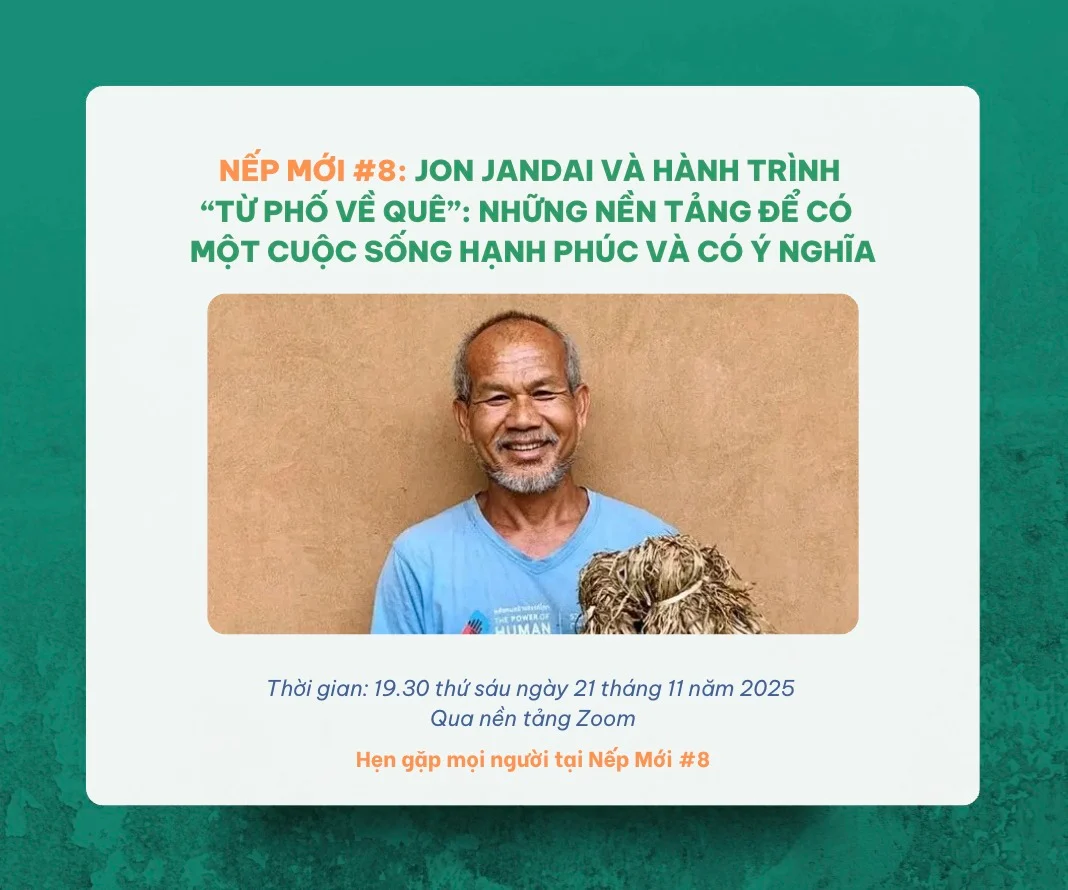
[Nep Moi #8] Jon Jandai and the Journey "From City to Countryside": Foundations for a Happy and Meaningful Life

Thông tin cho hội viên

Thông tin dưới đây chỉ dành riêng cho Hội viên Vcil
Để đảm bảo quyền lợi của bạn cũng như cộng đồng Hội viên Vcil, mong bạn đừng chia sẻ thông tin này nhé!


Bạn có thể chia sẻ thông tin về dự án dành cho công chúng bằng cách sao chép link này:

Nếp Mới #8: Jon Jandai's journey "from the city back to the countryside"

The foundations for a happy and meaningful life

At the Nếp Mới conversation in November 2025, our guest was Jon Jandai. In this session, we heard Jon Jandai share his experience of "disillusionment" in Bangkok, which led him to commit to carving out a different path for himself – one leading to genuine happiness and a meaningful life. Below is the recap of the Nếp Mới #8 gathering!

1. DISILLUSIONED WITH A HAPPY FUTURE IN BANGKOK

Jon Jandai's journey began in a remote rural area of Thailand, where he grew up in a simple farming family. At that time, a powerful social prejudice was deeply etched into the minds of the villagers: the countryside was a place of poverty, poor education and no future. The universal belief was that if you wanted to succeed, to have a good life and a quality education, you had to leave the village for the capital, Bangkok. It was the pressure of this expectation and the desire to escape poverty that pushed Jon to leave his family and throw himself into the grind of the largest city in the Land of Golden Temples.

However, the reality in Bangkok was the complete opposite of the promises of a "bright future". Jon Jandai spent 7 years of his life working hard there, regularly labouring more than 8 hours a day in the hope that hard work would bring wealth. But after nearly a decade, he realised he had nothing in his hands. Life in the capital was in fact a long string of days stuck financially and exhausted mentally. His income was so low that he could not afford decent meals, and he often lived on instant noodles just to survive. As for housing, he and many friends had to squeeze into a small, hot rented room, where privacy and comfort were luxuries.

It was during those nights lying in that cramped room that Jon began asking philosophical questions about human existence. He noticed a bitter paradox: why do humans, who consider themselves the intelligent and advanced species, have to work harder than any other animal only to receive hunger and anxiety in return? He watched the birds and saw that they did not need a university degree or a credit card, yet they always found food and spent most of their time singing and enjoying life. This contrast led him to conclude that his way of thinking and the current social system had something seriously wrong with them.

He realised that Bangkok was not a place for human beings but a machine that turns people into robots, where they lose their time and freedom just to serve needs that are not real. The sadness every time he held a bowl of instant noodles, and the feeling of being starved in the middle of a world of plenty, became the final push for him to decide to give up the city, end 7 years of mistakes and return to his home village.

2. THE PATH TO SELF-RELIANCE, FREEDOM AND HAPPINESS BACK HOME

As soon as he set foot back home, Jon Jandai set about growing his own food with a completely different mindset from the local farmers. Instead of following the monoculture model – growing a single crop such as chillies or greens to sell for money and then using that money to buy food – he chose to establish biodiversity right on his own land. In a small garden plot, he grew more than 50 different kinds of plants, from leafy vegetables and root crops to herbs and spices, focusing only on what the family really wanted to eat. His view was that no single crop needed to be grown in large numbers; sometimes just five or six plants of each kind were enough, but the variety had to be rich. This approach solved his food problem immediately and minimised the risk from pests and disease or fluctuating market prices.

The results of this new way of life completely shattered the assumptions about how hard farming is. After only three months, he found that it took him about 15 minutes to water the garden and less than an hour of work per day in total. As a result, he not only fed his family of 6 with clean food, but also had a surplus to take to the market to sell. The money earned from selling this surplus food was even higher than his income from 8 hours of gruelling labour in Bangkok. Success in the garden gave him the momentum to learn other survival skills: he built his own earthen house with his own hands, learned to make soap, shampoo and laundry detergent, and to make yoghurt and sauces. He also spent time studying herbal medicine and therapeutic massage so he could take care of basic health needs without going to hospital.

This process brought Jon Jandai a profound psychological change and a new sense of self-respect. From someone who had once been shy, insecure and always felt like a victim of poverty, he became more confident than ever when he realised he could be fully self-reliant in the four core needs: food, shelter, everyday essentials and healing. He affirms that when people have enough skills to help themselves, they find real stability and security, no longer ruled by fear about money or economic crises. Holding these skills is the root that helps people stand firm and free, because once you know how to survive in nature, no pressure from the capitalist system or inflation is a serious threat to your life any more.

3. THE BIG PICTURE OF AN UNSTABLE FUTURE: HOW DO WE PREPARE FOR IT?

Jon Jandai offered a sharp, critical perspective on the fragility of the modern economic system. He believes capitalism and the global financial system are approaching a breaking point after reaching the peak of their growth. In his view, the capitalist system is built on overconsumption, extracting natural resources faster than the earth can regenerate them, which inevitably leads to depletion and pushes resource prices up. When resources are no longer enough to keep the consumption machine turning, the system will fall into a deep crisis of its own accord. He believes we are living in a period in which ecological and economic crises will occur more frequently, and with greater intensity than normal, requiring people to completely change their thinking and way of life in order to survive in the near future.

Planetary boundaries - Wikipedia

Going deeper into the monetary system, Jon pointed out a common mistake: people tend to place absolute faith in money as the only tool guaranteeing security. In reality, however, the value of money is extremely precarious and can collapse at any time under the pressure of runaway inflation or sudden financial crises. He stressed that money only has value while the system keeps running, but if one morning you wake up and the currency's value has evaporated, those who own a lot of money but lack survival skills become extremely vulnerable. When people only know how to work like machines to accumulate numbers, without the ability to provide for themselves, they are in fact placing their lives in a highly risky position, entirely dependent on market fluctuations.

In that context, Jon affirmed that self-reliance, through mastering the four basic skills – food, shelter, essentials and self-healing – is the truest and most sustainable foundation of security. This self-reliance acts as a firm root system, helping people stay stable and feel less fear than ordinary people. He explained that when we can meet our essential needs with our own hands, fear of inflation or economic collapse loses its weight, because we already know how to find food and build shelter without depending on money. This is not only a survival solution but also a way to regain self-respect and confidence, allowing an individual to calmly face the three spectres of crisis waiting in the near future: economic recession, natural disasters and war.

Finally, Jon stressed that training in self-reliance skills is the most important preparation for each person to face the serious things that lie ahead. Instead of continuing to chase the illusory values of a capitalist system on its way down, returning to learn how to rely on ourselves brings absolute security in every situation. When people are self-reliant, even when money no longer has meaning, life can go on peacefully and freely. Self-reliance not only helps us get through crises but is also the key to escaping the control of the urban robot system, helping people truly master their destiny and live a life as easy as it is meant to be.

4. SEEDS & THE LIFE MISSION JON JANDAI HAS CHOSEN

Saving seeds is a supremely important and urgent task, because seeds are not just food but the very source of life and the foundation of freedom. In today's world, seed diversity is declining severely and disappearing every day, never to be recovered, leaving farmers with almost no seeds of their own in their hands. This is a frightening reality, because without seeds we lose our autonomy in producing food, especially when facing crises.

Looking back at the past, biodiversity was the most sustainable safety net; a child in those days could eat more than 30 kinds of vegetables each season and at least 100 different kinds of fish each year. It was this abundance that created a sense of absolute security, because if one crop failed or one kind of fish could not be found, there were always other alternatives from nature. Today, however, we have lost the forests and depend entirely on the supermarket system. Just imagine, if one day the shelves were empty, how could we survive with nothing in our hands?

The disappearance of biodiversity is not an accident, but the intention of a group of people belonging to the system that controls the world – a form of "new colonialism" or "new imperialism". They destroy native seeds by replacing them with hybrid seeds that cannot be saved, train farmers to depend on chemicals, and control the entire market. In Thailand, from thousands of traditional rice varieties, only about 200 are now cultivated, and most of the 70 million population eat only one or two kinds of rice their whole lives. We are being trained to eat what the corporations that own the seeds want us to eat. Indeed, the whole of Thailand now eats almost only one breed of chicken, one breed of pig, and eggs from a single breed of hen too. Although we see supermarkets full of goods, in reality our choices have narrowed dramatically; where we once ate hundreds of kinds of vegetables a year, that number is now often fewer than five.

The consequence of eating few varieties in large quantities is serious health problems. Food from industrial agriculture is pushed along with hormones and chemicals, so it does not have enough time to accumulate nutrients, making it bland and tasteless. Jon Jandai demonstrated this through an experiment: when he put a head of greens from the supermarket (grown with chemicals) and a home-grown head of greens (grown naturally) into two glass jars, the supermarket greens quickly dissolved into liquid within a few days because they contained only water and chemicals, while the natural greens kept their structure and merely wilted because their high nutrient content protected them. This micronutrient deficiency is the cause of non-infectious chronic diseases such as heart disease, cancer, diabetes, kidney failure and high blood pressure. We are proud of our civilisation, yet the quality of our food and health is deteriorating badly because we are eating "empty" food.

To counter this situation, Jon Jandai has spent 23 years of his life saving seeds and is committed to doing this work until he dies.

Q&A WITH JON JANDAI

1. How do you store seeds, what is the best way to store seeds, what is your approach? How do you store them?

In Jon Jandai's philosophy, seed saving is not merely a technical activity of storing genes, but a multi-layered campaign to preserve life and knowledge. He stresses that the most sustainable storage method is "storing them in people's lives". Instead of only locking seeds away in cold storage vaults, we must put them back into the hands of farmers, into restaurant kitchens, and onto the daily menu of every family. Only when a seed is grown, eaten and used does it truly exist and keep its lasting vitality. He sees this as a mission of salvation, because seeds are the source of freedom; if we do not control our seeds, we lose all autonomy over our own health and survival, and are forced to eat what the corporations impose.

In technical and practical terms, Jon Jandai runs a systematic yet deeply community-based storage process. He travels widely to collect native varieties, brings them back to the farm to trial-grow them and determine whether they are true, open-pollinated varieties. Once verified, he continues to propagate them and shares them free of charge with anyone who wants to grow them, in order to spread diversity everywhere. In this process, he uses the refrigerator as a valuable support tool; whereas seeds kept in natural conditions may only germinate within 1 year, cold storage extends their lifespan and germination capacity to more than 10 years. This extended window gives seed keepers more chances to replant and pass seeds on to the community before they lose their vitality.

In particular, Jon Jandai affirms that seed saving must go hand in hand with preserving indigenous knowledge. Seeds without the knowledge of how to grow and prepare them are just lifeless dry grains. He focuses on preserving the precious experience of ancestors in using plants, including toxic species for which earlier generations paid with their lives over many generations before finding safe ways to prepare them. This work requires multi-party coordination: from training farmers and working with the Slow Food movement to connecting with consumers in the city. Even those who do not grow anything themselves take part in the saving process by "eating to support", creating a market that gives farmers an incentive to keep traditional varieties. For Jon Jandai, seed saving is a lifelong commitment — a tireless effort to protect biodiversity and humanity's true freedom against the encroachment of industrialised systems. He has done this work for more than 23 years, and vows to continue until the end of his life.

2. How can you tell hybrid seeds apart from native seeds?

According to Jon Jandai, the clearest identifying feature is the stability of the results after each season. With native seeds (open-pollinated varieties), every time you sow them, the next generation of plants produces fruit and vegetables entirely consistent with the parent plant in shape, quality and flavour; this stability is maintained sustainably from season to season, allowing farmers to confidently save and reproduce them.

Hybrid seeds, by contrast, are extremely unstable. When you buy a hybrid watermelon seed from the market or supermarket, the first season may give very good results, with beautiful, sweet fruit. However, if you take the seeds from that watermelon and grow them a second time, the structure of the plant and fruit changes completely: the fruit may become ugly, small, rough or suffer many growth problems. Because of the strong and uneven genetic variation in the next generation, farmers cannot use hybrid seeds for commercial replanting, since they cannot produce a stable product to sell or create a sustainable income. In short, native seeds carry a promise of stable inheritance, while hybrid seeds are "single-use" seeds, forcing people to throw the seeds away after eating and depend on buying new ones continuously.

3. Is going back to the countryside to farm and grow crops really as easy as you describe?

From the experience of many of my friends, they do not find growing things easy at all, especially those who moved from the city to the countryside. They also tried to grow many different crops for diversity, but the soil is depleted, and then there is climate change too. So what was the real process you went through?

Jon Jandai affirmed that the first key factor for farming effectively is that each person must ask themselves whether they truly love farming. In his view, if you have real love and passion, the work becomes much easier. When you love it and are passionate about it, you devote time and attention, which drives daily observation, learning and information-seeking. Even when starting from zero (as in his case), you actively seek information and experience from others and try to understand the phenomena that are happening.

Conversely, if you have no passion or love at all, farming will be a disaster. He cited many urban people who went bankrupt and into debt right after quitting their jobs to go back to the countryside, because they farmed based only on imagination, and with the desire to make money through farming. As long as they think that way, they do not understand the nature of the system or of farming.

He therefore advises people, before committing to farming for the long haul, to build their understanding and foundation first, by trying to volunteer for others to "test their love", because when we do what we love we always enjoy it, and if not, it will feel like hell. Once you truly love and seriously understand soil, water, crops, animals, pests and diseases, planning your farming becomes much easier.

4. I would like to ask your advice: for those of my generation who grew up in the city, depending on the system for everything from childhood to adulthood, never knowing how to grow anything or do anything other than earn money. I also know you have a son who is studying in the US, so I am curious how you raised him and how you support him on his career journey?

As advice for the younger generation, especially those born and raised in the city who are only used to earning money to buy food and have never had experience growing things, Jon Jandai stressed that the most important thing is for each individual to identify what they truly love. He affirmed that everyone should be free to do the work they are passionate about and should not force themselves to do things they do not like.

If someone feels suited to the skills and lifestyle of the city, there is nothing wrong with that at all, and they should build on that strength. However, the core message he wanted to convey is connection and interdependence. Instead of everyone having to become a farmer, people in the city should find ways to connect with farmers who are farming organically, who are working to preserve seeds and produce wholesome food. That means knowing who you are, looking more broadly at the systemic level, and doing "the right work". He explained that farmers cannot sustain their profession and do what they do best without people who consume what they produce – food. Supporting one another in the food chain is a shared responsibility, and anyone can contribute to this preservation process wherever they live. As city dwellers, we can consume from and support farmers and ethical, regenerative businesses.

Sharing his story of raising a child, Jon Jandai said his son was raised and grew up right on the farm, where he learned the things needed to build a self-reliant life. From the age of just 9, his son was taught how to build his own house, how to grow wholesome food and how to make everyday household items with his own hands. Although they equipped their son with the strong survival skills of a farmer, he and his wife never put pressure on him or expected him to become a farmer in the future. He and his wife did not want their son to become a farmer or anyone else in particular. They just wanted their son to be himself.

His educational view is to let the child be himself and to give maximum support to his personal choices. When his son grew up and expressed a desire to go out and explore the wider world rather than stay on the farm, he and his wife fully supported that decision.

He believes that although his son already knows how to live in harmony with nature and take care of himself, the outside world is vast and he needs to "fly out of the cocoon" to see the bigger truth, because "he's still young", he shared. Now, at 21, his son is studying Computer Science in the US by his own decision. What matters is that his son is actively exploring the world in his own way, engaging with the real world and finding the truths of this world for himself, instead of being confined to the "small well" of the farm. For him, whether his son returns to Pun Pun farm or not is not the important issue. What reassures him most is that his son clearly understands the value of good food and has the ability to grow his own food whenever he wants. That is the freedom and the core foundation he equipped his son with through growing up on the farm.

5. You mentioned that we will soon face 3 major crises: economic, ecological and war. To prepare for this scenario, self-reliance is very important, but in many places I see farmers selling their land, their only resource for self-reliance, to pay for their children's university education. What do you think we should do in this case?

Jon Jandai affirmed that going to university or school is not the issue we need to focus on; the key lies in what children learn and how we teach them to face life. He believes that even when children attend school as normal, parents need to teach them the most basic survival skills at home, starting with cooking for themselves, choosing edible food and learning to make simple things for daily life. He cited his own community, where families send their children to the farm at weekends to learn to build earthen houses, make soap or shampoo. Surprisingly, many children only 12 years old can already generate income from these products, sometimes earning more than their parents. The core message is that self-reliance can be practised anytime, anywhere, starting from the most essential needs.

Going deeper into educational methods, he shared his experience of homeschooling through project-based learning. He told the story of when his son wanted money to buy a Lego set: instead of giving him money, he showed him how to earn it himself. The child learned to save seeds and raise seedlings to sell. Through this process, the child not only learned scientific knowledge thoroughly but also understood the value of work and felt proud of not being financially dependent on his parents. He stressed that this mindset stays with children into adulthood; children educated this way will know how to work and support themselves at university instead of asking their family for money.

What matters is equipping children with an independent attitude and the ability to meet at least the four basic human needs themselves. When a child knows how to take care of themselves and has a problem-solving mindset to create value, they will have the strength to face any upheaval in the future, whether economic, natural disaster or war, without relying on their parents' assets.

6. How is climate change affecting the food system and food security in Thailand? And how does practising self-reliance help with adapting to climate change?

Climate change really is having many negative impacts on people's lives, especially on farmers in Thailand. It is currently the rice harvest season, and the weather is usually dry. But now it is raining a great deal.

To withstand climate change well, growing a diverse range of crops, rather than only rice, is far more feasible and practical. If on our land we grow all sorts of things, from bamboo, vegetables and fruit trees… and even dig a pond to raise fish, then even when climate change hits, only a few crops are affected, while many others are affected little or not at all. We still have many other kinds of food.

If he grew only a single rice variety, he would certainly face great difficulty, first with the harvest, then with a lack of space to dry the rice. And if he grew it only to sell, he could not sell it at a high price in such conditions, and losses would follow.

In general, when we practise self-reliance and grow diversely, we run into fewer problems and are less affected.

7. What advice do you have for people who are already farming but feel it is extremely burdensome, exhausting and hopeless because they have no other source of income? In today's context, is farming becoming too great a risk for them?

Jon Jandai observed that farming is one of the hardest professions in the world. He therefore advises that if the purpose of farming is to make money, you should not pursue it. In his experience, the farmers who survive do not rely solely on selling raw produce; they have many other strategies to diversify their income. They usually apply at least one of three strategies:
- first, selling seeds,
- second, processing produce to add value,
- and third, using the farm as a tool for other purposes such as education, a learning centre or eco-tourism.

He stressed that even in developed countries, farmers cannot sustain their livelihoods by selling raw products alone without government subsidies. He therefore does not support treating farming purely as a business venture to get rich, because the risk of failure is extremely high.

To illustrate the economic irrationality of agriculture, he shared his personal experience of how the price of Jasmine rice has slid against inflation over the past 50 years. When he was a child, selling 1 kg of rice could buy 3 bowls of noodles. Now, however, 1 kg of organic rice sells for only about 14 baht, while a bowl of noodles costs 50 baht. This means the price of farm produce has not grown in step with the rising cost of living. He analysed that for other industrial products, producers can calculate the cost of materials and labour and add a profit to set the selling price; but farmers have no right to price their own products. Even when the cost of fuel, fertiliser or labour rises, they still have to sell at the price the market sets.

Jon Jandai also pointed out a paradox: while every product in the world adjusts its price for inflation, the price of farm produce tends to go in the opposite direction or stand still. If Jasmine rice had been adjusted properly for inflation like other goods, it should cost at least 150 baht/kg instead of 14 baht as it does today. Because of this imbalance, he reaffirmed that farming on a monoculture business model is a path to failure.

Finally, he said that to pursue farming over the long term, we need to change our mindset. First, grow food to secure food security for your own family (self-sufficiency). Once your food supply is secure, only the surplus should be sold for additional income. He concluded that only practical approaches such as selling seeds, processing to add value to produce, or combining tourism/education are viable paths for farmers to survive and maintain their autonomy in today's harsh economic context.

In the training programmes his centre runs, he does not support growing monoculture crops such as plain rice, cassava or sugarcane. Instead, he guides people, when they return to their own land, to redesign their plot: reduce the area under rice, while increasing the area for fruit trees and forest, and especially set aside space for ponds. The most important philosophy behind this design is the reality that people grow older over time. So the core goal is to create a system in which, over the long run, the amount of manual work steadily decreases while food security and income are ever more firmly secured.

Designing land this way helps farmers avoid the risks of the traditional monoculture model. Jon Jandai says that if you grow only rice or sugarcane, farmers have to work extremely hard and invest heavily every year, yet regularly face "bumper crop, falling prices". Typically, when yields are high the market price drops, and when prices rise due to a crisis, farmers have nothing to sell. Switching to a diverse system therefore helps farmers feel more secure and self-reliant in terms of both finance and food supply.

In the new design model, he emphasises "passive" systems to optimise labour. Specifically, digging a fish pond requires very little maintenance but brings far higher income than growing rice. Similarly, once fruit trees are mature they yield steadily without the heavy investment of effort that short-term crops require. In addition, the forest area within the garden acts as a source of sustainable profit in the long term. When we shift our thinking from simply working hard to designing intelligently, farming truly becomes a "paradise". This is the key for farmers to live happily, freely and enduringly in their profession.

8. Besides preserving native seeds, do you raise native animal breeds? Do you have any advice or related experience to share with everyone?

Jon Jandai shared that although he personally is not directly involved in raising livestock, he and his community are working hard to support many farmers in preserving and developing native breeds such as chickens, pigs and fish. The aim is to keep local breeds that are gradually losing their place in the market. To help these farmers sustain their work and earn a stable income, he has set up a network connecting them with the Slow Food movement – a group of many restaurants that prioritise quality and traditional value over the convenience of supermarkets. Through this direct connection, farmers can sell native products at higher-than-usual prices, creating the financial resources to continue pursuing and expanding the preservation model.

Beyond the economic value, he stressed that preserving native livestock breeds is a vital factor for future food security. He explained that when pandemics or animal diseases strike, while common industrial breeds are often easily wiped out, native breeds with strong genetic traits have a high capacity to survive and adapt. Maintaining these healthy gene pools is how we ensure a stable food supply in the face of unforeseeable changes in the environment and disease.

Finally, he pointed out that this support model also plays an important role in raising consumer awareness of the importance of biodiversity. In Thailand, those involved in the sustainable food movement tend to bypass the supermarket system and go directly to farms. They are willing to support farmers who persist with organic farming, seed saving and raising native animals. This mutual support not only helps farmers get through hard times but also fosters a kind food ecosystem in which producers and consumers are closely bound together to protect local values.

DESCRIPTION OF NẾP MỚI #8

Like many young people, Jon Jandai was once a young student who had chosen to leave his village to study in the city, seeking a "better life." But after years of working in the city, he began to question whether the conventional path to success—education, competition, accumulation—was truly leading to happiness and fulfillment.

He was forced to question the society he was living in. Eventually, he made a radical decision: to return to his village and explore a different way of living based on community, sustainable agriculture, and spiritual practice.

Today, Jon Jandai is known internationally as a visionary leader who challenges conventional development paradigms and offers alternative models for living. He has dedicated his life to demonstrating that happiness and wellbeing don't require endless consumption or competitive struggle. Through his work at Pavilion and his farm in rural Thailand, he shows that another way is possible.

In Nếp Mới #8, we will have the extraordinary privilege of hosting Jon Jandai, who will share his personal journey of transformation and his vision for building communities that prioritize wellbeing, sustainability, and spiritual deepening.

Expected Topics:

- The journey from city to countryside: personal transformation and learning

- Beyond development: alternative models for community wellbeing

- Sustainable agriculture and self-reliance as pathways to freedom

- Building communities based on cooperation rather than competition

- Integrating spiritual practice with practical community work

See you at Nếp Mới #8!

You can register as a member to attend Nếp Mới #8 for free. Detailed information is in the comments section.

CONTACT INFORMATION

Fanpage: Vcil Community

Phone/Whatsapp/Zalo: 0836243541 (Huy)

Email: vcil.group@gmail.com

Các dự án liên quan bài viết

New Ways will invite scholars, experts, and people with practical experience to share about essential and familiar topics in life